



Climate Resilience Through the Lens of Ethiopian Women Coffee Farmers
Through their own photos and words in "Buna Love," women show how they’re adopting regenerative practices and leading their communities.

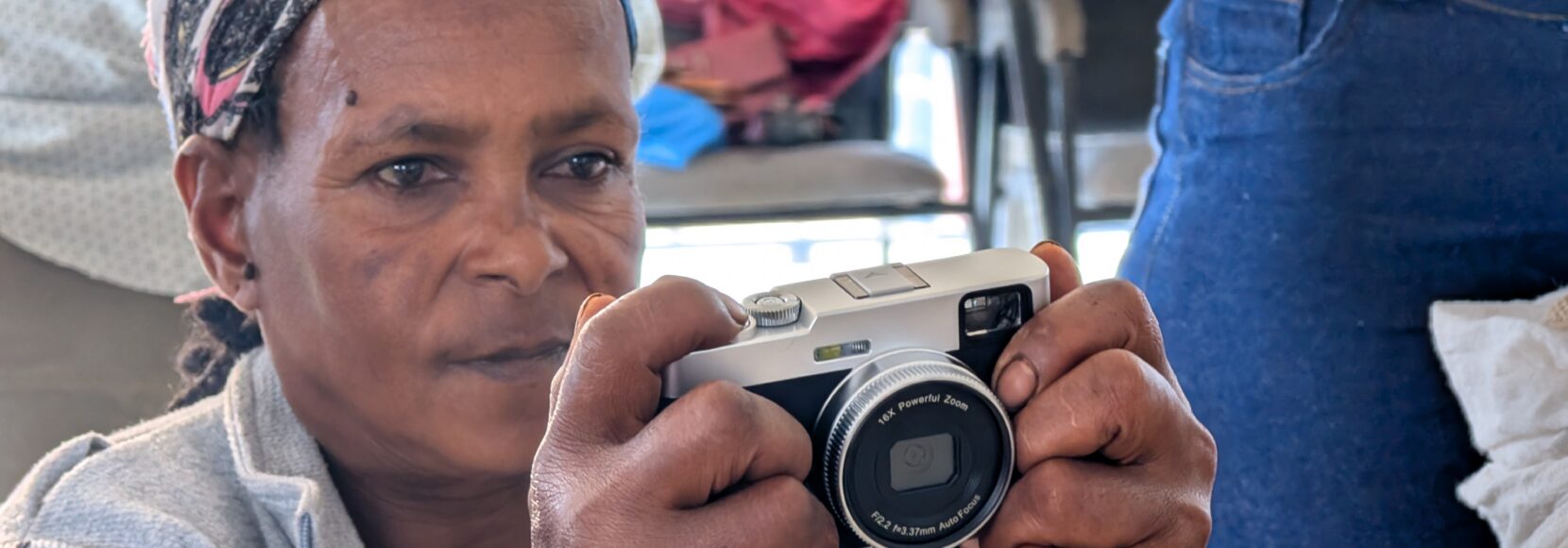
ADDIS ABABA – Forty-five women coffee farmers in Ethiopia’s Sidamo region picked up digital cameras this year to document how they are adapting to a changing climate and how their roles at home and in their communities are changing with it as part of TechnoServe’s Climate Resilience through Empowering Women (CREW) project, in partnership with Global Affairs Canada and Nespresso.
Their photos and stories are available in “Buna Love,” a collection created through photovoice, a participatory research method that Fotosynthesis led in close collaboration with TechnoServe’s field team.
Buna is the Amharic and Sidamo word for coffee. The women coffee farmers photographed their lives, analyzed the images together, and decided which stories to tell. The women also curated a community exhibition to foster important conversations with family, the community, and decision-makers.
The women’s photos surfaced four themes of Becoming, Creating, Reimagining, and Uniting. Their stories show that women are not only driving the adoption of regenerative agricultural practices, such as stumping their coffee trees to grow high-quality coffee, but also convincing their husbands and neighbors to do the same.

“Before, everything in my life was closed like this home, and my husband did not want to accept my suggestions to stump coffee,” said Bizunesh Dukamo Dorich, a photovoice participant, describing her photo of a closed door. “After participating in the TechnoServe training, he started to support me, and the gender gap decreased. As I became a leader, both he and the wider community started to accept me.”
Women are the backbone of Ethiopia’s coffee sector.
They often have limited say over how land is managed. At the same time, climate change is threatening the crop. TechnoServe’s case for regenerative coffee in Ethiopia predicts an 85% reduction by 2080 in the areas where indigenous Arabica coffee grows naturally.
“In our communities, men usually decide what happens on the farm, but the results we’re seeing through CREW, and that the women confirmed through photovoice, are something different,” said Solomon Ayalew, senior portfolio manager at TechnoServe Ethiopia. “Women are not just making changes on their own land, but convincing other farmers in their community that this change is worth making. That’s leadership, plain and simple.”
CREW pairs technical training through Coffee Farm College, including stumping, shade tree planting, mulching, and composting, with women’s leadership and decision-making skills.
“Through Canada’s partnership with TechnoServe, we are seeing firsthand how women’s leadership is strengthening the resilience of coffee-growing communities in Ethiopia. During my visit to project communities, I was deeply encouraged to see women and men working together to make decisions about their farms and households, and the women being equal partners in their households,” said Lidia Elias, development officer at Global Affairs Canada. “Empowering women to have a voice in decisions that affect their lives is at the heart of Canada’s international assistance efforts, and it is inspiring to witness this change taking root and creating lasting impact for future generations.”
The project will benefit 79,000 women and men in coffee-growing communities in southern Ethiopia, and by 2028 nearly 2,000 women will take part in its Women’s Leadership in Coffee program.
“The future of Ethiopian coffee is shaped by the people behind it,” said Jérôme Perez, head of sustainability at Nespresso. “Through the Nespresso Sustainable Quality Plan, we are proud to support women farmers as they strengthen their voice, their livelihoods, and the resilience of their farms for generations to come.”
The project midterm evaluation results show positive movement on three of four indicators of women’s empowerment in agriculture, including self-efficacy, access to information, and entrepreneurial mindset. A fourth indicator tracking attitudes related to gender-based violence held steady, with some indication that attitudes among women and men were shifting in a positive direction.
“The quantitative data tells us that combining equitable decision-making and resilient farming practices is working for coffee farming families in Ethiopia,” said Cristina Manfre, TechnoServe’s senior director of Global Practice for Women and Youth. “And the photovoice exercise allows us to hear it from the women in their own voices and through their own frames of reference.”
###
Notes to Editor:
- Download “Buna Love”
- Photos and captions are available for media use.
- TechnoServe experts are available for comment.
Media contacts
- Addis Ababa, Ethiopia: Solomon Ayalew | ayalews@tns.org
- Arlington, VA: Trishna Gurung | tgurung@tns.org
About TechnoServe
Founded in 1968, TechnoServe is a leading nonprofit that helps people lift themselves out of poverty for good by harnessing the power of the private sector. We work with people in over 30 countries to build a better future through regenerative farms, businesses, and markets that increase incomes. Our vision is a sustainable world where all people in low-income communities have the opportunity to prosper.