


Can Regenerative Agriculture Deliver Living Incomes for Coffee Farmers? New Data Says ‘Sometimes’
A paper from Sustainable Food Lab and TechnoServe finds that regenerative agriculture can eliminate or shrink the living income gap for coffee farmers and outlines additional approaches to boost livelihoods and resilience.
HARTLAND, VT (July 6, 2026) – Today, nonprofits Sustainable Food Lab and TechnoServe published a new paper which finds that the use of regenerative farming practices can deliver living incomes for the typical coffee-growing household in Ethiopia and Vietnam and nearly close the living-income gap for farmers in Honduras and Kenya. In the three other countries covered by the analysis, additional approaches are needed to ensure coffee-farming households earn enough to cover their basic needs and boost household resilience.
Globally, millions of smallholder coffee-farming households live in poverty, struggling to afford essentials–like nutritious diets, healthcare, and adequate housing–or to invest in their farms. Helping farmers improve their earnings and the resilience of their farms is critical for securing the future of the coffee sector.
Fostering Resilience: Regenerative Agriculture and Living Income applies a living-income lens to typical smallholder coffee households in Honduras, Kenya, Uganda, Ethiopia, Vietnam, Peru, and Indonesia, comparing their on- and off-farm incomes to local benchmarks.
“A living income lens adds value in two ways,” said Molly Leavens, Program Manager at Sustainable Food Lab and one of the paper’s authors. “First, it helps contextualize how an increase in income contributes to a decent standard of living for farmers. Second, by using the whole farm household as its unit of analysis, it accounts for all sources of income, capturing the contributions of diversified production and off-farm earnings. Consequently, the framework helps companies, governments, and other stakeholders understand their respective roles and responsibilities in supporting income improvement.”
The report’s economic modeling shows that while the typical farming household across all seven studied nations falls short of a living income baseline, regenerative agriculture can substantially improve farmer income:
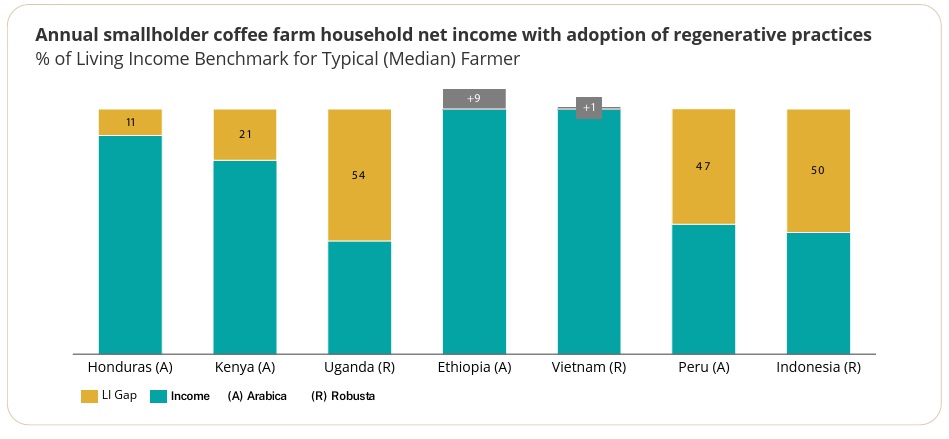
- Ethiopia & Vietnam: The typical smallholder can fully cross the living income threshold by adopting the recommended regenerative agronomy.
- Honduras & Kenya: The living income gap narrows significantly, putting a decent standard of living within arm’s reach.
- Uganda, Peru, & Indonesia: Farmers face steep structural hurdles like small parcel sizes, low productivity, or high production costs, but regenerative practices are still an important part of narrowing the gap and building vital economic stability.
“Last year, our research found that transitioning toward regenerative production can dramatically improve the incomes farmers earn from coffee,” said Paul Stewart, global coffee director at TechnoServe and one of the paper’s authors. “This new analysis allows us to go a step further and measure what this really means for farming households’ well-being.”
But the authors warn that regenerative practices alone aren’t a panacea. Fully closing living income gaps and building resilience will require a range of actions, from improved access to training and credit to market conditions and procurement practices that offer farmers higher, more stable prices. Additional investments are also required to help farmers improve their other on-farm and off-farm income streams.
“While the modeling in this paper focuses on coffee, the paper’s key takeaways on the reinforcing relationship between regenerative agriculture and living income apply to all smallholder farming contexts,” said Molly Leavens. “Regenerative agriculture, procurement practices, diversified income, and off-farm opportunities all have an important role in helping close the living income gap. These interventions support one another in that farmers with higher and more stable incomes have greater capacity to continue to invest in their farms. Supporting the regenerative transition is an opportunity in any value chain.”
The full paper is available at https://www.technoserve.org/resources/regenerative-agriculture-and-living-income-paper/
##
About Sustainable Food Lab
Sustainable Food Lab works to shift sustainability from niche to mainstream across global agricultural systems. A non-profit organization, we partner with businesses, farmers, NGOs, and public sector leaders to build the know-how, tools, and partnerships for sustainable farming and supply chains of the future.
More information at: LinkedIn @SustainableFoodLab | Website sustainablefoodlab.org
About TechnoServe
Founded in 1968, TechnoServe is a leader in harnessing the power of the private sector to help people lift themselves out of poverty for good. A non-profit organization working in around 20 countries, we work with people to build a better future through regenerative farms, businesses, and markets that increase incomes. Our vision is a sustainable world where all people in low-income communities have the opportunity to prosper.
More information at:
X @TechnoServe | Facebook @TechnoServe | LinkedIn @TechnoServe