


How Young Farmers Are Shaping the Future of Central American Coffee
Meet two young coffee farmers in Central America who are improving their yields and turning their farms into new business opportunities.
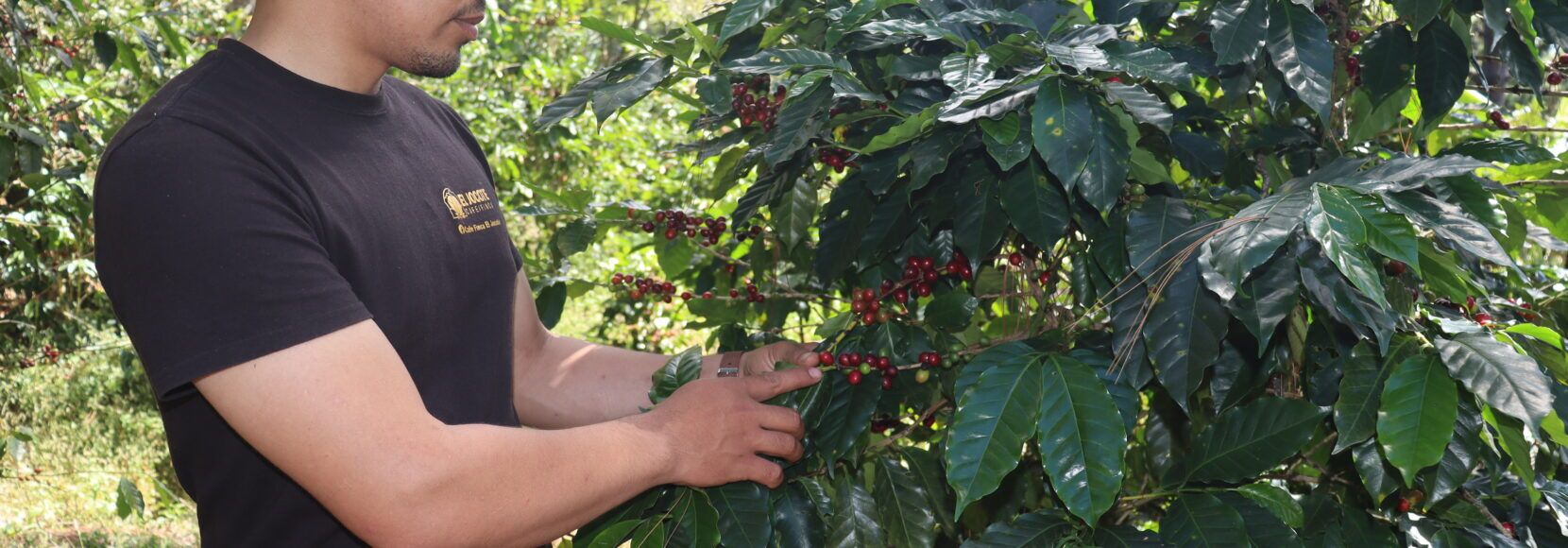
Producing coffee is the obvious connection between José Elías Cáceres and Cecilio Martínez, two young coffee farmers from Honduras and El Salvador, respectively. They share a belief in coffee farming as a way of life, a business, and a future worth building. At a time when many young people in rural Central America choose to migrate or leave their family farms behind, José and Cecilio chose a different path: they stayed.
The Next Generation of Central American Coffee Farmers
Their journeys began in much the same way. Both grew up alongside their fathers, learning about coffee from an early age and developing a strong connection to the land. Their fathers became role models, passing down not only knowledge about coffee production, but also a love for the crop and the farm.
“I remember that from a very young age, I liked getting up early to go to the farm with my father,” José recalled. “We would walk there together, and I would help him pick coffee. That is how I gradually learned, and from then on, I started to enjoy coffee farming.”
But staying in their communities and in the coffee business was only the beginning. Both young men understood that continuing the family tradition would require new ideas, new knowledge, and a willingness to do things differently.

José’s Journey: Boosting Productivity in Honduras
For José, coffee became an opportunity to build a different future.
In 2018, José’s father, Ismael Cáceres, gave him 1 manzana (0.7 hectares) of the family’s land. José now manages his small farm in Lepaera, Lempira, Honduras. Over the years, he began looking for ways to make his farm more productive and profitable.
One of his biggest challenges was coffee leaf rust, which reduced his coffee trees’ productivity. Motivated to learn new practices to protect his crop and improve his results, José joined the Avanza Café training sessions in 2024, following in his father’s footsteps, who was also participating in the program.
Avanza Café works with market actors in Guatemala, Honduras, and El Salvador to help over 30,000 coffee farmers increase their incomes while reducing carbon emissions and protecting forests and other natural resources.
Through the project’s training and technical assistance, José learned new approaches to integrated pest and disease management, pruning, grafting, and producing homemade fertilizers—practices that can improve productivity and make better use of locally available resources.
“I used to fertilize my coffee plants with a formula that many people in my community used, but it wasn’t based on my plants’ specific needs,” José recalled.
When he began training with Avanza Café, his trainer’s first and most important recommendation was to switch to a more complete fertilizer formula and adjust application rates to meet his plants’ nutritional needs.
“My plants were showing signs of nutritional deficiencies,” José said. “Their leaves were turning yellow, and after each harvest, they lost much of their foliage. But when I changed the formula and increased the application rate from two to three ounces per plant, I saw my plants recover and produce more flowers.”
Although the new approach required applying more fertilizer per plant, José believes the investment was worthwhile. During the 2025-2026 harvest, his coffee cherry production increased by 50%, rising from 40 to 60 quintals.
When harvest time came, and I realized that production had increased, I felt very happy. It was rewarding to see that the practices really work and that we are improving the way we manage the farm.”
For José, those results reinforce a simple belief: new knowledge can change a farm’s future.

Cecilio’s Story: Best Practices and Innovation in El Salvador
Cecilio, meanwhile, has taken that idea of transformation even further.
A third-generation coffee producer in El Salvador’s Metapán area, Cecilio saw that producing coffee alone wasn’t enough to make the family farm profitable. He recognized that he needed to strengthen his knowledge of agronomic practices to turn his ideas into reality. This led him to join Avanza Café’s training program in late 2024, where he gained the technical knowledge and practical tools to manage his farm more effectively and bring his vision to life.
Just as José dealt with high levels of coffee rust, Cecilio faced significant coffee berry borer infestations on his farm. Through the Avanza Café training program, he learned about Integrated Pest Management (IPM) and how to use traps to monitor and manage the pest, helping him eliminate insecticide use and lower management costs.
“Right now, with all the modules we have received, the savings have been quite significant, around 70%. [We] cut expenses on insecticides, labor, fuel, and application time.”
To understand how Cecilio is building a future around his family’s coffee farm, we need to go back to 2018, when his entrepreneurial journey began. Building on his family’s coffee-production experience, Cecilio decided to take the business a step further, moving beyond production and primary processing to sell roasted and ground coffee directly to consumers.
“I started selling just 100 lbs during my first year, but gradually built a customer base and expanded my sales,” he said.
As demand grew, Cecilio moved from outsourcing the roasting process to investing in his own roastery, which he has operated for the past two years. Today, he sells in one or two weeks what he once sold in a year, while also generating additional income by roasting and grinding coffee for other producers following a similar path toward direct sales of roasted coffee.

Cecilio used Avanza Café’s waste-management training to refine his idea of transforming coffee pulp and other organic residues into an organic fertilizer he calls Mestli. He perfected the formulation and produced 100 sacks, which he is currently using on a new planting area on his own farm. His next goal is to expand production and, in the near future, begin selling Mestli to other coffee and vegetable producers in his community.
“I received the technical training I needed and was able to improve the fertilizer recipes. Thanks to that support, I was able to turn an empirical idea into a well-developed product, with the right quality and formulation to bring it to market,” he said.
With Mestli, Cecilio has found a way to recycle coffee by-products, lower farm expenses, and lay the foundation for a potential new income stream.
“Coffee by-products are not waste, but resources with great value,” Cecilio said. “Going from buying inputs to producing our own bokashi-style organic fertilizer and, eventually, being able to sell it to other farmers is incredibly rewarding. On the one hand, it gives us greater independence and helps us save money on the farm. But the best part will be knowing that I can offer producers in my area a quality product that improves their soils and strengthens local agriculture.”
Cecilio also plans to position his farm as a new tourism destination. He is developing trails among coffee plants and towering trees to welcome nature lovers interested in coffee production. He plans to launch this new project during the 2026-2027 harvest period and expects it to become another income source for his family.
Tradition Meets Innovation: The Future of Coffee Farming
For both young farmers, the challenges are real. Pests, diseases, climate change, higher input costs, and volatile prices can make coffee farming difficult. Yet their response has been similar: instead of giving up, they have proactively sought ways to improve.
Their fathers gave them their first connection to coffee. TechnoServe has helped them strengthen that foundation with new technical knowledge and practical tools. And they are using that knowledge in different ways to create opportunities for themselves and their families.
Both are proving that tradition and innovation can grow together.
“In the past, many young people in my community did not see a future in coffee and preferred to migrate because traditional agriculture was no longer providing a viable livelihood,” Cecilio explained. “My path was different because I refused to give up. I looked for ways to reach better markets so that the farm could become profitable. Today, young people are once again seeing potential in coffee.”

A Different Way to Make A Difference.
Discover how TechnoServe bridges the gap between “thinking big” and practical business solutions that help hardworking people move from poverty to prosperity around the world.

