


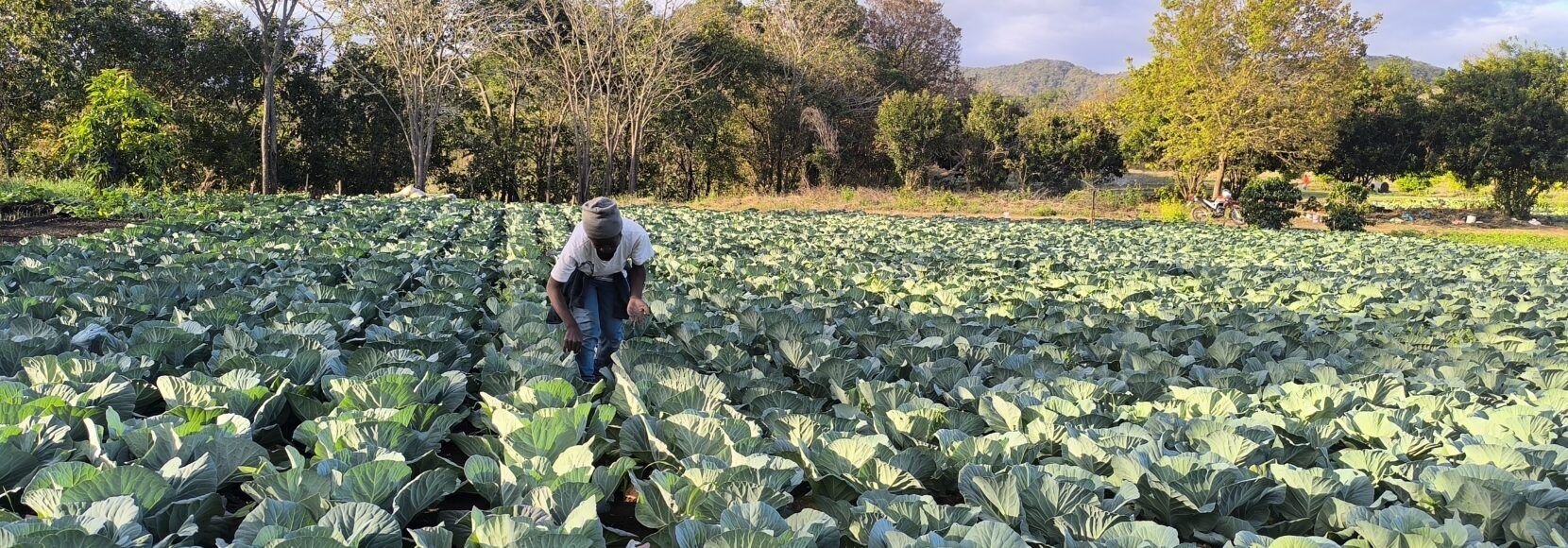
Lower Expenses, Higher Yields: Building a Profitable Farm in Mozambique
Learn how a farmer in Mozambique transformed her agricultural business by replacing expensive commercial fertilizers with thermal compost and liquid fertilizer, dramatically lowering production expenses while boosting yields and household income.
High Input Costs and Distant Markets
Laura João Pepe has spent more than 30 years growing cabbage, kale, onions, tomatoes, peppers, corn, beans, and fruit trees in the village of Chuala, located in the Báruè district of Mozambique.
For decades, commercial fertilizers were her main tool for keeping crops growing, but living 40 kilometers (~25 miles) from the nearest city made transporting those inputs expensive. Pests and plant diseases still regularly hit her vegetable crops, and the financial weight affected her household budget. The 52-year-old needed to feed her family while also paying college tuition for her three children studying in Zimbabwe.
Laura’s situation changed when she joined the Mangwana program in 2024. Mangwana works to improve food security across Mozambique’s Beira Corridor. It is funded by the Embassy of the Kingdom of the Netherlands and implemented by TechnoServe, Resiliência, the Zambeze Valley Development Agency, and the Manica Economic Development Agency. The four-year program set an initial target of reaching 27,332 hectares under regenerative practices. It has surpassed that goal, covering 38,000 hectares and benefiting over 227,000 people.
Replacing Commercial Fertilizer with Thermal Compost and Liquid Fertilizer
Through Mangwana, Laura learned to make humified thermal compost for base fertilization, a high-temperature biological process that rapidly decomposes organic matter into stable humus. With this process, farmers can produce a nutrient-rich compost in a significantly shorter timeframe, typically weeks to a few months. Laura also learned how to make “manure sup,” a liquid fertilizer created by fermenting local poultry manure.
“This combination has made it possible to significantly reduce the need to buy commercial fertilizers, which are expensive, and has also been influenced by rising fertilizer prices and transportation costs,” Laura said.
The physical changes in the soil appeared during the first season using organic compost. The soil grew darker, earthworms multiplied, and organic matter built up. Her vegetable yields matched what she used to get with commercial fertilizers, but the production costs dropped.
“Cabbage, for example, showed surprising growth for a crop grown with organic fertilizer, achieving a quality comparable to that of market-grade cabbage with less fertilizer, and the kale reached a higher market weight, thanks to the continuous supply of nutrients provided by the manure,” Laura said.
Soil retained moisture longer, protecting the tomatoes and peppers during hot weather. During the 2026 cabbage harvest, she applied manure sup through phased fertigation, which led to faster, consistent head formation across her plot. Phased fertigation uses timed steps or stages to optimize nutrient uptake and prevent root damage.
Lower Production Expenses and Stronger Vegetable Sales
Making thermal compost on her farm reduced Laura’s purchase of commercial base fertilizers by more than 80%.
Previously, Laura grew vegetables on a 30-by-20-meter plot and spent approximately 16,900 meticais ($264) on fertilizers. Today, she works a much larger vegetable plot, earns about 80,613 meticais ($1,261) from her production, and spends only around 8,000 meticais ($125) on inorganic fertilizers, using them primarily alongside organic compost for her corn and bean crops.
“I no longer feel the same pressure of having to rely exclusively on inorganic fertilizers when growing cabbage, tomatoes, and onions,” Laura explained.

Technical Leadership and Expansion Plans
Laura’s farm has become a demonstration site for neighbors to study her thermal compost piles and learn how she prepares liquid fertilizer.
Her work has reshaped her standing in the community. She is now viewed as a technical leader. Her husband works alongside her, supporting her decisions and business strategy.
“At first, you might have your doubts, but the results in the field will speak for themselves and your wallet will thank you,” Laura said. “I’m very happy and grateful for the technical support from Mangwana.”
Laura wants to buy a tractor, expand her crop area, and turn her farm into a model center for technical training for other women farmers across the Beira Corridor.

A Different Way to Make A Difference.
Discover how TechnoServe bridges the gap between “thinking big” and practical business solutions that help hardworking people move from poverty to prosperity around the world.


