


On the Ground in India: Scaling Impact in the Dairy Sector
Table of Contents
- Introduction
- The Challenge: Improving Productivity and Quality in India’s Dairy Sector
- Project Ksheersagar: A Model for Shared-Value Success
- Financial Security and Women’s Empowerment: The Ripple Effect
- TechnoServe’s Unique Role: The Market Systems Convener
- Capacity in the Field
- A Future Built on Bold Ideas
I recently returned from India, where I saw firsthand the impact of TechnoServe’s work in the dairy sector. Learn about how this work is improving incomes—with farmers seeing a $11.80 return for every $1 invested—and driving women’s economic empowerment.
On my recent trip to India, I spent time with our teams and partners and saw firsthand the impact of our programs. It was a chance to witness the practical application of our market systems development (MSD) approach. In these programs, we work alongside public and private sector actors to design and test ways to improve how markets function for specific target groups.
A major highlight of the trip was seeing our work with Indian dairy farmers through our collaboration with Abbott.
The Challenge: Improving Productivity and Quality in India’s Dairy Sector
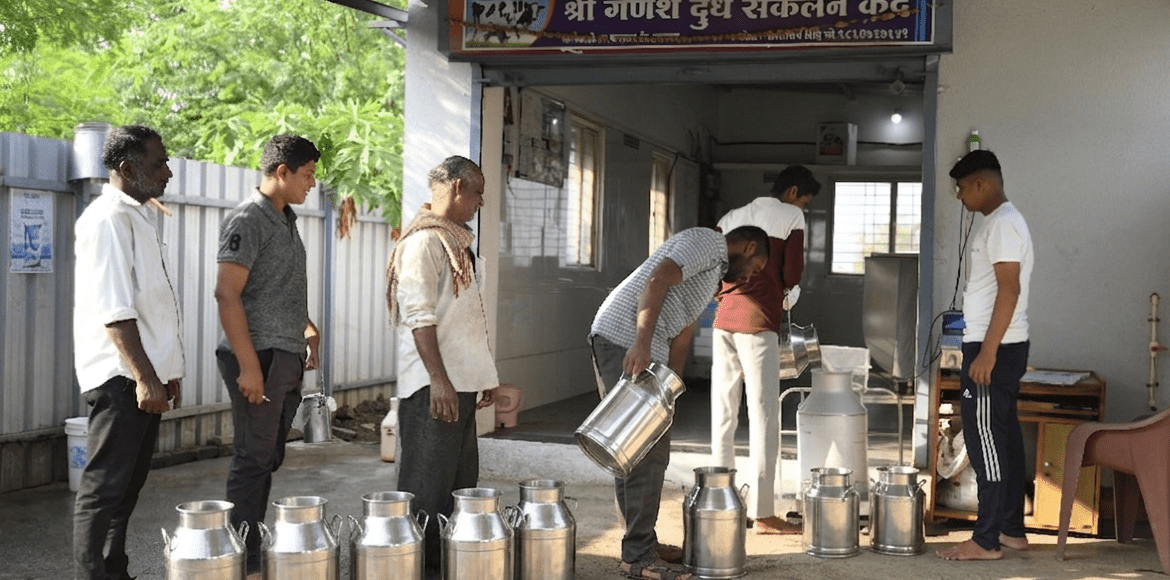
India is the world’s top milk producer, supplying almost a quarter of the world’s milk. It’s the cornerstone of rural livelihoods, sustaining over 80 million farming families, 70% of whom are smallholders. Yet, despite this scale, India’s milk productivity per cow remains below the global average, limiting both supply and farmers’ incomes. Many small-scale dairy farmers still live in poverty. Low yields, weak market connections, and limited access to training and technology can keep farmers trapped in poverty.
Project Ksheersagar: A Model for Shared-Value Success
Project Ksheersagar is a shared-value initiative designed to support dairy farmers while building a sustainable raw milk supply chain in the country. Rooted in a long-standing collaboration between TechnoServe and Abbott, the initiative began when Abbott identified the need for a reliable source of high-quality raw milk for its nutrition products, including baby formula.
In response, Abbott and TechnoServe collaboratively co-designed a model that ensured a consistent supply of high-quality milk for Abbott and focused on transforming farmers’ lives by strengthening their capabilities, improving productivity, and empowering them to become active participants in a resilient and sustainable dairy ecosystem.
The results of this collaboration have been remarkable. In 2025, 88% of the milk handled in the project meets Abbott’s quality standards, a threefold improvement since 2022. Improvements in milk quality have also significantly benefited the local economy.
Over 12,000 farmers who previously lacked a reliable commercial market now have a stable, secure buyer. Now, smallholder dairy farming families have the financial security to reinvest their incomes in their families. Project Ksheersagar validates the power of elevating standards across a value chain.
The ripple effect of this work is raising the standard for milk quality across the entire Indian dairy sector, not just for Abbott.
Financial Security and Women’s Empowerment: The Ripple Effect
The financial results have been striking: for every $1 invested, farmers improved their incomes by $11.80. More importantly, Ksheersagar has driven significant progress in women’s economic empowerment and financial inclusion. In 2022, only 6% of the program’s farmers were women; today, that number has risen to 62% (7,481 women farmers). Women farmers in the project have seen a 1.5x increase in their incomes. To ensure their contributions are valued and compensated, 100% of women participants are now paid directly into their own bank accounts.

TechnoServe partnered with local financial institutions to provide training on dairy best practices and financial literacy. We helped set up 60 doorstep banking points run by women entrepreneurs, enabling many women dairy farmers to open their first bank accounts. In just four months, 6,000 women received direct payments, and 2,500 became first-time registered milk suppliers.
For farmers like Reshma Adlinge, this has translated into tangible gains. Milk production on her farm increased from 30 to 80 liters per day, and her monthly income has doubled to around ₹10,000 (~$110), enabling her to contribute to her children’s education and household. There are also many women like Sheetal Shinde who have been trained as community-level trainers. These trainers play a critical role in helping women farmers open bank accounts, manage digital payments, and access training.
TechnoServe’s Unique Role: The Market Systems Convener
What makes this program effective is TechnoServe’s unique role. Our work isn’t about working directly with the farmers or running processing plants. Instead, we act as a critical coordinator and convener within the market system. The most challenging part of the job is often convincing diverse market actors, who are sometimes direct competitors, to collaborate for the benefit of the value chain as a whole. This ability to align disparate parties ensures the impact is sustainable and widespread.
To manage this network, the program relies on a sophisticated program management unit. This team serves as the central hub, coordinating efforts to ensure everyone remains focused on the shared goals of higher-quality milk and commercial growth.
Capacity in the Field
Beyond the project structure, I was struck by the caliber and dedication of our staff in India. They are true experts in their fields, and it was great to meet so many of them in person for the first time. I also noted the sophistication of the local market actors, which confirms that the capacity to sustain and expand this change already exists within the country.
Seeing this reinforced my belief in working through local partners and systems to ensure improvements are owned and maintained by the communities themselves. On a personal note, the welcoming nature of the people I met was a reminder of the human connections at the core of our development work.
A Future Built on Bold Ideas
My professional life has been dedicated to strengthening the operational systems that allow organizations like TechnoServe to scale their impact. As chief operating officer, I oversee our work across more than 20 countries, focusing on high-quality implementation and consistent, measurable outcomes.
The success I witnessed in India reinforces my belief in our mission. I have seen the power of entrepreneurship and local innovation to drive lasting change. At TechnoServe, I am excited to help build the systems that enable bold ideas to take root and to support the farmers and small businesses shaping a more resilient future. Ksheersagar is a clear demonstration of this vision in action, showing that collaboration and a deep respect for local capacity are the true building blocks for economic resilience.


