



Innovation Spotlight: How Biofertilizers Help Farmers Increase Yields at Lower Cost
Table of Contents
- Introduction
- What Are Biofertilizers?
- How Do Biofertilizers Work?
- Advantages of Biofertilizers
- How Are Farmers Using Biofertilizers?
- India: The Srishti Program
- Peru: Coffee Farmers and Biofertilizer Entrepreneurs
- Biofertilizers and the Global Fertilizer Crisis
- 2022: The Ukraine War and the First Wave
- 2026: The Strait of Hormuz and the New Shock
- Building Resilience for the Long Term
- Frequently Asked Questions About Biofertilizers
Smallholder farmers around the world are turning to fertilizers that leverage helpful microorganisms to boost the profitability of their land. Learn more about biofertilizers and how TechnoServe is helping farmers to adopt this green technology.
Traditional synthetic fertilizers have been a critical part of increasing farm productivity, food supplies, and farmer incomes around the world. However, these fertilizers remain too expensive for some smallholders to use profitably, contribute to climate change and other environmental problems, and are vulnerable to supply shocks. As a result, an increasing number of farmers are turning to a green technology that they can often produce themselves: biofertilizers.
What Are Biofertilizers?
Biofertilizers are products containing living microorganisms. Rather than directly providing most of the nutrients, as synthetic fertilizers do, biofertilizers introduce bacteria, fungi, or algae. These microorganisms then carry out biological processes that increase the availability of nutrients for plants. In addition, biofertilizers directly provide small quantities of nutrients and also improve the physical qualities of soil–a process called soil conditioning–to support plant growth.
How Do Biofertilizers Work?
Biofertilizers improve the availability of vital plant nutrients through two main processes. Some contain microorganisms like Rhizobium and Azotobacter bacteria that support nitrogen fixation, in which the bacteria help convert nitrogen in the atmosphere into ammonia, which is essential for the healthy growth of plants. The other process makes nutrients–such as phosphate, potassium, and zinc–in the soil more available to plants. In phosphorus solubilization, for example, bacteria or fungi help break down preexisting phosphorus into a form plants can absorb. In addition to those mechanisms, some biofertilizers catalyze or accelerate other natural processes–like the breakdown of organic matter and the strengthening of root systems–to support plant growth.

Advantages of Biofertilizers
Biofertilizers offer several advantages for smallholder farmers. Many biofertilizers can be created by the farmers themselves, primarily using materials they already have on their farms. For example, a TechnoServe project in Peru taught coffee farmers to create biofertilizers using cow manure, compost, molasses, milk, wastewater from coffee processing, microorganisms, yeast, rice bran, and metallic compounds.
This ability to control production is especially important at moments when synthetic fertilizer production and transportation are disrupted.
In some instances, replacing some or all of the synthetic fertilizers a farmer uses with biofertilizers can also reduce input costs, thereby improving farm profitability. In Brazil, for example, where 80% of the country’s enormous soybean crop is grown with biofertilizers, these inputs can cost as little as one-nineteenth as much per hectare as synthetic fertilizers.
Biofertilizers also offer several potential environmental benefits. Synthetic fertilizers have a large carbon footprint, as natural gas is the primary input for producing nitrogen-based fertilizers like urea. In fact, the production and use of synthetic fertilizers are responsible for more emissions each year than global aviation. Scaling up the use of biofertilizers supports efforts to mitigate climate change.
Additionally, biofertilizers can help reduce nutrient runoff. When excess nutrients from synthetic fertilizers are washed into waterways, they can disrupt aquatic ecosystems. By improving nutrient-use efficiency and reducing the need for chemical inputs, biofertilizers can help mitigate this risk.
How Are Farmers Using Biofertilizers?
Biofertilizers have been commercially available since 1895, but while they play a significant role in some sectors–like soy in Brazil–they still represent a small niche in the global fertilizer market. This is particularly true for smallholder-led agriculture in regions like sub-Saharan Africa, Latin America, and South Asia, where awareness and adoption of biofertilizers remain especially low.
That is starting to change, however, and TechnoServe programs around the world are working with smallholders to support the adoption of this regenerative technology.
India: The Srishti Program
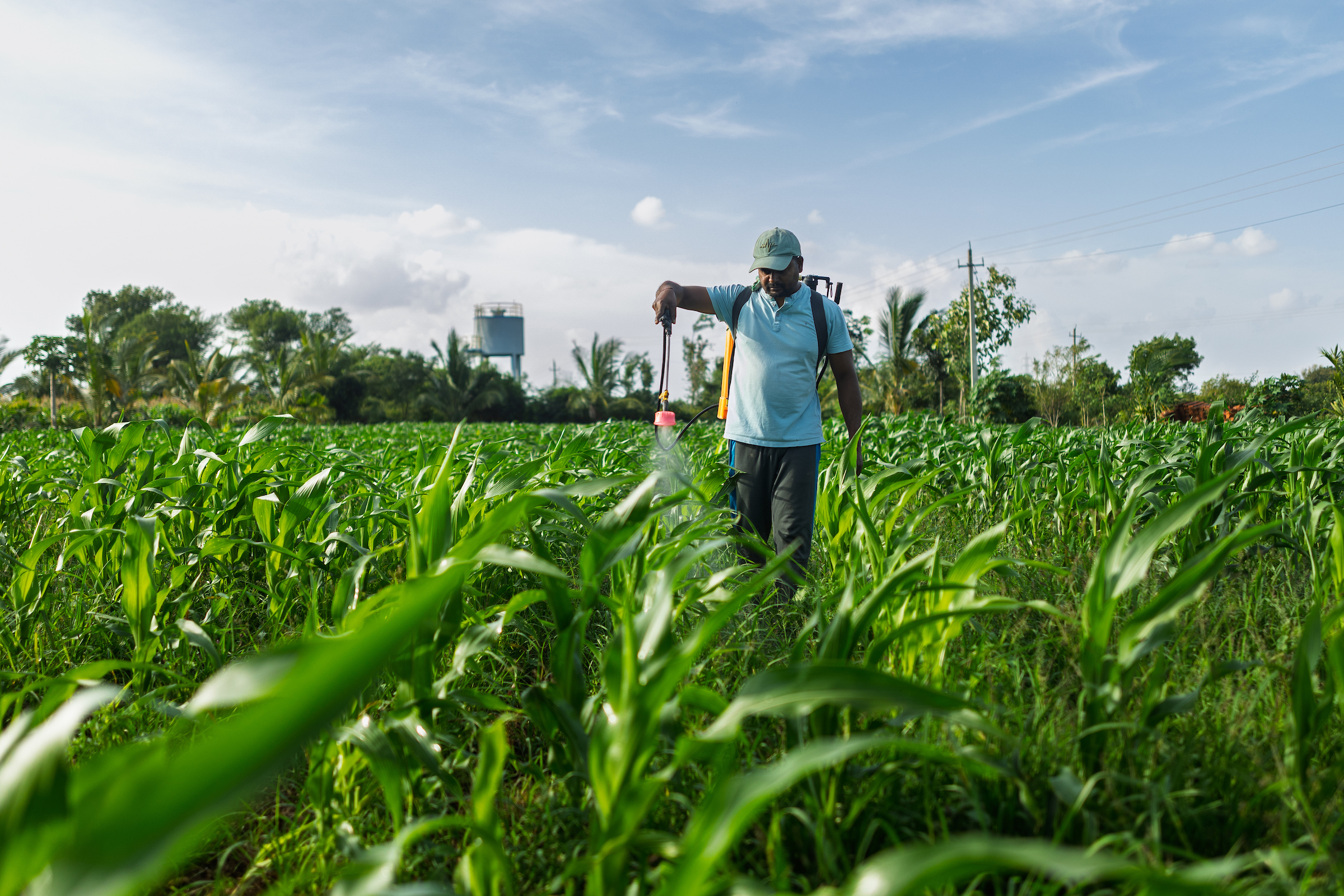
The Srishti project, a partnership between Cargill and TechnoServe, is helping maize farmers in Karnataka, India, adopt regenerative farming practices. One of the first practices that participants learn is the production and use of Jeevamrutha, a biofertilizer, to supplement or replace synthetic fertilizers.
Farmer Chandru Hotteppanavar hosts a Srishti demonstration plot on his farm and was one of the first program participants to see the impact of biofertilizers. “The crop on which we sprayed Jeevamrutha has 40-45 roots, whereas the conventional maize crop only has 19-20 roots,” he said.
Peru: Coffee Farmers and Biofertilizer Entrepreneurs
In Peru, TechnoServe’s coffee training curriculum has included modules on producing and applying biofertilizers. One group of farmers took this further and launched a micro-enterprise to produce biofertilizer at scale and market it to their neighbors.
Farmer Wilder Tucto Aguirre is a member of the César Vallejo savings group, which manufactures a biofertilizer called Bioproduce+. “We’re harvesting cucumbers, napa cabbage, and even tomatoes — it’s producing good results,” he said.
Biofertilizers and the Global Fertilizer Crisis
Biofertilizers have taken on additional relevance and importance in the face of recent events. Conflicts have disrupted global trade in natural gas and products derived from it, leading to a scarcity of many synthetic fertilizers and higher prices for farmers.
2022: The Ukraine War and the First Wave
Russia is a leading producer of fertilizer and fertilizer inputs, and the economic sanctions applied to it after the invasion of Ukraine complicated the export of these products. In Peru, for example, urea imports fell 84% in the six months after the conflict began. Shortages and speculation added to already elevated fertilizer prices, driven by high demand and high energy costs. Between April 2021 and April 2022, global fertilizer prices more than doubled, pricing many smallholder farmers out of the market.
2026: The Strait of Hormuz and the New Shock
While global markets adjusted in the years after the invasion of Ukraine began, conflict once again led to higher fertilizer prices in 2026. The regional conflict in the Middle East severely restricted trade through the Strait of Hormuz–through which about a third of all urea fertilizer passes–and curtailed production of Qatar’s liquefied natural gas, an important input in fertilizer production. Consequently, urea prices jumped by more than 50% in less than a month.
Building Resilience for the Long Term
By studying the business case for biofertilizers in specific contexts and helping smallholders adopt them, TechnoServe is building resilience to these shocks. By supplementing—and in some cases replacing—synthetic fertilizers with this green technology, farmers can cushion themselves from price shocks, improve farm profitability, and reduce their environmental footprint.

A Different Way to Make A Difference.
Discover how TechnoServe bridges the gap between “thinking big” and practical business solutions that help hardworking people move from poverty to prosperity around the world.
FAQs
Frequently Asked Questions About Biofertilizers
What are biofertilizers, with an example?
Biofertilizers are preparations containing living microorganisms that improve soil nutrient availability and plant growth. A common example is Rhizobium inoculant — a bacteria-based product applied to legume seeds that colonizes root nodules and fixes atmospheric nitrogen, reducing or eliminating the need for synthetic nitrogen fertilizer.
How long do biofertilizers last?
Commercial biofertilizer products typically have a shelf life of 6–24 months when stored correctly (cool, dry, away from direct sunlight). On-farm produced biofertilizers — such as liquid inputs made from effective microorganisms — are generally used within weeks of preparation. In the soil, microbial populations can persist and reproduce through multiple growing seasons if conditions (moisture, pH, temperature, organic matter) remain favorable.
Can biofertilizers fully replace synthetic fertilizers?
In most cropping systems, biofertilizers perform best as part of an integrated approach — reducing synthetic fertilizer requirements significantly (often 40–60%) rather than replacing them entirely in the short term. Over multiple seasons, as soil health improves and microbial communities establish, dependency on synthetic inputs can decline further. TechnoServe’s programs take this phased approach, using biofertilizers to progressively reduce — and in some cases eliminate — synthetic fertilizer use.

