


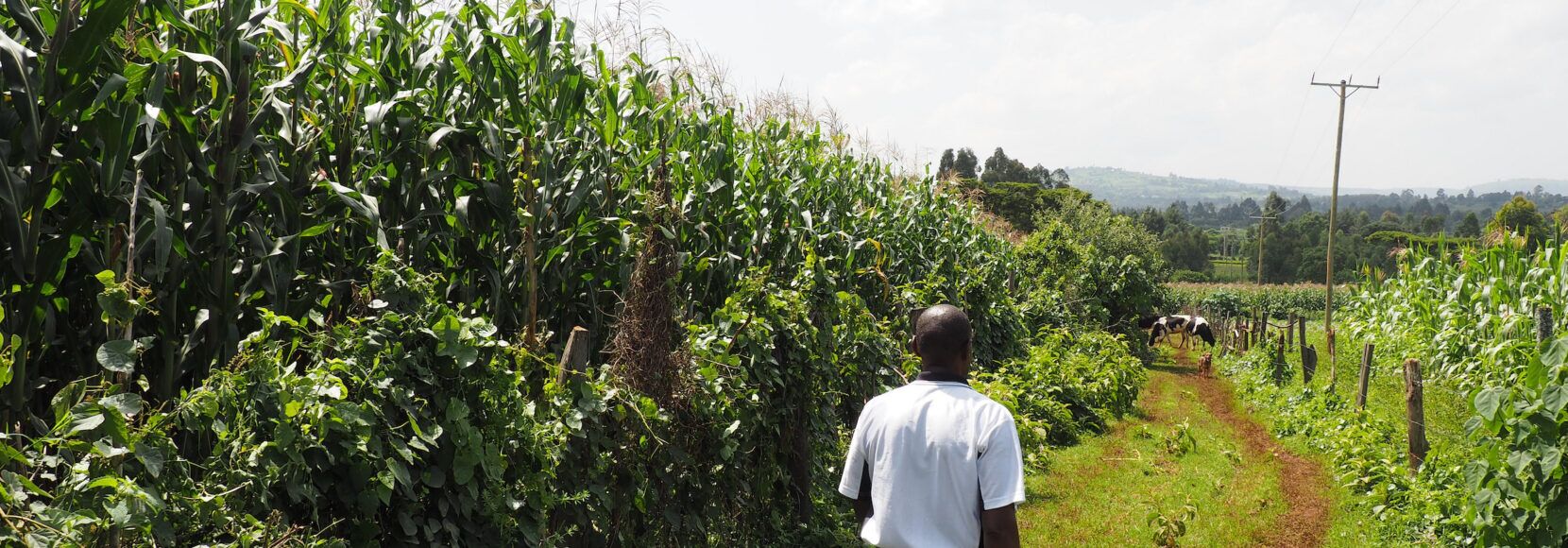
AI for Investment Readiness: Helping African Agribusinesses Access Capital
Table of Contents
- Introduction
- Why Access to Finance Matters for African Agribusinesses
- The Aceli Growth and Investment Program: Bridging the Missing Middle
- The Challenge: Assessing Risk and Loan Readiness for Agri-SMEs
- The GIP Growth Compass: An AI-Powered Tool for Financial Inclusion in Agriculture
- Designing Responsible AI for Agricultural Finance
- AI-Driven Credit Assessment, Benchmarking, and Human Advisor Review
- Expected Impact: Faster Loan Readiness and More Inclusive Capital
- What Comes Next for AI in Agriculture Finance?
- Future Steps: Testing, Governance, and Responsible Scale
Improving access to finance for African agribusinesses can create ripple effects for farmers, workers, and consumers. Learn why TechnoServe is developing an AI-powered tool to help these businesses attract much-needed investment.
The financing gap for agricultural small- and medium-enterprises (agri-SMEs) remains one of the most significant hurdles to economic transformation in East and Southern Africa. Agribusinesses are critical to regional food security and rural livelihoods but they often struggle to navigate the rigorous financial standards required by commercial lenders.
This led us to ask: can AI help close this gap?
Why Access to Finance Matters for African Agribusinesses
The demand for productivity, innovation, and value addition within African agriculture is expanding rapidly.African agribusinesses operate across not only a wide range of value chains but also at different points from input suppliers and producers to aggregators, processors, and distributors. These businesses require financing to grow and operate effectively. Capital allows them to expand their production facilities, increase their sourcing, and invest in new technologies.
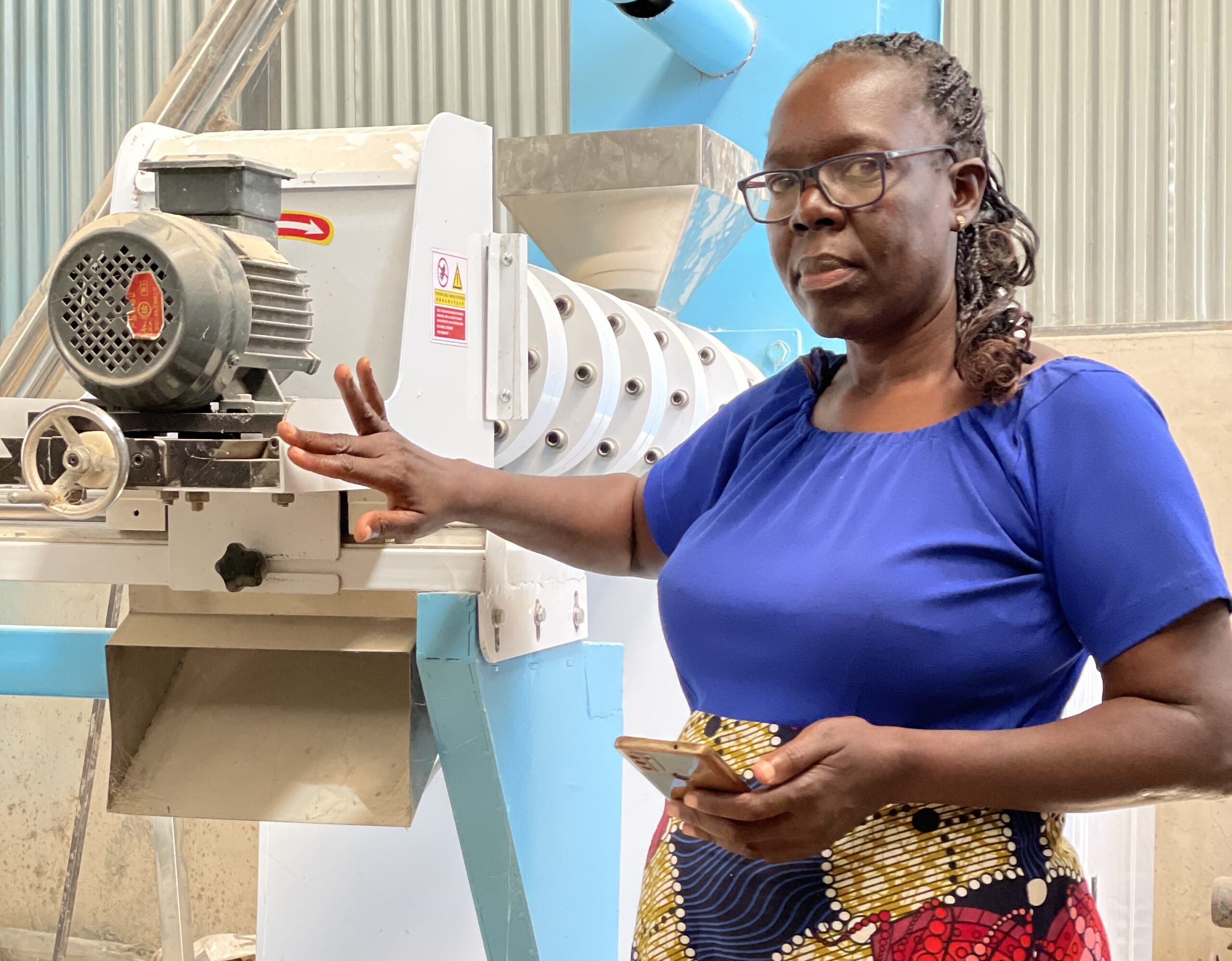
Too often, however, they struggle to access adequate finance. Agri-SMEs in Sub-Saharan Africa face an estimated $65 billion annual financing gap.
The Aceli Growth and Investment Program: Bridging the Missing Middle
The Growth and Investment Program (GIP), funded by Aceli Africa, works to address this exact challenge across Kenya, Rwanda, Uganda, Tanzania, and Zambia. The program specifically targets the missing middle: agri-SMEs that have outgrown microfinance but are not yet sufficiently prepared to meet the requirements of commercial lenders.
While many of these businesses demonstrate strong growth potential, their ability to secure and effectively use financing is limited by gaps in financial management, documentation, and business structure. .
To address this, the program delivers targeted technical assistance to strengthen investment readiness. A structured approach combines digital learning, group-based sessions, and one-on-one advisory to help agri-SMEs improve financial visibility, strengthen operational discipline, and align their business strategies with appropriate financing pathways.
In 2025, the program worked with 53 agri-SMEs across Kenya, Tanzania, Uganda, and Rwanda, with 44 businesses supported to develop investment-readiness tools. Ultimately, participating businesses accessed $3.17 million in finance, composed of debt financing, grants, and equity, as well as supplier credit.
The Challenge: Assessing Risk and Loan Readiness for Agri-SMEs
A key part of this process is translating the growth potential of agri-SMEs into credible, decision-ready information. It is difficult for entrepreneurs to plan growth, manage working capital, or determine the right type, amount, and timing of financing without visibility into their performance.
The challenge for lenders lies in assessing risk when a business’s records are incomplete, inconsistent, or not structured to support lending decisions.
Addressing this requires more than just collecting data. It requires ensuring that information is accurate, structured, and usable both for internal business management and for external financing conversations. That process can be time-consuming and challenging.
The GIP Growth Compass: An AI-Powered Tool for Financial Inclusion in Agriculture
This inspired us to design and develop the GIP Growth Compass, an AI-designed-and-powered intelligence hub that is integrated within the program’s digital ecosystem. It converts raw financial history into verifiable evidence of investment readiness, ensuring that the data are usable for both internal business decisions and external financing conversations.
Designing Responsible AI for Agricultural Finance
We began the development of the GIP Growth Compass a year ago with a focus on system architecture and user experience design. We knew that rather than replacing human relationship-building, the tool must be engineered to extend the reach of our advisors, ensuring that human judgment remains central to data interpretation.
AI-Driven Credit Assessment, Benchmarking, and Human Advisor Review
The result is a platform that builds the capacity and credibility of agribusinesses. When agri-SMEs’ financial information is added to the system, the GIP Growth Compass not only provides a summary but also carries out a rapid audit of the documents. The system automatically checks for accounting errors and recalculates important financial numbers to ensure the information is accurate. This helps businesses prepare and develop the appropriate documentation needed to secure loans.
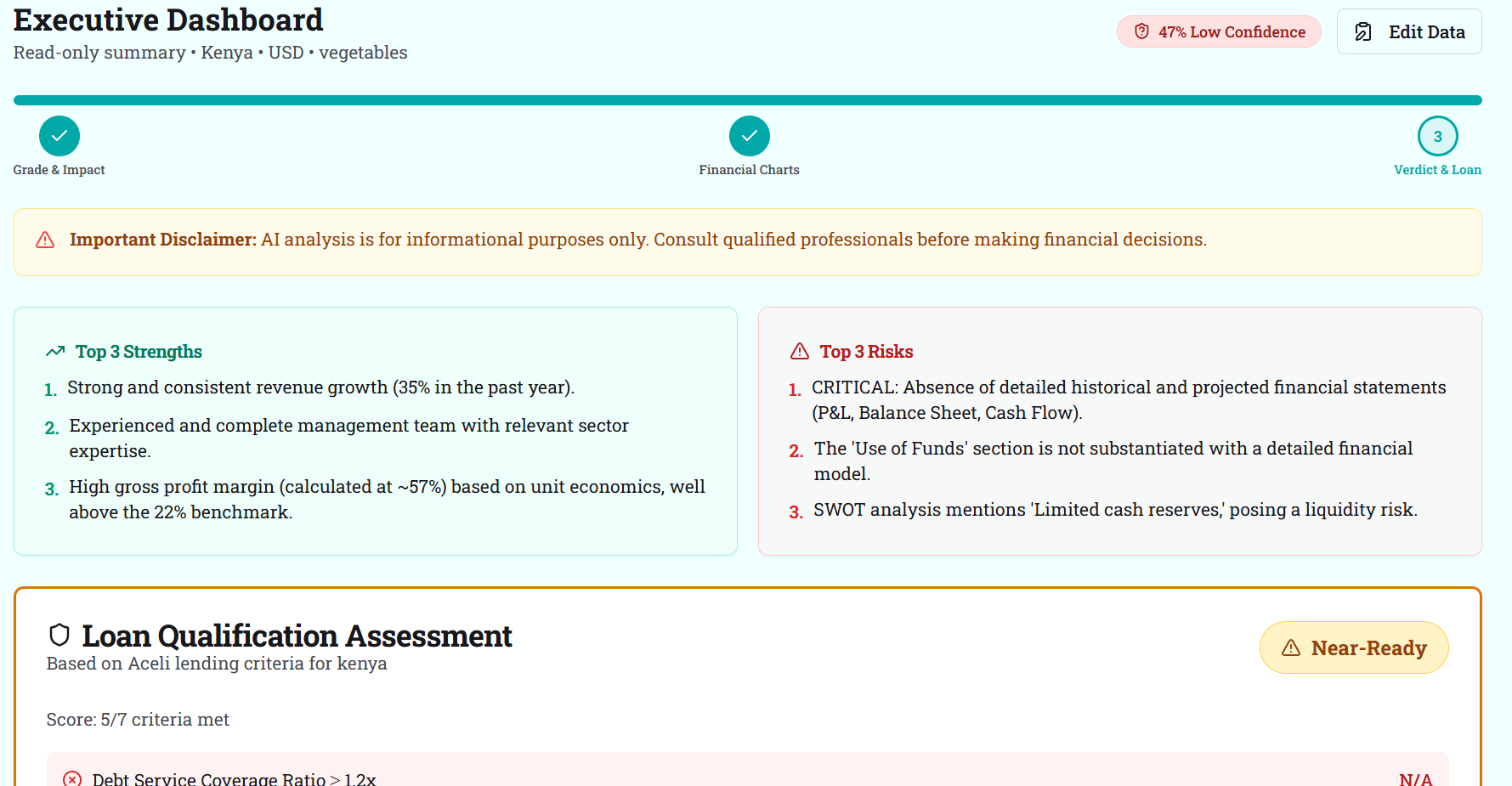
The GIP Growth Compass also uses this information to identify gaps in the agri-SMEs’ operations and generate recommendations for entrepreneurs. Every suggestion made by the AI platform is bound within the program guardrails, and outputs are reviewed and confirmed by a human advisor.
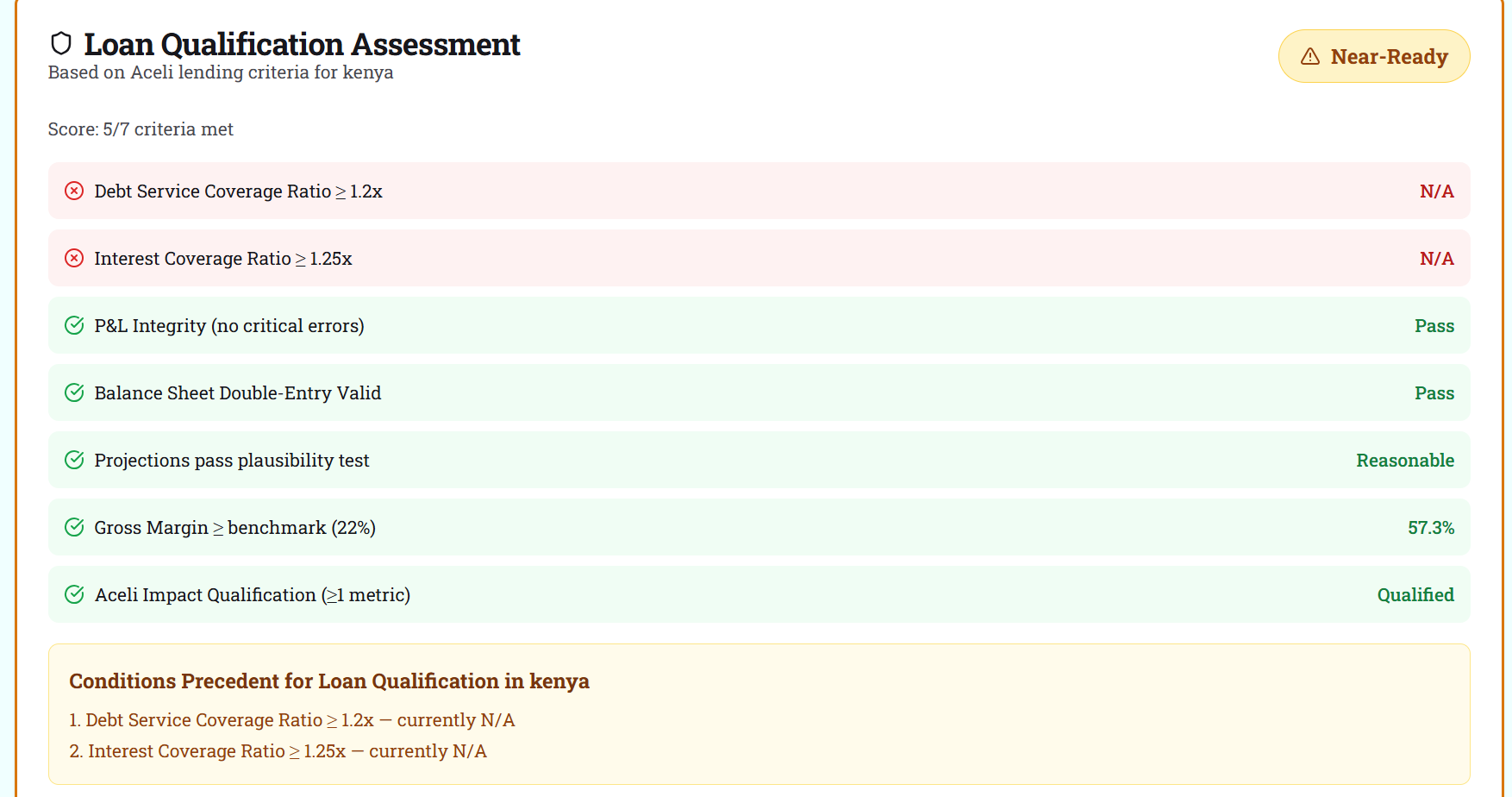
Because the GIP Growth Compass is integrated with the Aceli Growth and Investment Program digital ecosystem, it can pull together data from multiple sources. The platform tracks entrepreneurs’ progress through TechnoServe’s digital training modules and integrates them into the digital dashboard. The GIP Growth Compass also accesses sector reports and financial benchmarking data to enable the AI to compare an individual agri-SME’s performance against sector-and country-specific statistics.
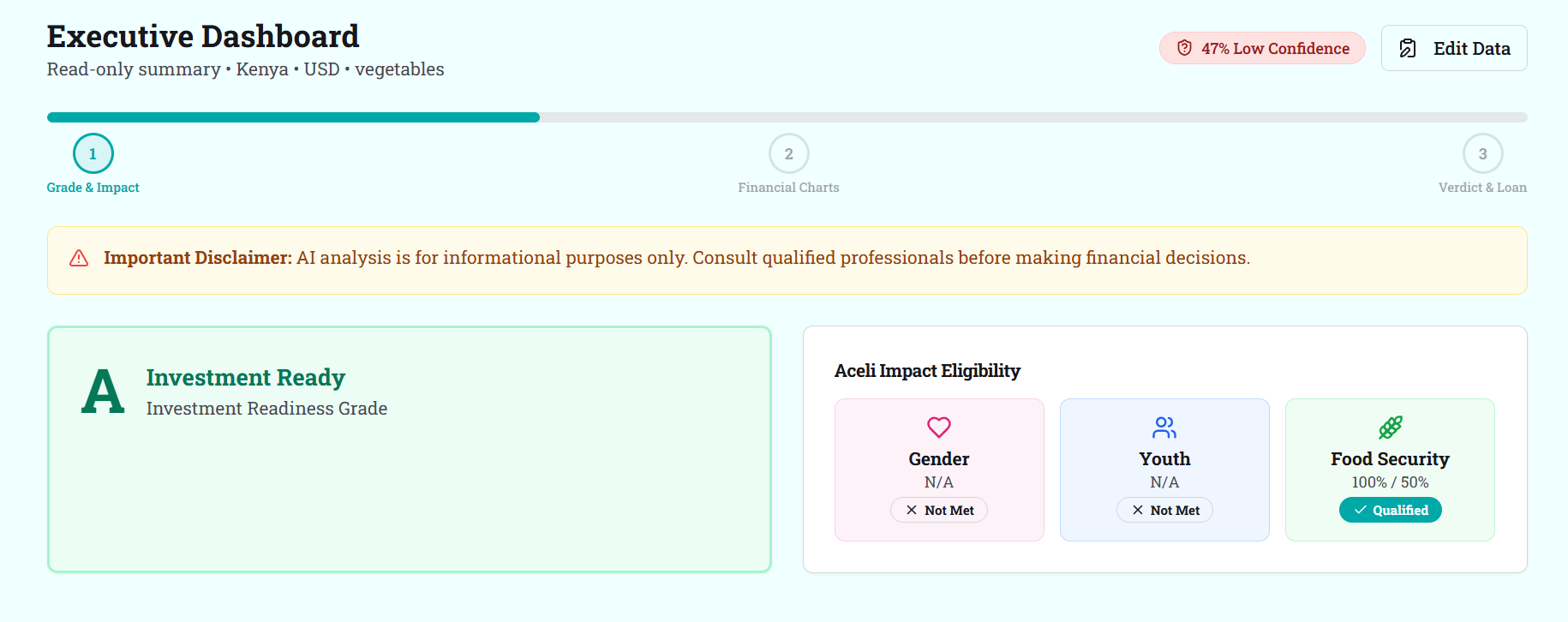
The platform also integrates the social impact of agri-SMEs, capturing their contributions to women’s and youth economic empowerment, food security, nutrition, and climate resilience.
Expected Impact: Faster Loan Readiness and More Inclusive Capital
Pulling all of this information together, the system provides a clear “loan readiness grade” that guides our support and shows that an agri-SME is a safe investment.
We expect the AI-integrated advisory model to improve efficiency of the program’s work by about 30%, enabling greater scale in engaging agribusinesses. The assumption that TechnoServe business advisors will deliver structured support more efficiently while maintaining quality will be tested during the pilot phase. Automated document auditing is expected to reduce manual errors and data entry, which will improve accuracy, standardization, and enable earlier, continuous visibility into business performance.
Taken together, these changes will help ensure that agri-SMEs have a clear, verified, and bankable path to growth.
What Comes Next for AI in Agriculture Finance?
While we have advanced a lot over the past year, the GIP Growth Compass is still a work in progress.
Future Steps: Testing, Governance, and Responsible Scale
Our team is currently in the phase of advanced development and stress-testing for the GIP Growth Compass. The strategic deployment with the new cohort of entrepreneurs will serve as the primary vehicle for measuring the platform’s impact. It will provide the field data we need to assess how AI-driven data validation accelerates the timeline from program entry to formal bank loan approval.
Before these systems go live at scale, updates to the tool’s AI governance framework will guarantee that all data handling meets strict privacy, cybersecurity, and inclusive-development values.
This process will be enabled by collaboration between key stakeholders. We are excited about where this journey will take us: not because of the complexity of the technology but because of the impact it will have on agribusinesses, farmers, consumers, and employees.

A Different Way to Make A Difference.
Discover how TechnoServe bridges the gap between “thinking big” and practical business solutions that help hardworking people move from poverty to prosperity around the world.


