


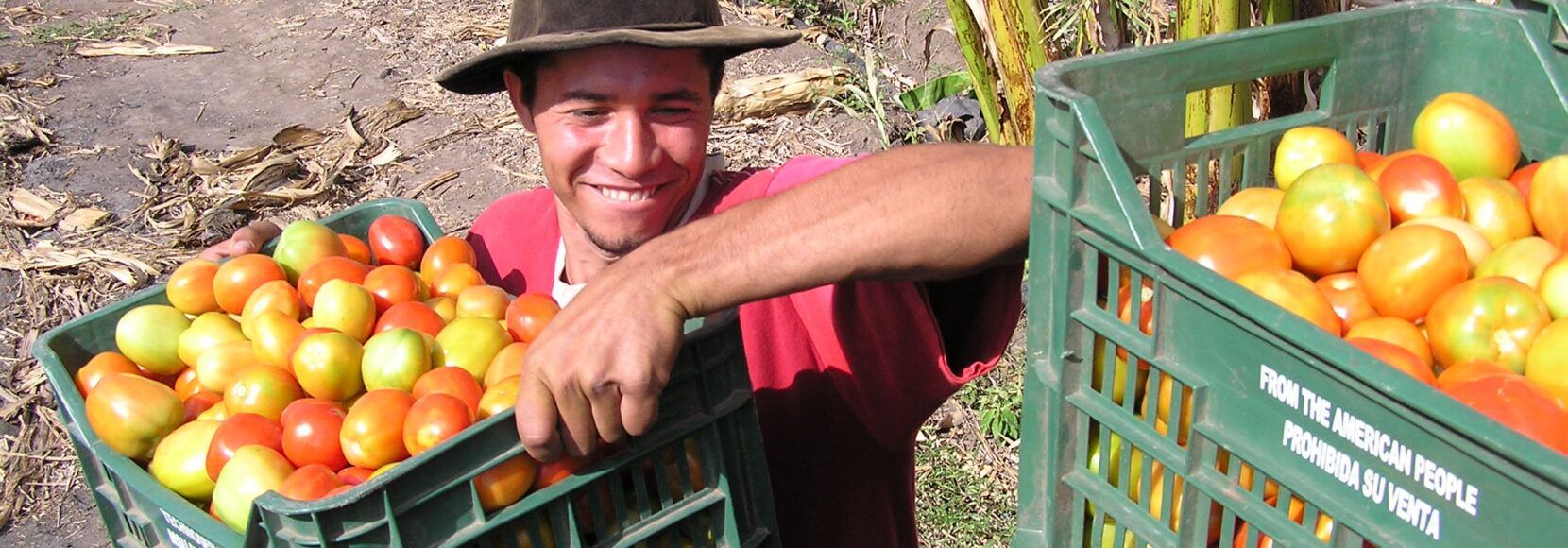
What is a Sustainable Supply Chain? Lessons from the First Mile
Table of Contents
- Introduction
- Sustainable Supply Chain Practices That Actually Change Outcomes
- How to Measure Supply Chain Sustainability
- Sustainable Supply Chain Examples: What It Looks Like on the Farm
- Common Sustainable Supply Chain Challenges — and What Solves Them
- Why women’s economic empowerment is a supply chain issue
- Future Trends in Sustainable Supply Chain Management
- Building a supply chain that holds
- What are some examples of supply chain sustainability initiatives?
- What is a sustainable supply chain?
- How do you measure supply chain sustainability?
- What are the five C’s of sustainability?
- What are the 7 C’s of SCM?
- Will SCM be replaced by AI?
Learn about the important role of farmers in the agriculural and food supply chain in this comprehensive overview.
A sustainable supply chain manages environmental, social, and economic impacts at every tier, from raw materials to end of life. Many agricultural and food supply chains begin with smallholder farmers and small suppliers, and successfully engaging them is critical to meaningful sustainability efforts.
For close to six decades, TechnoServe has developed business solutions to end poverty. We work across value chains with a focus on smallholder farmers, who are part of the crucial first mile of a value chain. Last year, we delivered $489 million in financial benefits to the smallholder farmers and entrepreneurs we work with. And over the last decade, we helped corporate partners design and execute $250 million in inclusive investment around the world.
Here’s our proven process for working on supply chain sustainability from the farm to the boardroom:
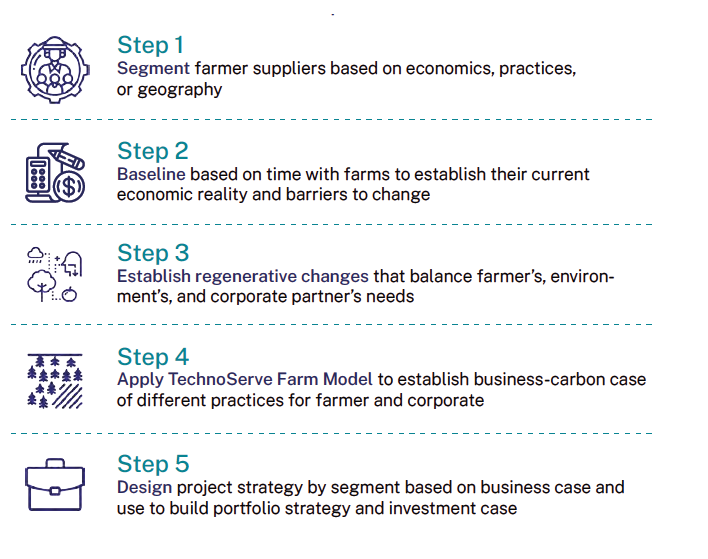
Read “Regenerative Transformation in Agricultural Supply Chains” to understand how TechnoServe helps develop supply chains that boost smallholder farmer livelihoods and resilience while also reducing carbon emissions and protecting natural resources.
What Is a Sustainable Supply Chain?
A sustainable supply chain is a network of raw material producers, processors, manufacturers, distributors, and retailers that actively manages its environmental impact, social consequences, and long-term profitability together, rather than trading one against the others.
The core principles of sustainable supply chain management
“Successful SSCM requires strong supplier collaboration, compliance with global standards, and a balance between sustainability investments and profitability, as well as integration of the triple bottom line (economic, social, and environmental sustainability).”
– Ayman Omar, Professor of Information Technology and Analytics, Kogod School of Busines
Sustainable supply chain management rests on a few durable principles, whatever the sector:
- Visibility before action. You cannot manage emissions, labor practices, or water use in a supply network that is not transparent. End-to-end mapping comes first.
- Shared value, not transferred cost. Imposing sustainability standards on suppliers without support simply shifts the burden down the chain. The suppliers least able to absorb the cost are usually the smallest.
- Measurement against a baseline. Sustainability goals without a starting measurement are aspirations, not targets.
- Durability over compliance. Sustainable practices that raise supplier incomes tend to persist. Practices adopted only to satisfy an audit tend not to. That third principle of measurement is where most supply chain sustainability claims fall apart.
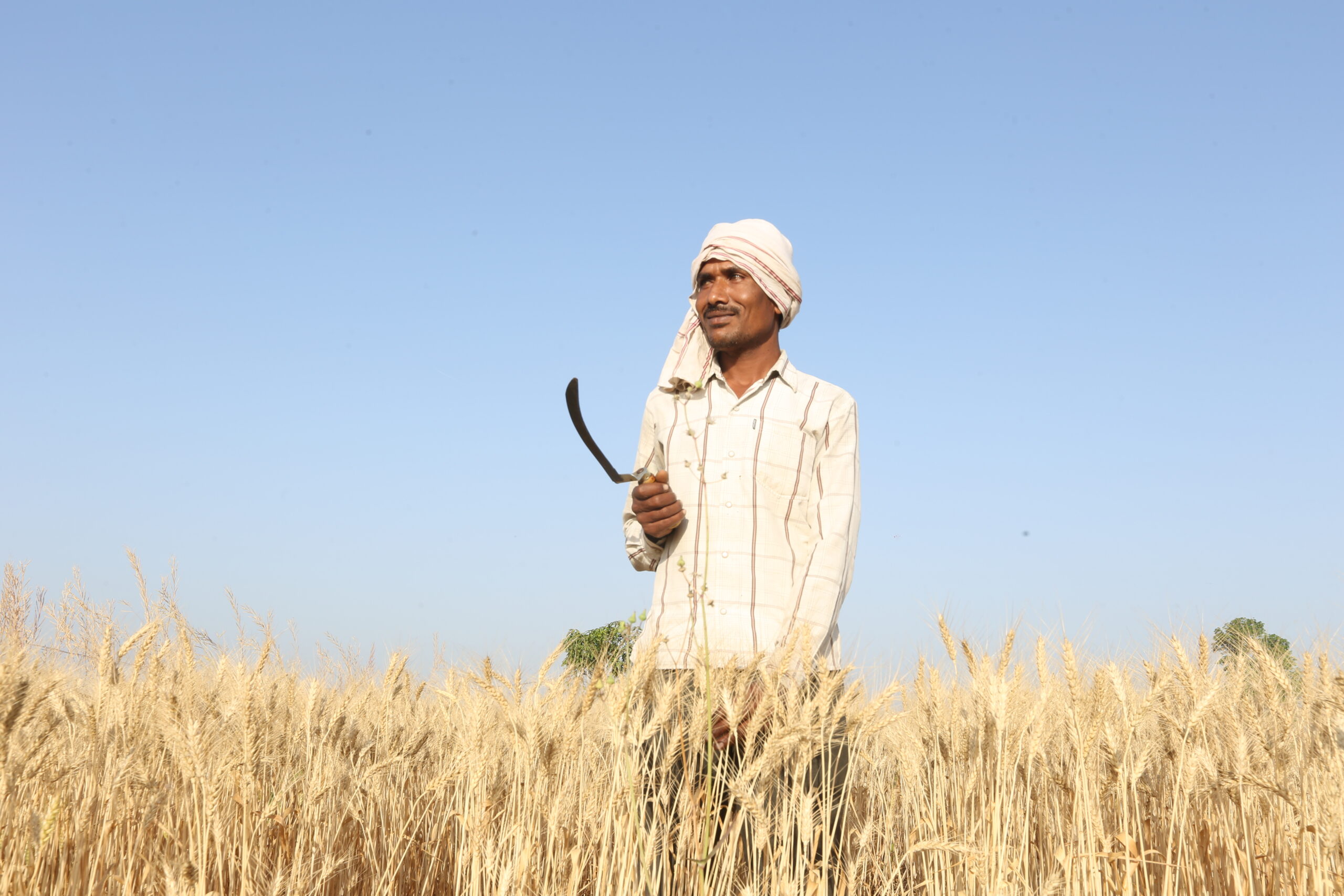
Why Supply Chain Sustainability Matters Now
Three pressures have converged.
- Regulation has tightened with disclosure regimes like European Union Deforestation Regulation (EUDR), which require specific commodities to prove they have not originated from deforested or degraded land. Others require companies to account for greenhouse gas emissions and human rights conditions well beyond their own operations.
- Investors, customers, and other stakeholders increasingly treat environmental responsibility and social responsibility as conditions of doing business rather than differentiators.
- Climate change is impacting agricultural supply chains in multiple ways. The raw materials for coffee, cocoa, dairy, horticulture, and grain products come largely from smallholder farms. When those farms lose productivity to drought, degraded soil, or pests, the effect arrives as volume shortfalls and price volatility in company procurement, often several years before anyone connects the two.
Risk management across the supply network
When treated as risk management, supply chain sustainability becomes easier to justify internally. A supply network that depends on hundreds of thousands of small producers with no agronomic support, no access to finance, and no reliable buyer is fragile. It carries concentration, quality, and reputational risk simultaneously.
Investment at the first mile reduces all three at once. Farmers trained in improved practices produce more consistent quality. Farmers with a reliable buyer have reason to invest in their own land. And a company that can describe, in specifics, what it does for the producers at the base of its chain is far better positioned when a journalist or regulator asks.
Sustainable Supply Chain Practices That Actually Change Outcomes
“Bringing sustainable and ethical products and services to the market will only be possible if smallholders, suppliers, producers, lead firms, and States along global supply chains are all equipped with the right skills – and also only if sustainability brings long-term business value to all of the actors involved.”
Gerd Müller, Director General, UNIDO
Skills Development for Fair Production and Sustainable Supply Chains
Key practices that change supply chain operations and measurable outcomes:
Responsible sourcing and supplier standards
Labor practices, environmental management and, increasingly, producer incomes and livelihoods are among the conditions that responsible sourcing sets. A product is sustainably sourced only if the supplier can meet those conditions. The distinction between responsible sourcing that works and responsible sourcing that does not usually comes down to whether the buyer is invested in the farmer’s ability to meet the standard.
Certification alone rarely closes that gap. A standard tells a farmer what is required; it does not provide the agronomic knowledge, planting material, or working capital to get there. The most effective sustainable supply chain practices pair the standard with the support: field-based agronomy training, farmer field schools, demonstration plots, and access to finance.
Supply chain transparency and traceability
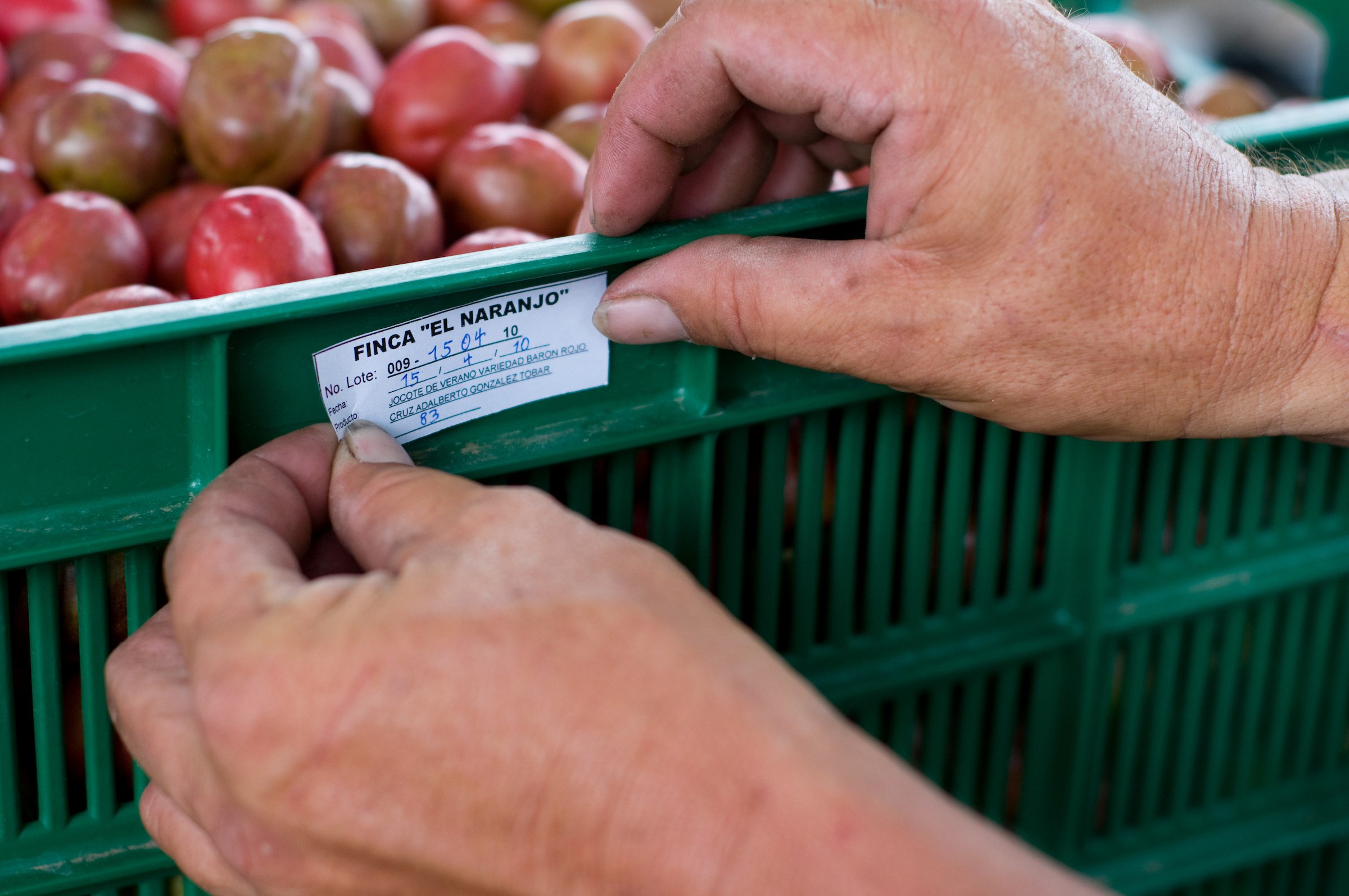
Traceability is the infrastructure everything else depends on. It answers a deceptively hard question: where did this actually come from? For products aggregated across thousands of smallholdings, the answer has historically been unavailable at any useful level of detail.
That has changed. Digital record-keeping at collection points, mobile data capture, and—where the value justifies the cost—blockchain-based ledgers have made near real-time traceability practical in supply chains that were opaque a decade ago. Third-party verification remains important, but the underlying data is now often captured at the source rather than reconstructed afterward.
Transparency and traceability are not the same thing. Traceability is knowing. Transparency is publishing what you know, including the unflattering parts.
How to Measure Supply Chain Sustainability
Supply chain sustainability is measured against environmental, social, and economic pillars. A credible measurement framework covers:
- Environmental factors. Were regenerative agricultural practices adopted?
- Economic. Did producers see an increase in income?
- Social. Were farmers able to gain more agency and ability to make decisions?
At TechnoServe, we work with companies to create inclusive design models that benefit both the bottom line and first-mile smallholder farmers. We seek to align interests and create mutually beneficial outcomes that create self-sustaining relationships that deliver real value for both parties.
We have internal reporting requirements and build monitoring, evaluation, and learning systems tailored to our projects’ goals, with overarching impact measurement for the whole organization. We have experience running our own systems and partnering with monitoring, evaluation and verification (MRV) companies or third-party evaluators.
A data-driven approach sets TechnoServe apart. We share our impact metrics on all our projects because we believe transparency helps inform better, more effective programs to end poverty, both at TechnoServe and in the wider international development field. Click on the image more to explore our data.

Sustainable Supply Chain Examples: What It Looks Like on the Farm
Unilever: regenerative agriculture across a global supply chain
TechnoServe and Unilever partner to promote regenerative agriculture practices across Unilever’s global supply chain by supporting farming methods that rebuild soil health and reduce emissions while making farms more resilient to climate shocks.
Driving regenerative practice adoption for many of these farms requires a thoughtful mix of technical assistance and financial incentives designed in conjunction with farmers and suppliers to manage risk and the potential impact of different practices.
Projects are more successful when they’re carefully co-designed across all parties. TechnoServe starts at a smaller scale to prove the value of certain practices—combined with on-farm measurement and testing—then determines which are most effective for their specific context. We then scale up the practice that the farmer finds most effective and transition the responsibility to them, both from a cost perspective and an operational implementation perspective.
Nespresso Reviving Origins: rebuilding a coffee origin
Nespresso’s Reviving Origins program works to restore coffee production in regions where it has collapsed because of factors like conflict, economic disruption, or climate pressure. TechnoServe’s role runs from agronomy training through wet-mill processing, the stage where coffee quality is largely determined and where smallholder farmers have historically captured the least value.
This is what rebuilding the first mile of a supply chain actually requires: not a sourcing commitment alone, but the processing infrastructure and technical knowledge that let a region supply the quality the commitment assumes.
Common Sustainable Supply Chain Challenges — and What Solves Them
- The first mile is invisible. Most companies can name their tier-one suppliers and few beyond. Mapping the base of the supply network is unglamorous, rarely makes it into a supply chain strategy deck, and is usually the highest-return sustainability investment available.
- Standards outrun capability. Requirements arrive faster than the smallest suppliers can meet them, and those suppliers exit the chain. This looks like compliance improving. It is often consolidation.
- Programs end before practices stick. Three-year project cycles rarely match how long agricultural change takes. This makes it important to ensure persistent gains supported by patient capital and programs.
- Measurement is asserted rather than evidenced. Without a baseline and a published methodology, a partner, a regulator, or a journalist cannot check sustainability claims.
Why women’s economic empowerment is a supply chain issue

Women do a substantial share of the work in agricultural supply chains and hold a much smaller share of the land, finance, and buyer relationships. That gap is not only an equity problem; it is a productivity problem. Supply chains that reach women producers directly with training, inputs, and payment made to them, rather than through an intermediary, consistently capture gains that supply chains routed only through household heads do not.
This is why women’s economic empowerment appears in TechnoServe’s supply chain work as a design decision rather than a reporting category, and why we disaggregate results by gender as a matter of course.
44% of those reached were women or women-owned businesses — 2025 Annual Report
Future Trends in Sustainable Supply Chain Management
AI will not replace supply chain management, but it is changing it. Demand forecasting, route optimization, and anomaly detection in traceability data are all improving quickly. AI does not build the relationship with a farmer organization that determines whether a practice is adopted. The first mile stays human.
Circular supply chain thinking is moving upstream. Circular economy principles have concentrated on end of life and packaging. The same logic applies to agriculture. Returning organic matter to soil and treating residue as an input is where the larger emissions and resilience gains sit.
Regulation will keep pushing visibility further up the food chain. Disclosure requirements are steadily extending further up the chain. Companies that have already mapped and invested in the first mile will find this a reporting exercise. Companies that have not will find it a discovery exercise.
Renewable energy and low-emission last-mile logistics will become table stakes. These are necessary, well understood, and increasingly expected by eco-friendly consumers. They are also the part of supply chain sustainability that competitors can copy. The upstream relationship, the stretch of the value chain furthest from the customer, is the part that takes time to build.
Building a supply chain that holds
Sustainable supply chains are not built in sustainability reports. They are built where raw materials come from, by companies willing to invest in the suppliers who produce them. It takes time. The commitment has to outlast the news cycle that prompted it.
TechnoServe has projects in around 30 countries, with more than 95% of our staff from the countries where they work, helping farmers and small businesses build the capability that makes supply chains sustainable at the source.
That work is funded through a combination of corporate partnerships and philanthropic support that work to ensure farmers are a strong part of the first mile.
If your company is examining the first mile of its supply chain, explore our corporate sustainability work or partner with us.
Supply chain sustainability initiatives include regenerative agriculture programs, responsible sourcing standards, and supplier training. TechnoServe works with companies including Unilever, Nespresso, and Walmart to train smallholder farmers in improved agronomic practices and connect them to reliable buyers. This improves both crop quality and farmer incomes at the origin of the chain.
A sustainable supply chain manages environmental, social, and economic impacts across every tier, from raw materials to end of life. It combines responsible sourcing, supplier standards and traceability with measurable outcomes. Done well, it improves conditions for the farmers and small suppliers where most supply chains begin.
The five C’s of sustainability are commonly given as clean, community, culture, care, and conservation. Frameworks vary by source. In supply chains, the practical test is simpler: whether environmental, social and economic outcomes improve measurably at every tier, including the farms and small suppliers at the first mile.
The seven C’s of supply chain management are typically listed as connect, create, customize, coordinate, consolidate, collaborate, and contribute. They describe how supply chain partners work together. Sustainability depends most on collaboration and contribution; how value reaches the smallest suppliers, not only the largest.
AI will not replace supply chain management, though it is reshaping it. AI improves demand forecasting, route optimization, and traceability at scale. But sustainable supply chains still depend on human relationships at the first mile for agronomy training, farmer organizations, and buyer commitments that no algorithm can substitute.

A Different Way to Make A Difference.
Discover how TechnoServe bridges the gap between “thinking big” and practical business solutions that help hardworking people move from poverty to prosperity around the world.
