


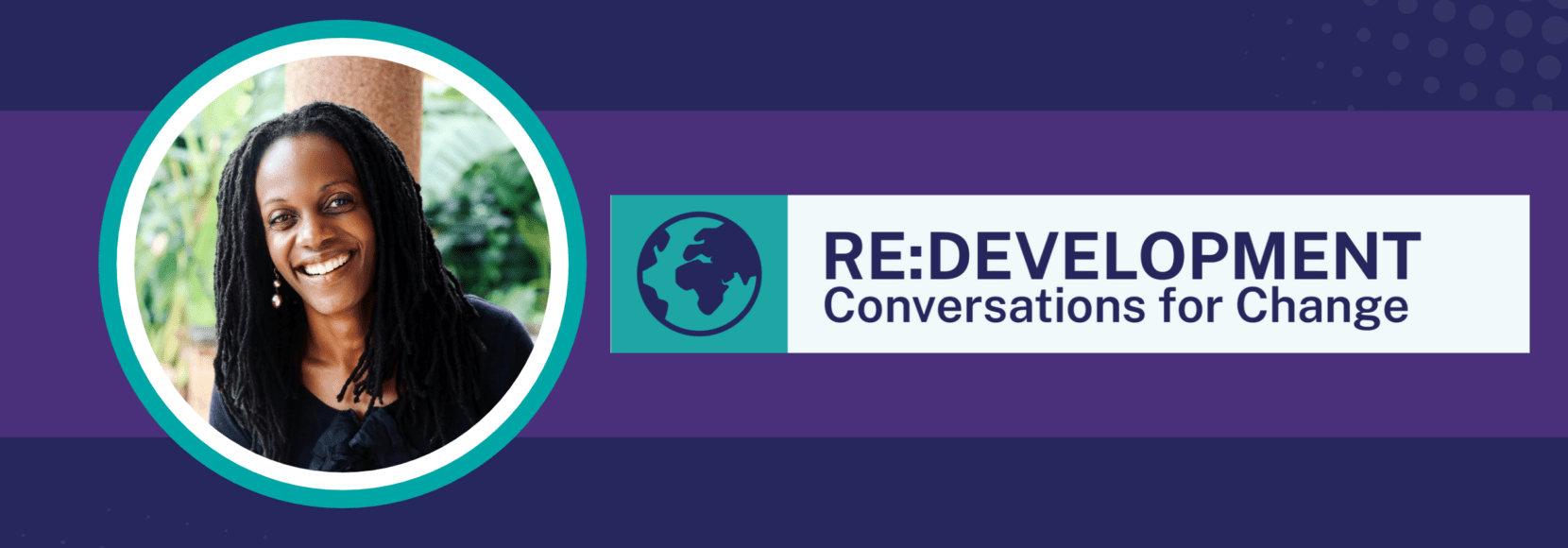
Re:Development: Dr. Catherine Nakalembe on AI in International Development
Table of Contents
- Introduction
- Meet Dr. Catherine Nakalembe
- Weighing the Real Risks of AI
- How Can AI Be Used Positively in International Development?
- Who Really Owns AI? Compute, Infrastructure and the “Turn the Tap Off” Problem
- Can AI Regulation Work?
- The Overlooked Challenge: Lack of AI Training Data in Low-Income Countries
- How Can AI Improve the International Development System?
- Development Insights from Uganda: Agency, Not Aid
Can AI save international development as aid budgets shrink? We caught up with Dr. Catherine Nakalembe to talk real risks, tech ownership, and moving past charity.

International development has entered a new era. The United States Agency for International Development (USAID) has been shut down, and many countries are cutting foreign aid budgets. And yet global poverty remains one of humanity’s most urgent challenges.
At this moment of crossroads, TechnoServe is exploring what the future of international development should look like—and how we get there.
In TechnoServe’s series, “Re:Development | Conversations for Change,” we interview leading thinkers and doers with bold perspectives on how to build a world where everyone has an equal chance to succeed.
In this episode, TechnoServe CEO Will Warshauer speaks with University of Maryland Professor Catherine Nakalembe about the risks of artificial intelligence (AI), its potential to advance human development, and how to apply AI to reduce global inequality and improve international development systems. Her view, in short: the risks are real, the opportunities for low-income countries are immense, and the biggest overlooked bottleneck is a lack of training data.
Read previous episodes of the series.
Meet Dr. Catherine Nakalembe
Dr. Nakalembe is an Assistant Professor of Geospatial AI at the University of Maryland and Director of the NASA Harvest Africa Program, which uses AI and satellite imagery to help African countries fight drought and food shortages. She also founded the Xylem Lab and Xylem Institute, translating geospatial AI into policy-ready intelligence for food security, climate adaptation, and environmental decision-making.
Dr. Nakalembe holds degrees in geographic and environmental sciences from Makerere University in Uganda, Johns Hopkins University, and the University of Maryland. She has been awarded the Al-Sumait Prize, the Africa Food Prize, and the Ugandan Golden Jubilee Medal, the country’s highest civilian honor. She is also a TED Fellow and a National Geographic Explorer.
“AI systems built in the West often also fail to account for the contexts of the Global South, including high internet costs, limited bandwidth, and a lack of labeled training data,” she has stated previously. “If these systems aren’t adapted, they remain irrelevant, potentially deepening existing inequalities in wealth and access to resources, [and] there is a risk that these systems prioritize corporate and company profit over farmers.”
Weighing the Real Risks of AI
Will Warshauer: So Dr. Nakalembe has been awarded the AI-Sumait Prize, the Africa Food Prize; she’s a TED Fellow. But something that really gets me going is that she is a National Geographic Explorer. And if you are anywhere near my age and grew up with a lot of National Geographic around you, you know that’s the coolest thing. So welcome, Catherine.
Catherine Nakalembe: Thanks for having me. You could say a dream did come true, becoming a National Geographic Explorer. I was explaining it to my sons because they love the books.
Will Warshauer: I am appropriately in awe. Well, you know, we certainly at TechnoServe believe AI is gonna make profound–and, we hope, positive–changes in the international development space. And so I’d really like to focus on that.
But before I do that, I can’t help but ask you sort of a different question, because there has been a series of op-eds and interviews recently with some of the people who helped create these AI systems and who have very deep knowledge of them. And I just have been shocked by how scary and pessimistic many of them are, including most recently Bill Gates, who did an hour and a half with Ezra Klein [in the New York Times]. That’s really essential viewing. But you don’t sleep very well for several nights after you’ve watched it because Bill is talking about how there is today in place the ability for people to use these systems to mount bioterrorism attacks that could kill a hundred million people, to mount huge cyber attacks that could disable whole banking sectors or power grids or so on. And he’s normally such a positive, “glass half-full” guy, that hearing him say all of this and hearing how concerned he is was quite striking to me.
And so as someone who knows a lot about these systems and how they may be used–in the sort of “AI is gonna wreck the human race” perspective, where are you in that conversation?
Catherine Nakalembe: One, delighted to be here and to talk about this. Reflecting on the grand scheme of things, I think there are lots of moving parts; a lot is going on. And depending on what you’re hearing or what you’ve been reading or what you’ve been following, we always get snippets and bits and pieces of what might be happening.
So I focus on trying to do work in the positive space, trying to leverage data sets, methodology, compute to create products that could be utilized for improving the human experience or human condition. So improving crop productivity, forecasting extreme events so we can respond early, etc.
Those risks are real, and they’re serious. After things have been released into the world and other actors take over, it starts to be out of the hands of whoever might have started the revolution.
But on the other side of it, I think it would be naive to ignore the fact that yes, crime and criminality exist. And that even with the internet that created and brought us a lot of connectivity, you opened up a whole new way to find victims, for example, that could be extorted. If we think about cybersecurity, somebody could click on something on LinkedIn or something in your email, and that can open up your entire company to being extorted or your entire systems being shut down.
Where maybe you needed a coordinated team of a hundred or so to develop the method, do the phishing, etc., that could be done by one individual. So then that means that the power of a hundred has been multiplied.
The other thing I think, is that the same model, methodology that could be utilized for, let’s say, developing cancer medicine–let’s publish open access in all fairness, trying to get others to use that methodology to develop other things, or have that information accessible to a broader community–that same model can be cloned and run offline for the opposite, like investigating how you could accelerate this cancer.
And so I think those risks are real, and they’re serious. At that point, after things have been released into the world and other actors take over, I think it starts to be out of the hands of whoever might have started the revolution. So now it means there’s like a whole new way that we have to do policing, right? It’s very complicated.

How Can AI Be Used Positively in International Development?
Will Warshauer: And the point Gates was making at one point in the interview was that a lot of those security measures and things that are put into the models can be stripped out by a bad guy who wants to do bad things with them.
But at any rate, let’s turn the page on that, because there are enough other podcasts all about the potential horrors of AI. Let’s talk about how AI could change for the better some of the issues that we all think about with international development. And I’m wondering if you want to call out the kinds of opportunities in developing countries where you think AI has the most potential to make a positive difference.
Catherine Nakalembe: I really like this question. Especially when you’re exposed to young people who have some ideas and things that they want to do, but don’t have the means. So I’ve met a lot of young African researchers and students or recent graduates and have so many conversations with them like, “Well, I’m really interested in fixing transportation, or “I’m interested in education,” or “I’m interested in healthcare.”
While AI could open up the opportunity for people to have access to more information in an organized way, more curated, better material for learning–at the same time, it might strip away the opportunity to learn, which is a challenge that we’re facing in higher education in the U.S., where students can write the entire essay without, you know, reading or preparing anything at all.
So if a young person is thinking about this, it’s a great space for them to maybe develop a tool that would ensure the goal of learning is maintained as you’re exposed to more things. So there’s an opportunity on the positive side to be able to develop more tools that are community-driven. So young people could develop a tool that maybe helps learners and brings a type of education that would not be accessible, let’s say, in very, very rural areas.
I mentioned the nefarious actors…But community change makers also have the potential for their capacity to be multiplied.”
I think the positive opportunities are immense, in the sense that it is a little bit easier to delve into something now that you don’t know anything about. So I’ve been learning a lot about ESG, but if I’m trying to brainstorm and understand how that might relate to my field, I have a chatbot, for example, that I could try to brainstorm with rather than potentially having to take a degree at a very expensive university.
Particularly healthcare, too, I think [for] a lot of diseases that have been ignored, researchers in low-income countries can try to push for research and methods and solutions to problems by combining the best possible research that exists with the context of the environment to create tools that are specific to their community.
I mentioned the nefarious actors, their potential being multiplied in the thousands for every individual. But community change makers also have the potential for their capacity to be multiplied. And at some point we’ll hit a steady state, I hope, and their potential won’t be drowned out.
Who Really Owns AI? Compute, Infrastructure and the “Turn the Tap Off” Problem
Will Warshauer: Exactly. And I want to go one level down into that, because a lot of folks are talking about it. Obviously, in this country, most of the AI has been developed by big, for-profit tech companies. And that dynamic then seems to be reinforcing and even exacerbating the vast income inequality we see here.
You talked about community ownership, and I’d like to understand better where you have seen that or where you see perhaps others doing more development. Many people in Africa are using open-source Chinese LLMs, for instance, because they’re free to use and then they can be tailored rather easily, which made perfect sense to me. And you see so few iPhones anywhere, but you see lots of all the Android devices for the same reason.
Is it possible that that model could be a really positive and healthier alternative as these LLMs are developed more in Africa? Or does it sort of lock them into second-tier models? What do you think about all that?
Catherine Nakalembe: I think ownership is very complicated, right? Like I can build a model, I can access a cloud or compute cluster, I can run it. But if I don’t own the compute, I don’t own the infrastructure on which it depends. Somebody can just “turn the tap off.”
True ownership is a lot more complex than being able to develop your own model. And so the requirement of infrastructure becomes even more important. Things like internet are critical to develop anything. But if you don’t own the infrastructure on which your local “everything” depends on, then you don’t own it, right?

So we have this [crop] yield forecasting bulletin. And we do our analysis and develop reports; it covers six African countries. And then to make it a little bit accessible, on top of it, we have a little LLM enabled, like a promptable AI system for you to be able to ask questions about what is happening based on what our analysis has been over the last couple of months.
And that is actually built off of OpenAI’s system. So the back end of it relies on OpenAI; we need OpenAI tokens. And so if it becomes too expensive, we’ll probably stop that component.
If a national system is built that way–imagine like a drug delivery or hospital coordination system–built off of an infrastructure like OpenAI or a Chinese token system, and it’s turned off, that’s where the situation becomes problematic, right? Let’s say there’s an emergency and it’s supposed to trigger all of these things for the ambulance to be sent in the right direction, right? I don’t know if you remember all the businesses that used Facebook and Instagram as platforms for selling stuff or advertising stuff–and then your country decides, “No more Facebook.” So this is like that type of situation, but on steroids.
Can AI Regulation Work?
Will Warshauer: Speaking of governments, let’s talk about them for a minute because I think you know, here in the U.S., there are a lot of calls for government to play a heavier regulatory role than they have. Are there African governments or governance frameworks you’re seeing in Africa that may be useful going forward?
Catherine Nakalembe: So yes, I can mention two, actually. I think [in] South Africa and Kenya, there’s been a lot of investment in thinking about policy. But one of the biggest issues is, as is true for a lot of things, policies look so good on paper, but giving them legs and infrastructure and realizing them–I think that’s where things fall apart.
Will Warshauer: TechnoServe has been working a lot on food fortification, and you see that very clearly there in West Africa in particular. Nigeria was one of the first countries to have a whole legal framework requiring by law that various staple foods be fortified with various micronutrients. And yet, fast forward to today, and they’re often [struggling with] how much is actually being done. So you can have great laws, but if they’re only observed occasionally, then they don’t play the helpful role that they could.
The Overlooked Challenge: Lack of AI Training Data in Low-Income Countries
Will Warshauer: What about training data? You’ve mentioned this elsewhere in some of your talks and some of your writings, and I think we’re seeing it here. TechnoServe has an internal initiative trying to have AI deployed more often in our field programs in a way that would increase the impact of that program by multiples.
There’s a young Indian staff member working on productivity of smallholder farms in India. But she’s run into the problem that there are no databases. She wants to use many more photographs and have AI synthesize those photographs and be much more proactive and much quicker to see potential outbreaks of pests or fungus or other things which could hurt the crops.
And she is going to have to spend six weeks essentially taking photographs and building that database, even though her crop is mainstream and even though the place where she’s doing it has thousands to millions of smallholder farmers. Are you surprised by that? And is the lack of training data going to slow things down or make the systems less great out of the box?
For a lot of low-income countries, a lot of data is not digitized…It requires real, serious investment if we’re going to figure it out on a large scale.
Catherine Nakalembe: Yeah, a really good question. Something I definitely talk about a lot and something that I invest a lot of time in. So I’m surprised–six weeks? Six weeks might not be enough.
So the reason why large language models work very well, particularly for English, is that we already have all the text, all the books, and all the lawsuits about, you know, people’s IP being utilized to develop models. And you’re scraping the internet to have training data. Similarly, with facial detection: thanks to Twitter, Facebook, and Instagram, people have posted their faces all the time. And so models like image segmentation, computer vision methodology for face detection, is way advanced because of that data existing.
It becomes a lot more complex when we’re looking at things in the natural environment: modeling how a crop behaves or things like weather. Weather forecasting, for example, in the U.S. would work really, really well because of the dense observation network that NOAA [the National Oceanic and Atmospheric Administration] has maintained for a very long time. So you can build a really good model utilizing that historical data. Same in agriculture–the USDA [U.S. Department of Agriculture] has, I think, over a million crop surveyors, and a lot of things are harvested with machines. So it’s easy to digitize.
But for a lot of low-income countries, a lot of data is not digitized. What a farmer harvests, when they harvest, when they plant–there are not a lot of records. It is from those records that you can model the relationship between rainfall, soil moisture, and temperature to figure out what might come out of a field.

I’ve spent a huge chunk of my time the last couple of years basically just focused on data collection, creating a database of just images, like multiple images of multiple [crop] diseases.
Last year, a NASA satellite was launched that [was] basically meant to be used for soil moisture modeling, which is important for forecasting droughts earlier than vegetation. But if you look at the International Soil Moisture Network–a group that keeps track of soil moisture sensors around the world that can be utilized for the kind of modeling for forecasting drought–there’s not a single active station on the continent of Africa that’s readily accessible.
But this effort is a drop in the ocean, right? It requires real, serious investment if we’re going to figure it out on a large scale. There are so many different things that we’re trying to model. And I think what is happening is there’s a lot more investment in compute and fancy things that give you an immediate output than working on the input. So the data collection is the most expensive thing. So–not invested in, has to be invested in, and not overlooked for sure.
How Can AI Improve the International Development System?
Will Warshauer: Well, it raises 16 other questions in my mind, but I think I’m gonna park those for the moment and go on to a couple of other ones I wanted to be sure to ask you before we run out of time. You know that TechnoServe is a nonprofit organization working in the international development space, and I think our sector is at a crossroads. We’re seeing foreign aid budgets shrink, not just here in the United States, which was formerly the largest aid donor in the world by a wide margin, but in almost all of the developed economies and all of the top aid-giving countries,
There’s a group of young people thinking really provocatively and creatively and potentially helpfully about how to redefine development and think about it in new ways that may democratize it and make it better. In all of these conversations, where do you see that AI fits in with how foreign aid is going to evolve? Will it [turbocharge] foreign aid by making it five X or ten X more efficient? Will it complement it in some other way? Will it be the foundation for some totally new form of development that we’re not thinking about today?
How do you coordinate this very disjointed ecosystem of [development] players? Maybe AI could play a role in that.
Catherine Nakalembe: I’ll probably just add more complexity to your question. Because if we think about the grand challenges of our time–climate, massive displacement, conflict, etc.–these are very big problems.
And we live in an interconnected world where things that happen in pockets around the world have cascading effects that end up impacting everybody on some level. And I think people have gotten a good feel for this, especially with the Strait of Hormuz as an example. You can’t be like, “I don’t care. It’s so far away from me.”
Because of this interconnectedness, we have the opportunity to think more like we’re all on this one big boat–one tiny boat, actually. And I think this is the thing that is absolutely missing, more and more. I think everybody thinks they’re on their own little boat rather than we’re all on this one little boat together.
And what that means is–trying to do systemic work requires collaboration across, right? So you can’t be like, “Well, I work on wells,” or “I work on healthcare,” or “I deliver food.” So what I think the role that AI could have in this particular case is maybe zooming out and thinking about these very things that we’re operating in a disjointed way, that we could think about in a more systemic way.
I was at the CGI, the Clinton Global Initiative in New York last week, and there wasn’t a lack of initiatives and teams and all sorts of people who were working on all of these different things. But there were so many things that were overlapping and were very similar.
And how do you coordinate this very disjointed ecosystem of players who are in the same proximity, but everybody has their own agenda? Maybe AI could play a role in that.
Will Warshauer: I like your answer. As you say, everybody’s there often doing very similar things in the same place, but having their own agenda. And so we will need a second generation of AI to figure out how to get people to collaborate more and better.
Everybody thinks they’re on their own little boat–rather than we’re all on this one little boat together.
Development Insights from Uganda: Agency, Not Aid
Will Warshauer: So I know you grew up in Uganda. And I just wonder if you cast your mind back and think about what your time there taught you about international development. And what don’t donors, or what don’t well-meaning people like me who lead NGOs trying to work for development–what do we not understand?
Catherine Nakalembe: So I grew up near Katwe, which is like this slum, and you could say we’re urban poor. But from my parents’ perspective–my parents just want to be able to work, be able to send their kids to school, for us to have food. That’s it.
When I was doing my PhD in Karamoja in northeastern Uganda–it’s probably one of the regions that’s received the most aid in all of Uganda. I have pictures from my first field work where I was just taking photos of signposts of like, “This project is doing this.” And there was no proof that there was anything that happened. There’s just a sign: “This dam was built by this.” “This school was funded by NORAD, USAID,” etc. Bringing blankets and food is great, but if people don’t have agency, then they’re just trapped in this cycle where they wait for the next time and the next time.
From my parents’ experience, for me and my sisters to be able to go to school was the number one priority. So to go to school, to be safe, and learn job opportunities for people to actually work.
I have the last example I’ll give, where I got my cacao [gestures at a cacao figurine on her desk]. There are these farmers in Madagascar, and they do pretty well, but they could do so much better. But what I realized is that they don’t want a gift, they don’t want a grant. If they could access a loan, they could improve their storage of their cacao. They could improve their drying shed of their cacao, which means they would get more value and be paid more. And they would absolutely be able to pay it back. So I think observation, learning, and just trying to figure out what agency looks like in different contexts is the best.
Will Warshauer: I love your answer, and in part I love it because you bring in the private sector there. And thinking about agency, the profit motive is a powerful motive all over the world. And so if you can find opportunities to align those incentives where the cacao farmer is doing better and the company that is buying the cacao is also doing well, those things, I think, will scale over time. They’ll last over time.
And when you build interventions that are dependent on a free giveaway or a subsidy, the risk is that at the end of that project, without the subsidy anymore, things may go south. Whereas if it can work in commercial terms, then it has the potential to really last over time, I think.
Dr. Nakalembe, thank you very much for your time today. We really appreciated your thoughts on many of the different challenges and the areas where we’re still at “drop in the ocean” sort of scale–but look forward to checking back in with you at some point as AI marches forward, not just here, but all over the developing world.
Thank you very much for your time today. Really appreciate your insights.
Catherine Nakalembe: Thank you very much too. I really enjoyed our conversation.
Re:Development | Conversations for Change is TechnoServe’s interview series on the future of international development. Explore more episodes, or support the market-based solutions that help farmers and entrepreneurs build lasting incomes.

A Different Way to Make A Difference.
Discover how TechnoServe bridges the gap between “thinking big” and practical business solutions that help hardworking people move from poverty to prosperity around the world.

