


Buna Love: Women Coffee Farmers in Ethiopia Are Leading the Way on Climate Resilience
A participatory research method called photovoice shows how women coffee farmers in Ethiopia are adapting to climate change and leading their communities.

(TechnoServe)
What we have in common is our love for coffee and having coffee as a social activity…Coffee is something that brings us social freedom, a moment to be with my friends…We also like working with coffee because it gives us income and a livelihood…We now see changes in ourselves, our kids and our husband…We have learned to be patient with the coffee trees, and we are more excited.
These are the words of women coffee farmers in Ethiopia’s Sidama region who are creating a stronger role for themselves with support from TechnoServe’s Climate Resilience Through Empowering Women (CREW) project, in partnership with Global Affairs Canada and Nespresso. The project equips farmers with the knowledge and skills needed to navigate climate risks and lead in their communities.
Photovoice: Participatory Research in Action
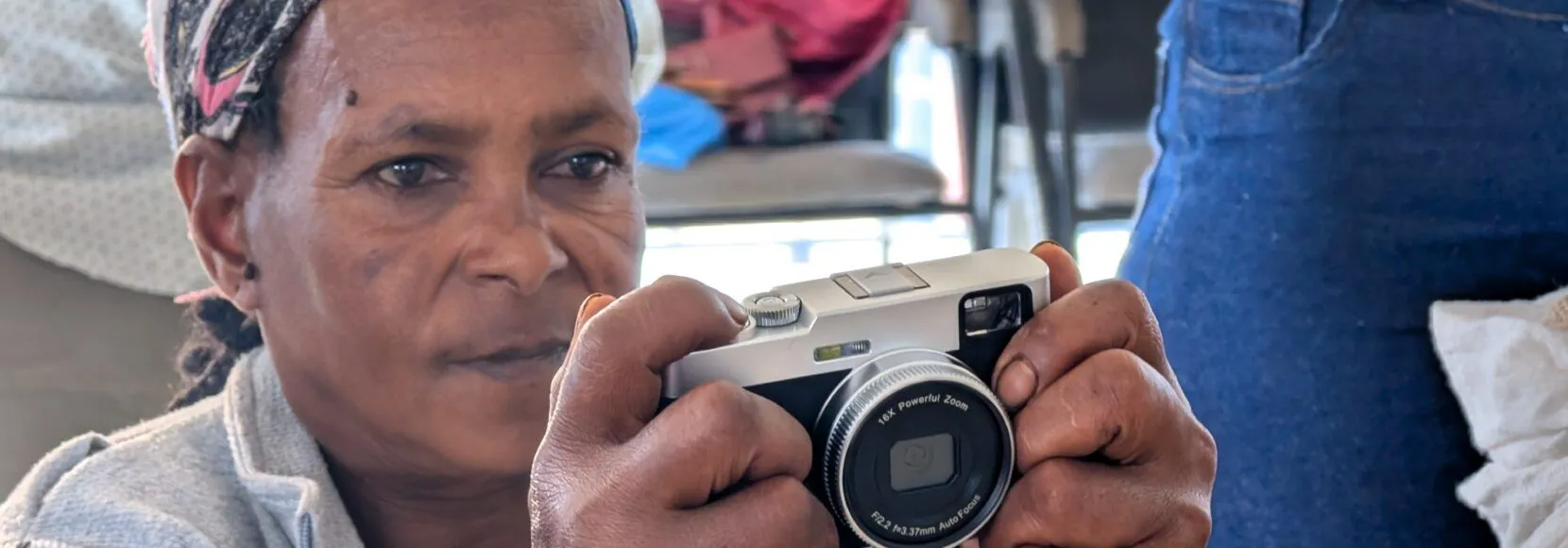
This year, 45 women coffee farmers from CREW gathered to learn something new: how to use digital cameras to capture their lives and then share the story behind the images as part of photovoice, a participatory research methodology that provides communities with the tools to drive their own social change.
Women were given cameras and asked to document their experiences, challenges, and achievements as coffee farmers in their households and communities. After taking their photographs, the women came together to analyze and interpret the images as a group, sharing the stories behind each one.
They then curated a community exhibition to foster important conversations with family, the community, and decision-makers. Fotosynthesis led the photovoice process in close collaboration with TechnoServe’s field team.
“Before, we collected success stories, but this was a good opportunity to hear from women, as before we did not have enough time to sit and listen to their stories,” said Hiwot Bahru, manager, CREW Women and Youth.


Buna Love
Buna is the Amharic and Sidamo word for coffee. Women coffee farmers selected the images and stories in this collection called “Buna Love.”
We invite you to see them as they see themselves and hear their stories of learning, growth, and triumph in four interwoven themes:
Becoming
These photographs turn the lens inward. The women who took them reflect on their past selves, how they see themselves now, and how they have grown.
Creating
(TechnoServe/ Almaz Bensa Bekira)
From the farm to the household to the marketplace, these images capture women taking pride in the knowledge and skills they have learned.
Reimagining
These images represent the future the women see for themselves, the aspirations they are working toward for themselves and those who come after.
Uniting

These photographs document the power found in connecting with one another, learning together, and strengthening the bonds of family and community.
Coffee, unsurprisingly, is a big part of “Buna Love.”
Women shared many stories of adopting regenerative practices like stumping and, notably, convincing husbands and neighbors to do the same.
(TechnoServe /Adaneh Alanbo Dikalo)
Building Leadership and Resilience For Women Coffee Farmers
The CREW project will benefit 79,000 women and men in coffee-growing communities in southern Ethiopia. By 2028, nearly 2,000 women will also participate in the Women’s Leadership in Coffee program.
We are already seeing positive changes.
Endline survey results show positive movement on three of four pro-Women’s Empowerment in Agriculture Index (WEAI) indicators measuring women’s empowerment in agriculture, such as self-efficacy, access to information, and entrepreneurial mindset. A fourth indicator tracking attitudes related to gender-based violence held steady with some indication that attitudes among women and men were shifting in a positive direction.
The program’s midterm evaluation goes further by disaggregating regenerative-practice adoption across women-managed, jointly managed, and men-managed farms, offering a clearer picture of where women’s decision-making translates directly into on-farm change.
“The quantitative data tells us that combining equitable decision-making and resilient farming practices is working for coffee farming families in Ethiopia,” said Cristina Manfre, TechnoServe’s senior director of Global Practice for Women and Youth. “And the photovoice exercise allows us to hear it from the women in their own voices and through their own frames of reference.”
With hard work, we get more money, but also other results, such as more careful not to lose money, and do more savings. With more hard working, we will be able to save money.” Photo taken in group.
(TechnoServe)
“In our communities, men usually decide what happens on the farm, but the results we’re seeing through CREW that were confirmed by the women who participated in photovoice are something different,” said Solomon Ayalew, senior portfolio manager at TechnoServe Ethiopia. “Women are not just making changes on their own land, but convincing other farmers in their community that this change is worth making. That’s leadership, plain and simple.”
Importantly, the women who participated in photovoice aren’t outliers within the program. While a smaller group of women completed CREW’s full leadership curriculum, the agronomic knowledge and confidence reflected in their photos, much of it rooted in the Coffee Farm College, mirror the experience of the program’s much larger cohort.
For TechnoServe, the exercise is also a window into a broader approach to measuring impact. It treats community-generated storytelling as data in its own right, not just illustration for a report.
“There’s an important conversation happening in development right now about how we measure impact, and a lot of it still starts from the outside through methods like surveys designed and handed to people,” said Cait Nordehn, senior manager of TechnoServe’s Global Practice for Women and Youth and the photovoice project lead. “Here, the women decided what stories mattered and how to tell them. Paired with the quantitative data, it gives us something more complete than either approach would on its own.”
Challenges and Opportunities for Women in Coffee
Ethiopia is the birthplace of coffee. It is Ethiopia’s primary export and economic cornerstone. Almost all the coffee is grown on small family-run farms, typically little more than one hectare—about 1.5 times the size of an international soccer pitch.
Women are the backbone of Ethiopia’s coffee farms. Women often have limited ownership of the land they farm and less voice in decisions about how it is managed. Men have traditionally made household decisions, including which farming practices to adopt, even when women carry out much of the day-to-day work.
Ethiopia’s coffee-growing regions face harsh climate realities. A recent study on climate change impacts in Ethiopia warned that it “is casting a long and formidable shadow over the future.” The authors noted that climate change intensifies extreme weather events and undermines farmers’ ability to rely on average temperatures and rainfall. This affects everything from planting to harvesting, which in turn lowers coffee bean quality. Climate change can also worsen plant diseases and the prevalence of pests.
TechnoServe’s case for regenerative coffee in Ethiopia predicts an 85% reduction by 2080 in areas where indigenous arabica coffee grows naturally without adaptation.
“Adapting to climate change in Ethiopia’s coffee regions is not something we can put off—it’s something the industry needs to support now,” said Paul Stewart, director of TechnoServe’s Global Coffee work. “TechnoServe is helping smallholder farmers learn practical, nature-based solutions that can help their coffee farms become more resilient.”
Practices like stumping, adding shade trees, mulching, manual weeding, and composting are all part of the training that TechnoServe offers farmers. Many of these practices are featured in the photos taken by the women coffee farmers.
In addition to strengthening resilience to weather shocks, regenerative practices can improve farm profitability from ~$1,747 / ha to ~$3,291 / ha in six years, largely through higher productivity.
Read more about how women are transforming Ethiopia’s coffee sector.
(TechnoServe)

A Different Way to Make A Difference.
Discover how TechnoServe bridges the gap between “thinking big” and practical business solutions that help hardworking people move from poverty to prosperity around the world.

