


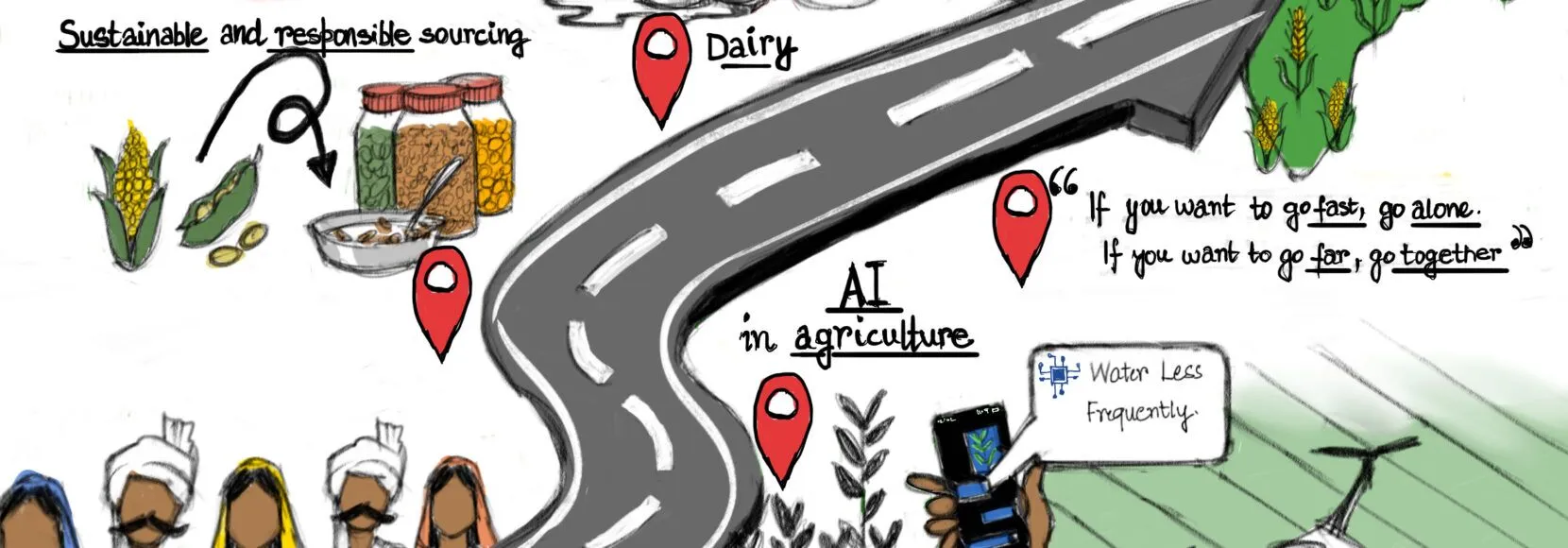
Growing Forward: Decisions That Could Define the Future of Agri-Food Systems
Table of Contents
- Introduction
- Sustainable Sourcing: Why Shared Value Is a Strategic Imperative for Smallholder Farmers
- Technology and AI: Closing the Information Gap for Farmers
- From India to the World: Scaling Dairy Exports
- Innovation in Agri-Food Systems
- What Makes Consortia Work?
- Looking Ahead: The Future of Agri-food Systems
The challenges facing agri-food systems today are deeply interconnected, and so too are the decisions that will determine their future. Learn key insights from a convening on the future of agriculture and food systems.
Designed to move ideas into action, TechnoServe recently organized Growing Forward: Decisions That Could Define the Future of Agri-Food Systems in the Indian capital of New Delhi. This closed-door dialogue brought together leaders from more than 56 organizations spanning government, multilateral institutions, corporates, philanthropy, development finance, entrepreneurship, impact investing, and civil society.
This convening was built around the recognition that challenges facing agri-food systems today are interconnected. Climate resilience, sustainable sourcing, market access, technological innovations, and farmer prosperity can no longer be addressed in silos. Progress depends on bringing together all actors who shape these systems: from farmers to businesses to philanthropists, entrepreneurs, civil society organizations, and policymakers.
In his opening remarks, Krishnan Hariharan, senior practice leader at TechnoServe India, noted that the theme “Growing Forward” reflected the need to think about agriculture through the lens of all the stakeholders in the room. The emphasis on “decisions” instead of “discussions” was a reminder that we can influence outcomes, and that “could” created a path of possibility that will evolve as the world changes.
Before we share some of the key themes, it’s important to understand the context.
India’s agri-food systems sit at the intersection of some of the most critical challenges of our time: food security, climate resilience, livelihoods, economic growth, and sustainability.
Globally, agri-food systems are growing in scale and complexity, with far-reaching implications for people, ecosystems, and businesses. In India alone, agriculture employs nearly 50% of the workforce. It contributes ~17% of GDP, meaning that decisions at every node of these agri-value chains directly shape outcomes for the environment, markets, and all involved players, from farmers to global multinational corporations.
Smallholder farmers absorb escalating climate and market risks while value chains face tighter quality, scale, and sustainability expectations. India is home to 150 million farmers, of whom 86% own less than 2 hectares of land, bearing high stakes with few buffers as weather disrupts crop cycles and corporate mandates such as net-zero create pressure and opportunity.

Sustainable Sourcing: Why Shared Value Is a Strategic Imperative for Smallholder Farmers
The first panel explored whether shared value has become non-negotiable for sustainable sourcing.
Session Takeaways:
- Sustainable sourcing is a resilience strategy. Corporate commitments or reputational considerations are no longer driving sustainable sourcing. Increasingly, it is about value chain resilience, managing climate-related risks, responding to changing regulations, and maintaining competitiveness in a rapidly shifting marketplace.
- Smallholder farmers sit at the center of agricultural value chains while simultaneously bearing many of the risks associated with climate change, production volatility, and market uncertainty. As a result, sustainability initiatives will only succeed if they create tangible value for farmers through demand signals, market access, and embedded revenue models.
- Farmers are increasingly recognized as critical partners in building resilient value chains. Investments in farmer resilience are increasingly being viewed as investments in business resilience.
Technology and AI: Closing the Information Gap for Farmers
The second session of the day explored another critical dimension of resilience: access to information.
As climate volatility, market fluctuations, and sustainability requirements reshape global agri-food systems, the resilience of smallholder farmers has become a critical determinant of value chain stability and long-term food security. Yet for most smallholder farmers, the ability to respond to these pressures depends on something deceptively simple: access to timely, relevant information.
Formal agricultural extension reaches fewer than 10% of India’s farmers, and where it exists, it is rarely frequent or localized enough to influence in-season decisions. That gap between what farmers need to know and what actually reaches them compounds with every cropping cycle.
Advances in artificial intelligence are creating opportunities to address this challenge.
Session Takeaways:
- AI-powered, multilingual, voice-enabled platforms could help democratize access to information by delivering localized guidance at a scale and frequency that conventional systems struggle to achieve. The potential applications span climate adaptation and crop health to market access and financial inclusion.
- Technology alone is not enough. Success depends on whether farmers trust the information they receive and whether solutions are designed around the realities of how they make decisions. Technologies that are not developed with farming communities or supported by strong implementation systems often struggle to achieve sustained adoption.
- AI is not a replacement for existing systems, but a way to strengthen them. Deployed effectively, it can help reduce information asymmetries, improve decision-making, and build resilience for millions of farmers navigating increasingly complex environments.
From India to the World: Scaling Dairy Exports
India’s dairy sector presents one of the most compelling opportunities within the country’s agri-food economy. India is the world’s largest milk producer, accounting for nearly one-quarter of global milk production and supporting the livelihoods of approximately 80 million farmers. Yet, despite this scale, it accounts for less than 1% of global dairy trade, with exports of $493 million (2024–25), against a global dairy product market estimated at $90–110 billion annually.
The discussion highlighted the scale of the opportunity, particularly in value-added products such as whey protein, cheese, and specialty dairy products, particularly in markets across the Middle East and Southeast Asia where a large proportion of dairy demand is imported. Scaling exports could significantly improve the sector’s global position and create new pathways to improve smallholder farmers’ incomes.
Session takeaways:
- Poor feed quality, aflatoxin contamination, and unhygienic handling practices continue to limit access to premium international markets. Addressing these challenges will require not only infrastructure, but also sustained behavior change, stronger quality systems, and continued investment across the value chain.
- India needs differentiated export models: smallholder structure is not the obstacle; it is the system. With the right digital and AI tools, scale efficiencies are achievable. The opportunity is an ecosystem of export models matched to producer scale.
- Productivity and sustainability are mutually reinforcing. Investments in animal health, nutrition, genetics, and farm management can improve milk quality, boost competitiveness and farmer incomes, and reduce emissions simultaneously.
Innovation in Agri-Food Systems
Across India, agri-entrepreneurs are trying to make agriculture more innovative, climate-resilient, and scalable. Yet despite the growth of the startup ecosystem, solutions often operate within fragmented value chains, few enterprises successfully transition from pilot to scale, and access to patient, risk-aligned capital remains limited.
The discussion explored how innovation, capital, policy, and collaboration can be better aligned to build agri-enterprises that are both commercially viable and future-ready. It surfaced practical pathways to accelerate value chain transformation and strengthen market opportunities for farmers.
Session takeaways:
- Farmer-centric models built on trust and direct market access are the most effective path to income stability. Scaling them requires consumer education, predictable ecosystems, and stronger market linkages.
- The most impactful innovations in agri-food systems are often non-tech: consumer-side category creation, capital structure diversification, FPO-led adoption services, and consumer education have driven more transformation than product or technology innovations alone.
- Engaging the next generation of farmers and documenting successful models are essential to ensuring that innovation is sustainable and inclusive over the long term.
What Makes Consortia Work?
The final panel explored a question that underscored the day’s discussions: if agriculture’s challenges are increasingly systemic, what does effective collaboration actually look like?
Session Takeaways:
- Successful consortiums are built on aligned incentives, clear governance structures, and trusted conveners capable of bringing together actors with different priorities and operating models
- Achieving impact at scale requires more than financial resources
- Technical expertise, implementation capacity, institutional credibility, and patient capital all play important roles in enabling long-term change
- Effective consortiums recognize these different forms of value and create mechanisms to deploy them toward shared objectives.
The session closed by challenging the sector to think differently about what success looks like. The ambition must extend beyond counting the number of farmers reached to measuring whether farmers are experiencing meaningful improvements in income, resilience, productivity, and market access.
Looking Ahead: The Future of Agri-food Systems
Convenings alone do not create change, but they can become catalysts for change. They provide opportunities to surface shared priorities, challenge assumptions, build trust, and identify areas where collaboration can accelerate progress. Growing Forward was conceived as a platform for exactly those conversations.


