


Navigating Climate Change: How El Niño Affects India’s Smallholder Farmers
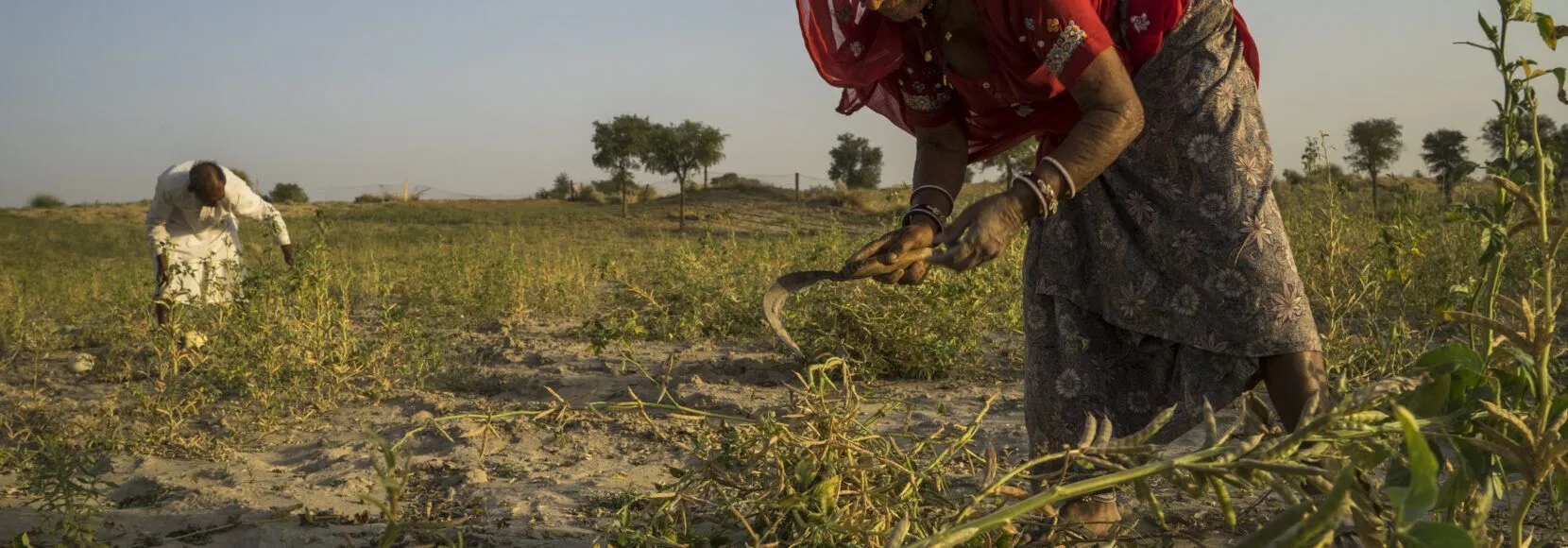
Millions of farmers in India rely on the arrival of the monsoons to grow their crops. But as climate uncertainty becomes the new normal, this vital season is increasingly defined by unpredictability.
Across much of India, the southwest monsoon starts in full swing by mid-June. The first rains are more than just a relief from grueling summers, when temperatures soar above 40°C. For farmers, the onset of the monsoons marks the beginning of the most anticipated agricultural season of the year: “Kharif”.
The High Stakes of India’s Kharif Season for Farmers
This season is high stakes. For a vast majority of smallholder farmers in India, the success of the Kharif cropping cycle determines the bulk of their annual income. The wait for the rains is especially significant because over 60% of India’s net sown agricultural area is rainfed, producing nearly 40% of our food. During this season, millions of farmers across India sow crops such as paddy, maize, soybean, pulses, oilseeds, and cotton.
If the rains don’t arrive on time, everything hangs in the balance. Every few years, El Niño, a climate pattern caused by unusually warm Pacific Ocean waters, reshapes weather patterns across the globe. In India, it often weakens the southwest monsoon, delaying and reducing seasonal rainfall.
This year, June passed by with very little rain, making it the fifth-driest June in India in over a century. In the Indian state of Maharashtra, the month ended with a staggering statewide rainfall deficit of 52%.
When the Rains Fail: The Economic Cost for India’s Smallholder Farmers
For Sangita Shinde, a farmer from Ahilyanagar, Maharashtra, this meant delaying sowing by more than 20 days. She had prepared her two-acre plot weeks in advance and kept her seed ready. But her farm is entirely rainfed, and she had no choice but to wait for sufficient rainfall to ensure successful germination.
While delayed rainfall has already disrupted the start of her season, Sangita is equally worried about what comes next. With fertilizer shortages and input prices continuing to rise, she fears that cultivation costs will increase just as the sowing window narrows.

Sangita isn’t an outlier. She’s one among millions of farmers in India for whom a rainfall deficit is not just a statistic. It can make or break an entire year’s worth of planning and investment, from what to sow and when to sow it, to how much to invest and whether they can afford to resow if the first attempt fails. Every decision carries a cost, narrowing already-thin margins.
More often than not, these decisions are no longer shaped by a single climate event. Farmers are navigating multiple pressures at once. For Sambhaji Shinde, a farmer from Nanded, Maharashtra, delayed rainfall is only one part of the challenge.
“We are facing difficulties accessing fertilizers, and because of the dry conditions, the incidence of pests and diseases has also increased. My turmeric crop turned yellow after sowing because of the extreme heat, and crop production has declined.”
Sambhaji is one of 15,000 soybean farmers participating in a TechnoServe regenerative agriculture initiative funded by ADM. The program provides farmers in the districts of Latur, Dharashiv, Beed, and Nanded with hands-on training, demonstration plots, digital advisory, and stronger links to Farmer Producer Organizations, helping them adopt practical farming practices that improve resilience, productivity, and long-term livelihoods.
While waiting for the rains, Sambhaji installed a drip irrigation system on his farm and switched to a different seed variety to adapt to the delayed monsoon. Through the program, he also learned to substitute traditional crops with fodder crops, which are often more heat- and drought-tolerant.

Rising Costs and Climate Stress: A New Reality for India’s Smallholder Farmers
For farmers like Sambhaji and Sangita, delayed rainfall, rising input costs, and fertilizer shortages are not isolated challenges. They are compounding risks, making an already uncertain season even more difficult to navigate.
This is becoming the reality of farming across much of India.
Heat stress, water scarcity, and erratic rainfall remain the most pressing environmental challenges for the nearly 200,000 smallholder farmers TechnoServe works with in India.
In Maharashtra alone, extreme weather has affected thousands of farmers across soybean, maize, pigeon pea, grape, onion, banana, mango, and cashew value chains. Just last year, uncharacteristic rainfall in late November, followed by this summer’s extreme heat (with temperatures exceeding 42°C compared with the usual 36-37°C), led to staggering crop losses of 80-90% in mangoes and halved cashew yields among affected farmers.
In Rajasthan, one of India’s most climate-vulnerable states, the impacts of extreme summer heat and water scarcity extend well beyond the farm. In arid regions like Bikaner, where we work, many families are forced to purchase drinking water from tanker services at a high cost, while limited water availability and fodder shortages place additional pressure on livestock and rural livelihoods.

A Different Way to Make A Difference.
Discover how TechnoServe bridges the gap between “thinking big” and practical business solutions that help hardworking people move from poverty to prosperity around the world.
From Productivity to Resilience: A New Approach for Agriculture
These stories force us to confront an uncomfortable reality. Climate change is no longer a distant risk for any of us, but adapting to it is particularly complex for the world’s most vulnerable communities.
Across the world, record-breaking temperatures and inclement weather are becoming part of our shared experience. Yet, our ability to respond to these disruptions is deeply unequal, shaped by privilege, geography, and circumstance.
The impact of climate change hits smallholder farmers from every angle. It’s not just an environmental issue but a livelihood, productivity, and business challenge. Yet, they have very limited means to adapt to or mitigate the impact of these events.
This is why the conversation can no longer be centered on productivity alone. The real challenge is resilience that ensures farmers continue to grow food, earn a livelihood, and adapt to unpredictable conditions.
Building resilience requires a more strategic approach, and solutions must be localized. This means:
- Investing in diversified and equitable agricultural value chains that reduce risks for smallholder farmers.
- Channeling different forms of capital within agri-value chains, such as private sector and catalytic investments.
- Wider adoption of regenerative agricultural practices that benefit both people and the planet.
- Improving access to practical, no- or low-cost innovations that help smallholder farmers adapt to climate change through timely and localized guidance.
- More collaborative, consortium-based models that deliver solutions at scale, given the issue’s complexity.
As climate uncertainty becomes the new normal, resilience must become the foundation on which we build the future of agriculture. The world must recognize that many of the most practical and effective solutions come from communities closest to these challenges. The road ahead is ensuring that farmers have the support and resources to put those solutions into practice. Lasting resilience must be built alongside farmers, not ‘for’ them.


