


How to Build a Sustainable Business in the Desert
Find out how Bahula Naturals built a successful climate-resilient business in the 122°F desert, proving that practical tech and a focus on women farmers can keep a traditional community thriving.
The Thar Desert in Rajasthan, India, is often described as a furnace, with temperatures frequently crossing 122°F (50°C). Most people would assume that very little can thrive in such an unforgiving landscape. But for Aakriti Srivastava, founder of Bahula Naturals, the desert became the foundation of an entirely new economic ecosystem — what she calls the “Bahulaverse.”
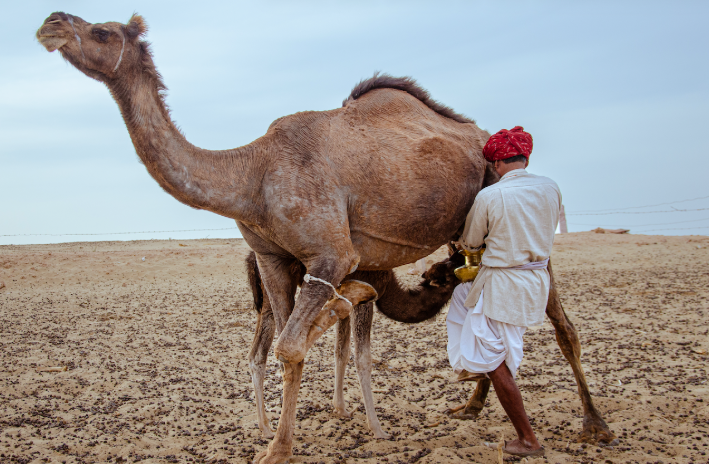
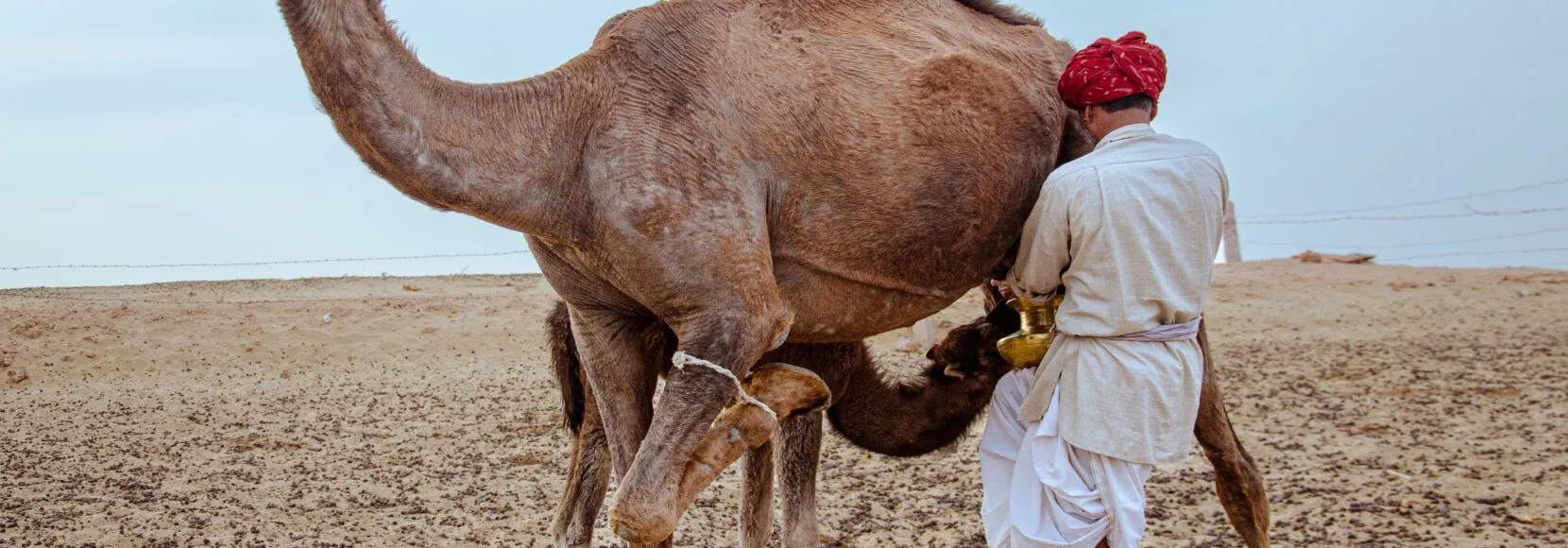
Aakriti began her career as a journalism student searching for stories about agropastoral communities in the desert. A 10-hour train ride and a crowded bus landed her in the remote region of Bajju. There, she encountered communities whose traditional way of life—rearing camels—was disappearing. Isolated from nearby cities and unable to reach mainstream markets, their traditional livelihood was dying out.
Inspired by their resilience, a new idea formed between Aakriti and her partners. They realized that by creating a link to urban markets, the farmers could turn their camel milk into a marketable, high-value superfood. Thus, Bahula Naturals was born.
Launched just three and a half years ago, Bahula Naturals has grown into a team of 20 people working with over 4,000 herders and 1,000 farmers. Today, Bahula Naturals serves over 5,000 customers across India through a portfolio of 18 products, including artisanal cheeses and ghee, while continuing to double its revenue year over year. Most importantly, the once-disappearing agropastoral communities now have a way to earn a stable income through their ancient tradition of camel raising and herding.
Hear Aakriti’s full story in her interview with TechnoServe.
What was once a struggling traditional practice is now a thriving, tech-enabled enterprise. But what did it take to build a business in the desert? Below are five lessons that made Aakriti’s vision come to life.
1. Create the Missing Links
Bahula Naturals was successful because it identified a key disconnect between agropastoral producers and urban markets. The challenge existed on both sides of the value chain: desert communities were producing incredible milk but had no way to sell it, while city consumers were being flooded with “greenwashed” marketing for imported brands. The key issue was delivery. There was no way to transport highly perishable camel milk from mobile desert herders to urban consumers.
Aakriti created a missing link. By equipping mobile herders with temperature-regulating cans and solar-powered chillers, Bahula Naturals safely moved fresh, high-value artisanal dairy from the desert to the city in just 48 hours. Filling these structural links provides economic opportunities to people who would otherwise be entirely excluded from the value chain.
2. Practice Local Sustainability
When people think of sustainability, they often picture planting forests or reducing plastic packaging. But in a place as extreme as the Thar Desert, sustainability is a matter of survival, and it requires looking closely at what the local ecosystem naturally supports.
Aakriti pointed out that “it cannot be possible to learn how to handle [a climate crisis]… from a region that has already been exploited with lots of chemicals. We need to learn from drylands, arid regions… spaces that have learned how to be resilient, learned how to grow with less, learned how to continue to feed people with less.”
True sustainability means working with the land rather than fighting against it. Instead of introducing resource-heavy farming methods, Bahula Naturals leaned into what was already thriving there: camels. Camels are naturally climate-resilient, require very little water, and cause minimal disruption to the delicate desert soil. By focusing on a native animal and powering their entire operations with renewable solar energy, Bahula Naturals proved that green businesses succeed by honoring and protecting the natural balance of the environment they call home.
3. Co-Design the Business with the Local Community
Aakriti discovered that it was impossible to build a sustainable business from afar; solutions had to make sense to the community in which they operated. So, Bahula Naturals designed its systems alongside the people who ultimately use them.
“Our producers move around the year, and so our systems have to evolve, our tech has to evolve accordingly,” Aakriti noted. “Designing something for a mobile value chain through tech, through traditional wisdom, and through the right market insights… is how essentially we bridge these two worlds.”
By co-designing the business with the local community, Bahula Naturals ensured that the people had real ownership. When early experiments faced setbacks and operational losses, local community members stepped in with their own time and financial resources to help put the machinery in place. Today, their collection centers are independently run by local micro-entrepreneurs, allowing the community to take ownership of the enterprise.
4. Innovate
Existing dairy equipment in India was built entirely for cows and buffaloes, meaning Bahula Naturals had to completely rewrite the rules of dairy engineering.
“None of [the infrastructure] existed,” Aakriti said. “And it has taken us years now to create a decentralized milk collection and milk transportation cold chain… All of it has been designed very specifically for this region.”
Innovation meant thinking completely outside the box, working directly with tech companies to invent specialized machinery tailored to non-bovine milk, deploying solar-powered instant milk chillers that can run entirely off-grid, and even using local camel wool to create insulated covers for transport cans.
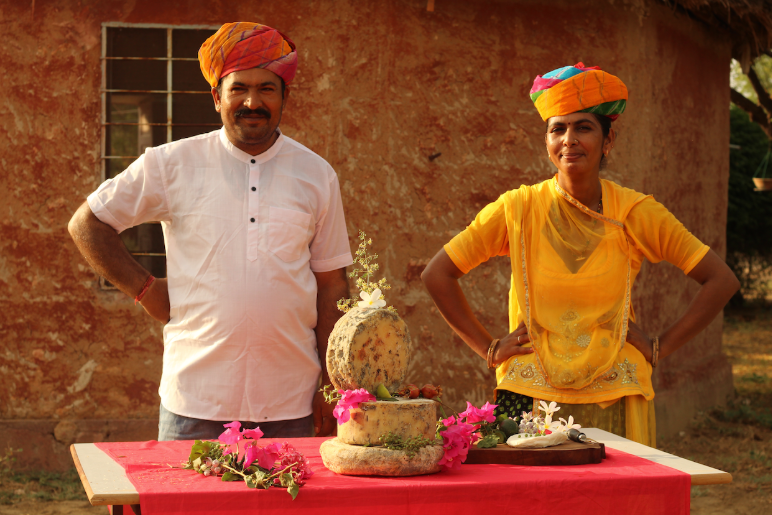
It also meant innovating in the kitchen, resulting in high-value products such as artisanal camel milk feta and halloumi. By pairing creative engineering with creative recipes, Bahula Naturals proved that new ideas can come from a harsh environment.
5. Advance Opportunities for Women
From the beginning, Bahula Naturals has prioritized women as a vital part of their operations.
“We realized that the vast amount of work that goes into a farm is mostly done by women, but all the income is directly channeled toward the men, which leaves very little agency with the women,” Aakriti explained. “So one rule set in stone for Bahula Naturals is that we only engage with women farmers… and the payment goes exclusively into the women farmers’ bank accounts.”
This intentional choice directly benefited their operations. By putting money into the hands of the primary workforce, Bahula Naturals built a deeply committed network of partners. And when women began reinvesting their earnings to buy more animals, the business secured a growing, reliable milk supply, enabling it to scale its production.
Creating economic opportunities for women also created a ripple effect within the community. From the moment the first payments landed directly in women’s bank accounts, families started investing in girls’ education, household lifestyles improved, and women began making their own entrepreneurial decisions. The effect was obvious; the entire community benefited when women were economically empowered.
Bonus Tip: Partner with a Business Accelerator
Bahula Naturals’ growth from a local startup to a pan-India brand was accelerated by its partnership with TechnoServe’s Greenr program, an initiative designed to unlock the potential of green small and growing businesses in India. It provides tailored business advice and mentoring to help high-growth businesses successfully scale up, create jobs, and achieve greater environmental impact.
Before joining, Aakriti’s team was heavily focused on their day-to-day operations, pouring energy into the backend of building a brand-new supply chain from scratch. While this was necessary to establish the business, it left little room for long-term planning. Working with TechnoServe provided a critical “bird’s eye view” that enabled a strategic look at the full scope of their business and to align their products with modern markets and new distribution channels.
Today, the TechnoServe team serves as a natural extension of Bahula Naturals, working hand in hand with Aakriti’s staff to refine their business strategy, identify new industry aggregators, and troubleshoot roadblocks.
“The [TechnoServe] team has almost become like an integral part of the Bahula team now,” Aakriti shared. “TechnoServe team members are working very closely with us. They, at times, represent Bahula Naturals where we cannot be present, and my TechnoServe program is always a call or a text away.”
The Story Behind our Plates
Aakriti’s approach to business shows that the most effective solutions to poverty don’t need to be imported from the outside. They are already waiting within local environments and can be unlocked through innovation, community ownership, and a commitment to equitable opportunities.
For Aakriti, the sprawling network of solar panels, custom machinery, and desert supply chains ultimately boils down to how we think about the everyday food we buy.
“At the end of the day,” she said, “it’s all about that single packet of food sitting inside your refrigerator. The next time you pick something up to make a meal, I hope you take a second to think about the people who produced it, the environment it came from, and how much a single choice can matter.”
For TechnoServe, supporting businesses like Bahula Naturals is a way to give local producers the strategic backing and market connections to make their hard work go further. When farming communities receive the right resources, it becomes a lasting pathway for hundreds of families to build a better future on their own terms.

A Different Way to Make A Difference.
Discover how TechnoServe bridges the gap between “thinking big” and practical business solutions that help hardworking people move from poverty to prosperity around the world.


