


Project Years: 2010-2015
The Haiti Hope Project
The Haiti Hope Project was a five-year public-private partnership among businesses designed to create sustainable economic opportunities for Haitian mango farmers and their families.
The Opportunity
Haiti’s distinctive Francique, or “Francis,” mango is popular locally and commands a premium in the United States. Yet farmers struggled to capture the full value of that demand. Production was scattered—often across only three to five trees per garden—and low prices discouraged farmers from planting more trees. Inconsistent supply chains also made it harder for farmers to reach reliable buyers.
The Haiti Hope Project brought together businesses, development institutions, the U.S. government, and nonprofit organizations to create sustainable economic opportunities for 25,000 Haitian mango farmers and their families. The partnership aimed to increase farmers’ mango income by improving production and quality, strengthening farmers’ access to finance and markets, and building stronger relationships across the industry.
The Strategy
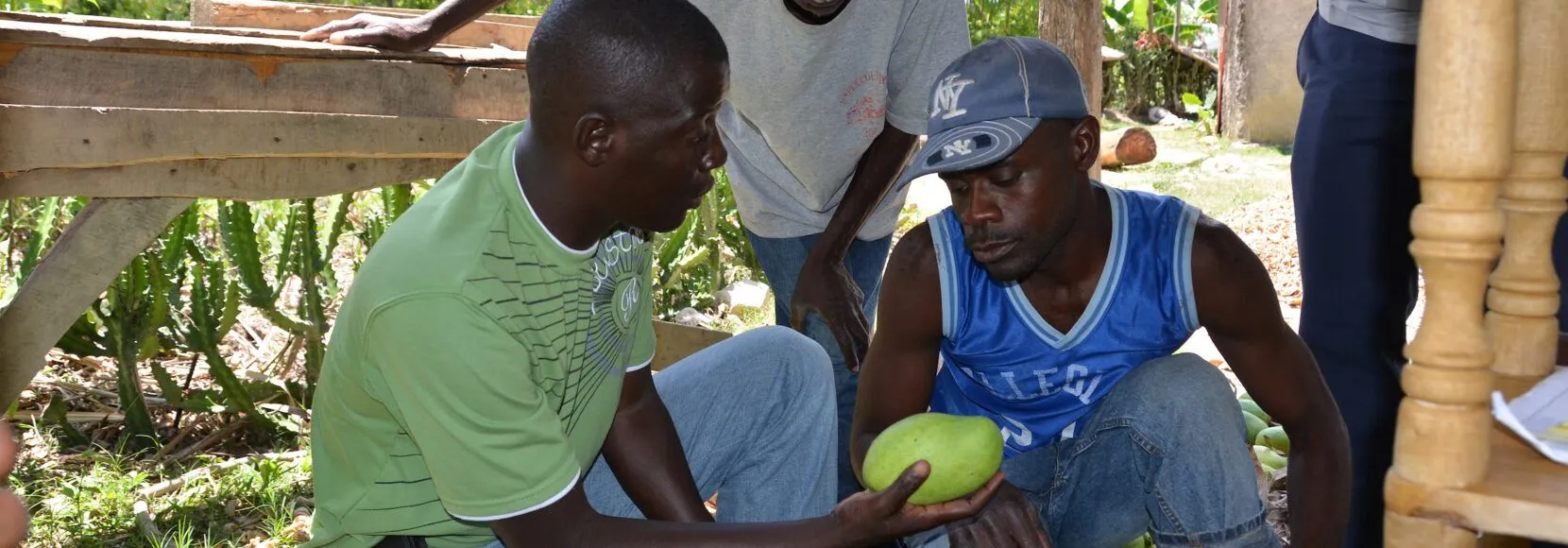
TechnoServe worked with farmers, producer groups, exporters, the Haitian government, and financial and market partners. Farmers received practical training in mango-tree production and care, harvesting, quality control, sales and negotiation, credit and financial management, traceability, and food safety.
The project also helped farmers organize producer business groups. These farmer-led groups aggregated mangoes and connected members more directly with buyers. TechnoServe supported group leaders with the skills needed to manage sales and business operations, while helping exporters and other market actors build relationships with farmers.
To strengthen long-term production, the project supported grafting and the establishment of micro-orchards. It also worked with the local commercial bank Sogesol to expand agricultural lending. The project tracked women’s participation across its services and promoted women’s leadership within producer groups. Fair Trade and organic certification connected participating farmers to higher-value sales through Whole Foods.
Results
- 25,125 farmers received training in production, quality, and marketing.
- Farmers completed 65,641 grafts and established 524 micro-orchards containing 63,214 mango trees to support future production.
- More than 262 producer business groups sold 2,523 metric tons of mangoes from 2013 onward; in 2015, these groups accounted for more than 10% of Haiti’s annual mango exports.
- 6,472 farmers sold more directly to buyers, including 2,205 farmers who sold Fair Trade and Organic mangoes to Whole Foods. Project-assisted export sales totaled $7.49 million in value from 2011 onward.
- In 2015, 94% of producer groups earned a profit while paying members prices above the industry norm.
- Fair Trade and organic sales increased 315%, rising from 148 metric tons a year in 2010 to 614 metric tons in 2015.
Women participated across project training and activities, including areas traditionally dominated by men, and adopted skills at similar rates. Women also held more than 30% of producer-group leadership positions.
Partners
The Haiti Hope Project was a partnership of The Coca-Cola Company;
the Multilateral Investment Fund, a member of the Inter-American Development Bank Group; and the U.S. Agency for International Development.