


TechnoServe’s 2026 Reading List
Table of Contents
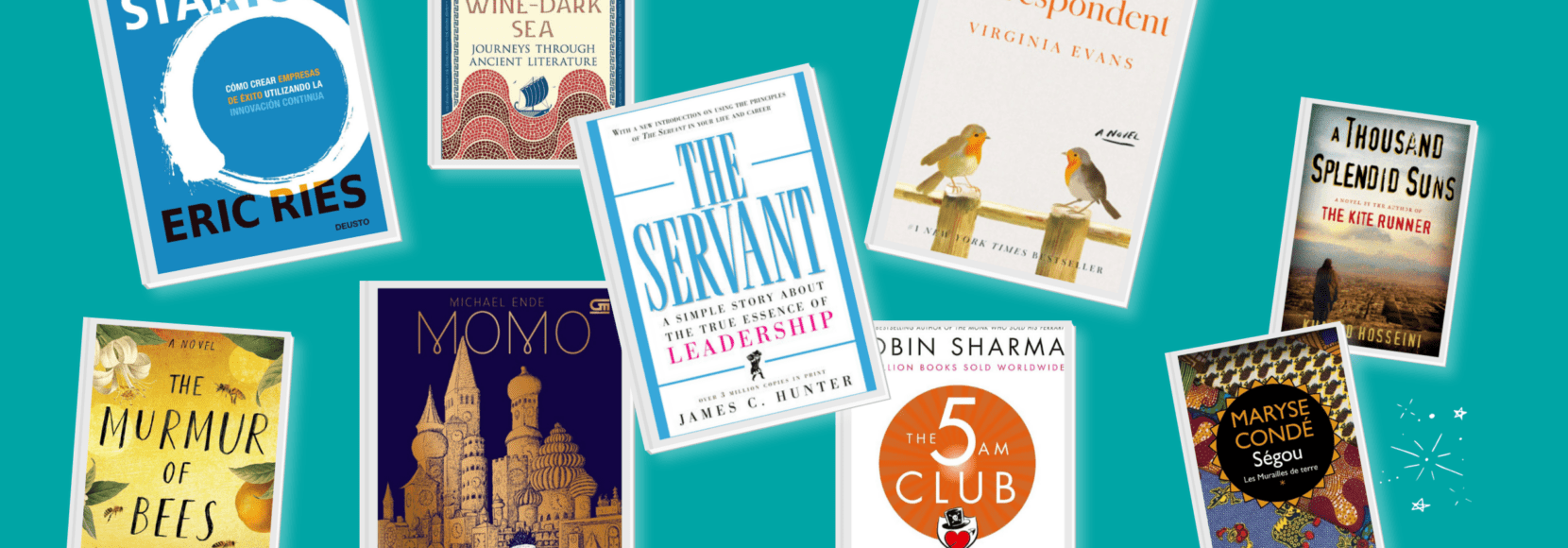
Our 2026 reading list features a variety of fiction and nonfiction options to keep you entertained during your next trip or staycation.
Whether you are looking to disconnect on a long flight, find inspiration during your daily commute, or simply enjoy a quiet weekend at home, nothing beats the power of a great book. We asked our colleagues across the globe to share reviews of books that have captured their imaginations and sparked new perspectives this year.
The result is a thoughtful, eclectic collection, ranging from compelling fiction that transports you to new places to insightful nonfiction that challenges how we view the world and our own work. We hope these recommendations provide you with the perfect new read to add to your shelf.
Fiction Recommendations

“A Thousand Splendid Suns” by Khaled Hosseini
Recommended by Wangari T., Senior Program Manager, Kenya
I recommend reading “A Thousand Splendid Suns” because it is a powerful reminder of the resilience, dignity, and strength of people facing immense adversity. While the novel is set in Afghanistan, its themes of inequality, gender, poverty, conflict, and hope resonate across communities (women and girls) around the world.
I read an article that claimed that reading fiction increases empathy and compassion by strengthening our ability to understand other people’s perspectives. “A Thousand Splendid Suns” is one of those rare books that truly does that. It doesn’t just tell a story—it immerses you in the life of a young girl, Mariam, allowing you to experience a world that may be vastly different from your own. By the end, you don’t just understand the characters; you feel deeply connected to them. The book, in particular, broke my heart a couple of times and left me with a few tears.

“Momo” by Michael Ende
Recommended by Andrea B., Global Entrepreneurship Senior Manager, Chile
“Momo” is a classic children’s book. If you feel like time slips away and you don’t have time for the things that matter, I strongly recommend it. Written in 1973, “Momo” is, to me, a poetic and deep critique of modern life and a book that has changed the way I understand what it means to live in the present moment.

“What We Talk About When We Talk About Love” by Raymond Carver
Recommended by Gabe P., Senior Director of Major Gifts, USA
It’s just a great book, full of wonderful short stories.

“Segou” by Maryse Condé
Recommended by Mouna M., Country Director, Benin
First, there are not many works of African historical fiction. This masterpiece takes you back to pre-colonial Africa and offers a bare fictional recount of the rise and fall of Western Africa’s greatest empire in the face of a changing world fuelled by slavery and religious and political conquests. The novel completely dismantles the idea that there was “nothing going on” in Africa prior to European arrival.
Instead, it paints a vivid, complex portrait of the 18th-century Bambara Empire (in modern-day Mali) and its rich indigenous culture. Rather than painting a flawless picture of the Bambara Empire, Condé portrays a deeply human society with internal rivalries, tribal conflicts, and the brutality of both local and transatlantic slavery.

“The Correspondent” by Virginia Evans
Recommended by Kris A., Country Director, Kenya, Tanzania, Uganda
No connection to the TechnoServe mission, other than the importance of connection and the power of the written word. We live in an age of constant contact and instant communication: email, text, WhatsApp, and we forget the power of time and the written (not typed) word. The book unfolds only through correspondence. I found it breathtaking, tear-inducing, and a testament to the humanity that exists beyond heartbreak and tragedy.
“The Murmur of Bees” by Sofía Segovia
Recommended by Rachel F., Program Development Manager, México
Available in both English and Spanish, it blends historical fiction with a touch of magical realism, like that of Gabriel García Márquez and Isabel Allende. A farming family faces the challenges of the Mexican Revolution and the Spanish Flu. It was called the literary discovery of the year by Penguin Random House.
“It doesn’t matter whether time passes slowly or quickly. What you can be sure of is that, in the end, all you want is to have more.”

“Short Stories” by Antón Chéjov
Recommended by Diana F., Communications Specialist, México
Anton Chekhov’s Short Stories is a collection of the author’s works, written in clear, accessible prose. Through an understated yet deeply insightful and often ironic style, Chekhov explores human emotions and reveals the profound meaning hidden within life’s simplest moments.
Although these are works of fiction, the way Chekhov observes, narrates, and portrays everyday life offers valuable inspiration for crafting compelling stories that authentically capture the experiences and emotions of the people whose lives are transformed by TechnoServe’s initiatives. His storytelling demonstrates how ordinary moments can reveal extraordinary resilience, hope, and human dignity—an approach that can strengthen narratives about beneficiaries and the impact of development programs.
Nonfiction Recommendations

“Crossing the Wine-Dark Sea: Journeys Through Ancient Literature” by Emily Wilson
Recommended by Ron O., Senior Director, Internal Audit, USA
You may have heard by now that a new film adaptation of the ancient Greek epic “The Odyssey” was just released in cinemas worldwide. The film’s director, Christopher Nolan, mentioned in recent interviews that he based his screenplay on the 2017 translation by Emily Wilson, a British professor of classical literature who teaches at the University of Pennsylvania in the U.S.
A woman involved in translating a story about an ancient Greek warrior-king!? Kick off the inevitable social media firestorm!! Professor Wilson’s latest book, published this year, is an engrossing, sharp-witted—almost pugilistic—explanation of her approach to translating the ancient Greek text into English. Who would have imagined that so much artful effort went into choosing the word “complicated” to describe the hero Odysseus in the very first—and famous— line of this 3,000-year-old story?

“The 5 am Club” by Robin Sharma
Recommended by Vilma R., Business Advisor, El Salvador
This is a personal development book that proposes a morning routine based on waking up early to boost productivity, improve health, and enhance creativity. It is presented through a story that makes it incredibly interesting and engaging.
What resonates with me is the 20/20/20 rule: Dedicate your first waking hour to three 20-minute blocks:
- Move (intense exercise to break a sweat, lower cortisol, and release dopamine).
- Reflect (prayer or journaling) and
- Grow (reading, listening to audiobooks, or reviewing goals).
It is holistic growth that requires working on your mindset, emotional state, physical state, and spiritual state. Highly recommended.

“El Monje que Vendió su Ferrari” by Robin Sharma
Recommended by Dinora C., Senior Coordinator, El Salvador
The book discusses the importance of nurturing and growing from within, of being selective in managing our thoughts, since the quality of our thoughts determines the quality of our lives. Nurturing our inner selves allows us to grow so that we can reach out to, support, and care for others, as well as achieve the success we desire as individuals.

“El Método Lean Startup” by Eric Ries
Recommended by Luis A., Monitoring and Evaluation Specialist, Guatemala
This book is essential for project managers in technology or innovation. It teaches the “build, measure, learn” cycle and how to manage projects under extreme uncertainty using minimum viable products. It is also used within the TechnoServe human-centered design methodology.

“How to Make Sh*t Happen” by Sean Whalean
Recommended by Ayodele T., Portfolio Lead, Nigeria
In a hectic, chaotic world of distractions, having a framework to cut through the noise is critical. Sean Whalen emphasizes taking charge of one’s morning, especially by delaying entry into the online chaos. Setting mental coordinates, realizing that movement isn’t necessarily momentum. Sean highlights ruthless prioritization as an act of protection and not pompousness. Understanding that progress may not be meaningful if it’s misaligned with purpose.
It’s a great book for people looking for simple hacks to cut through all the noise and stay focused on meaningful business, both at home and outside.

“The Servant” by James C. Hunter
Recommended by Hiwet H., Administrative Manager, Ethiopia
I recommend “The Servant” because it presents servant leadership as a practical, character-based approach that builds trust, motivates teams, and produces sustainable results in organizations. What makes the book special is that James C. Hunter emphasizes concrete behaviors such as listening, coaching, and modeling respect rather than abstract theory, so readers can easily translate the ideas into daily actions.
For example, it encourages leaders to shift meetings from instruction to problem-solving, ask how they can remove obstacles for staff, farmers, and stakeholders, and hold people accountable with respect. This approach is thought-provoking because it challenges the idea that leadership is mainly about authority or control. It also connects well to development work, since servant leadership centers on the growth and empowerment of others—employees, partners, and small-business clients—so people and communities can become more self-reliant.

“The Wizard and the Prophet” by Charles C. Mann
Recommended by Dustin H., Coffee Program Analyst, USA
The book compares two worldviews and approaches to the growing global population and poverty. Will we be saved by technology, or will the world’s resources require us to cut back?
“When I last spoke to Borlaug, a few years before he passed away, I asked him about the past criticisms. Critics, he said, never wanted to answer the counterfactual question: Where would the world be today if we had the same growth in population and affluence but none of the yield increases of the Green Revolution? Overuse of fertilizer, waterlogging soils, loading up land with toxic salts from badly run irrigation schemes—these were real issues, he said. But wouldn’t you rather have these problems than the kind of hunger we had in 1968?
“He asked me if I had ever been to a place where most of the people weren’t getting enough to eat. ‘Not just poor, but actually hungry all the time,’ he said. I told him that I hadn’t been to such a place. ‘That’s the point,’ he said. ‘When I was getting started, you couldn’t avoid them.’”

