


Rescuing Nutrients, Rebuilding Markets: How NutriSave is Addressing Kenya’s Food System Paradox
Kenya produces large volumes of nutritious produce, but much of it is lost before it can reach families. Learn how NutriSave is working to address this challenge.
By Carolyne Maina (TechnoServe) and Charlotte Bailey (Foreign, Commonwealth & Development Office)
Human health, agricultural sustainability, and climate resilience are deeply linked. Today, global food systems are failing on all three fronts. Gaps in the production, preservation, and distribution of safe, affordable, and nutrient-dense foods have triggered a compounding crisis: widespread malnutrition, significant economic inefficiencies, and severe environmental degradation.
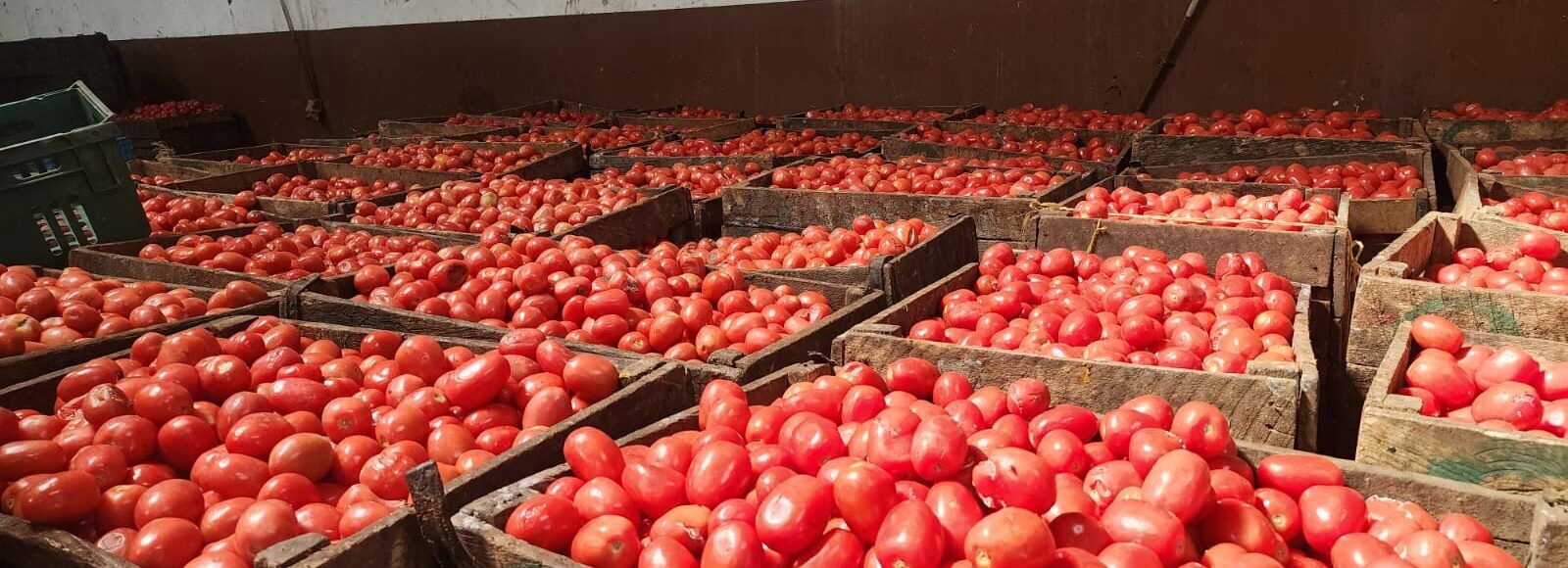
In the global development sector, we often speak of “food system challenges” in abstract, macroeconomic terms. But in Kenya, this challenge manifests every single morning as a stark, lived paradox. At major fresh produce hubs like Marikiti market in Nairobi or upstream in Kirinyaga’s Makutano market, thousands of informal market traders systematically sort through mountains of fruits and vegetables, discarding tons of safe, nutrient-dense produce purely due to cosmetic blemishes, minor handling bruises, or seasonal oversupply.
Simultaneously, public health data reveals a quiet, chronic crisis: 98% of the Kenyan population fails to consume the World Health Organization’s (WHO) recommended 400 grams of fruits and vegetables per day. The average Kenyan consumes a mere 140 grams daily. This significant nutritional deficit is also occurring in the context of rising consumption of unhealthy foods in Kenya, and a rapid rise in diet-related Non-Communicable Diseases (NCDs).
To break this cycle, TechnoServe—with funding from UK International Development and the Gates Foundation—is helping transform agricultural value chains toward healthier, more sustainable outcomes. Through the NutriSave program, we seek to better understand the loss drivers and demand enablers, empower and incentivize food system actors to build, test, and pilot innovations that increase the accessibility of nutritious fruit and vegetables while actively reducing food loss and waste.
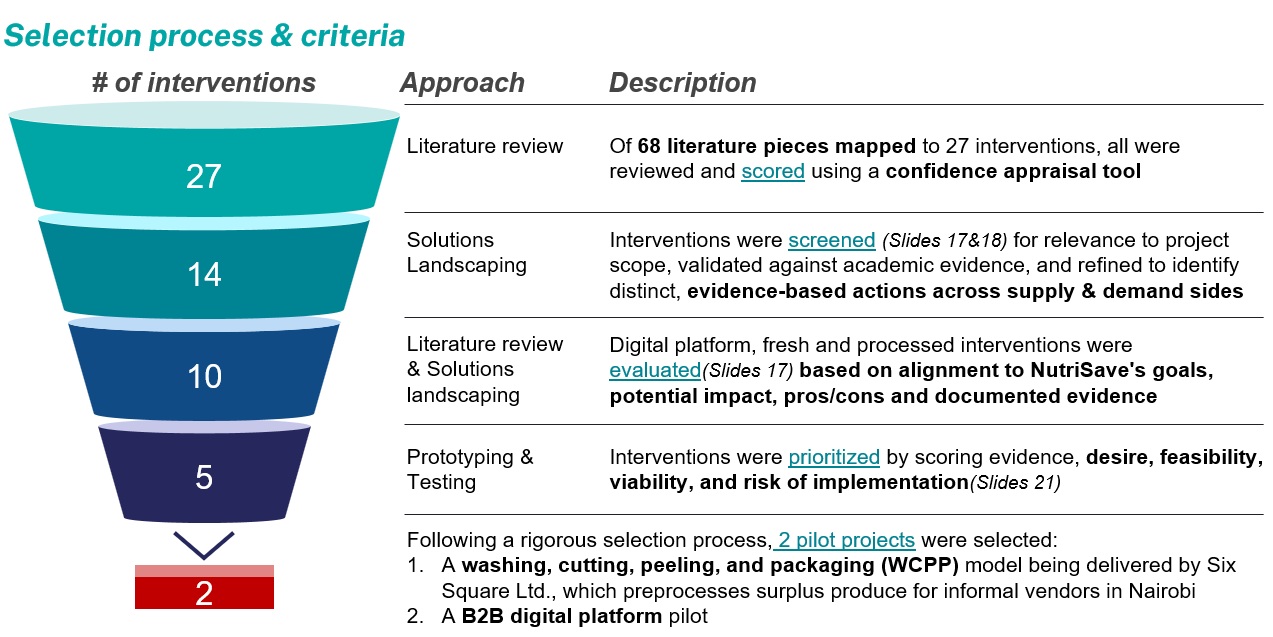
The exploratory phase shows the rigorous evidence-gathering and selection methodology used to filter down the program’s focus. At each stage, we gathered insights and made go and no-go decisions in stage gate meetings ensuring the clear north star on the equal dual objectives.
Selection Process & Criteria
Following a systematic method to select and prioritize pilot interventions, the team filtered choices through a multi-stage funnel:
- 27 Interventions (Literature Review): Of 68 literature pieces mapped to 27 interventions, all were reviewed and scored using a confidence appraisal tool.
- 14 Interventions (Solutions Landscaping): Interventions were screened for relevance to project scope, validated against academic evidence, and refined to identify distinct, evidence-based actions across supply & demand sides.
- 10 Interventions (Literature Review & Solutions Landscaping): Digital platform, fresh, and processed interventions were evaluated based on alignment to NutriSave’s goals, potential impact, pros/cons, and documented evidence.
- 5 Interventions (Prototyping & Testing): Interventions were prioritized by scoring evidence, desire, feasibility, viability, and risk of implementation.
- 2 Selected Pilot Projects: 1. A washing, cutting, peeling, and packaging (WCPP) model being delivered by Six Square Ltd., which preprocesses surplus produce for informal vendors in Nairobi. 2. A B2B digital platform pilot.
Key Evidence & Insights from the Discovery Phase
The evidence collected across the exploratory phases provided critical data that challenged baseline assumptions and reshaped the project’s strategy.
Value Chain Post-Harvest Losses (PHL) & Hotspots
- The analysis found that systemic waste accounts for 32% to 35% of annual yields across priority crops.
- Just as critically, though, it identified where this waste typically occurs—and it came as a surprise to us. Sourcing assessments revealed that waste at centralized packhouses is minimal; instead, the vast majority of cosmetic rejections occur upstream directly at the farm gate or downstream at destination markets.
- For example, tracking of tomatoes from farm to market showed that losses occur across multiple selection points: at the farm, at upstream open-air markets where imperfect tomatoes are left behind, and at downstream urban markets in Nairobi like Muthurwa, where ripened tomatoes compete with fresher arrivals and spoil within five days.
Consumer Behaviour & Preferences
- The Loss of Nutritional Integrity in Processed Foods: Laboratory analysis showed that processed foods currently sold in low-income markets have little to no actual fruit or vegetable content. Tested commercial mango juices contained 0–10% pulp, commercial tomato pastes contained 0–24% tomato content (often substituted with starch and artificial dyes), and African leafy vegetable-based processed products were entirely non-existent.
- Overwhelming Preference for Fresh Foods: An overwhelming 83% of low-income consumers strictly prioritize fresh produce over processed alternatives due to culinary traditions and deep-seated stigmas against non-fresh products. This matters because it rules out a category of solutions that development programs often reach for too quickly: processed, packaged, fortified products marketed as healthier alternatives. In Kenya’s low-income markets, these face an adoption ceiling that consumer preference research now makes quantifiable.
- Willingness to Purchase “Ugly” Food: On the other hand, low-income consumers are highly willing to buy cosmetically imperfect or near-spoiled produce if it is priced lower. This willingness is most acute in rural, food-scarce areas (e.g., Garissa displayed 56% willingness) compared to urban areas (e.g., Kiambu at 34%) where fresh variety is highly accessible.
Market and Operational Realities
- Extreme Price Volatility: Drastic seasonal price drops occur during glut periods (e.g., fresh tomatoes drop from KES 100/kg ($0.77 USD/kg) to KES 20/kg ($0.15 USD/kg)), crashing farmer income, while off-season scarcities completely block access for low-income consumers due to high prices.
- Local Processing Viability: Kenya produces an estimated 683,000 to 1,000,000 metric tonnes (MT) of tomatoes annually, yet the country imported an average of 3,050 MT of tomato paste in 2022, worth $2.6 million. This import dependence exists alongside a domestic loss rate of one-third of production.
- Local production of tomato paste is approximately 13% more cost-effective than importing, with local surplus tomatoes sourced at KES 13–14 ($0.10–$0.11 USD) per kilogram yielding a KES 188/kg ($1.45 USD/kg) production cost compared to KES 217/kg ($1.68 USD/kg) for imported paste.
- The Capital Challenge: The barrier is not economics—it is capital equipment. Nearly all industrial condensers in Kenya have been directed toward fruit jams and marmalades, which historically carry higher profit margins, leaving tomato paste production under-capitalised despite the emerging business case.
What It Takes for Solutions to Actually Scale
- The exploratory phase also generated sector-level evidence on why existing food loss and waste interventions in Kenya succeed or fail.
- Research published in Frontiers in Horticulture (Owino et al., 2024), based on key informant interviews across twelve solution providers, identified the most consistent challenges faced by partially successful actors: insufficient technical knowledge in food processing, limited financial capacity for both operations and scaling, inconsistent raw material supply due to seasonality, and slow market penetration driven by consumer preference for fresh produce.
- Successful solution providers, by contrast, shared a common set of strategies: they undertook comprehensive technical and commercial feasibility assessments before scaling; they partnered with universities, governments, and NGOs for research and initial financing; they adopted product differentiation to capture diverse market segments; and they established stable off-take contracts with farmers to counter supply inconsistency.
Looking Ahead: From Evidence to Action
Launched in July 2025, NutriSave’s two market-facing pilots—testing minimally processed supply chains for vibandas (informal eateries) and business to business (B2B) digital sourcing platforms—are actively translating our foundational evidence base into live interventions, with comprehensive findings scheduled for joint evaluation and publication alongside EDI Global by late 2026.
To establish systemic and commercial viability, the program is testing several practical questions:
- Can it reduce the cost of rescuing and distributing produce from KES 18/kg ($0.14 USD/kg) to a target of KES 3/kg ($0.02 USD/kg)?
- Can it encourage consumers to buy more nutrient-rich foods, instead of relying mainly on calorie-dense staples?
- Can it bridge the gap between supplier prices and what low-income retailers can afford?
- Can value chain actors easily adopt the digital platform? And can it persuade traders to shift from long-standing, relationship-based informal networks to a digital marketplace?
In parallel, NutriSave is working with Jomo Kenyatta University of Agriculture and Technology, Busara, Social Side, Cornell University, and IFPRI to disseminate the exploratory phase evidence through peer-reviewed journals, open-source playbooks, and learning briefs designed for practitioners and policymakers. The full suite of value chain analyses, ecosystem maps, and consumer demand studies is already publicly available at the NutriSave page.
As the NutriSave journey has demonstrated, strengthening infrastructure, aligning incentives, and improving access to reliable market data will play a critical role in ensuring that Kenya’s fruit and vegetable production more effectively reaches those who need it most.