

Annual Report 2025
Rooted and Rising
Annual Report 2025

Who we are
We believe that everyone deserves the opportunity to build a better life.
Our Mission: To fight poverty by helping people build regenerative farms, businesses, and markets that increase incomes.
2025 Impact Numbers

$489M
Financial benefits
Increased revenue for people and businesses benefiting from TechnoServe’s work.

1.2M
Beneficiaries
TechnoServe clients who grew their revenue in the past year, as well as others for whom we have data indicating revenue growth.

44%
Women
Represents the percentage of people and enterprises we supported that were women or women-owned businesses.

$5.70
Return on Investment
Average revenue increase for TechnoServe clients for every $1 invested in TechnoServe programs. TechnoServe programs consistently deliver positive ROI which varies across programs, sometimes significantly based on sector and type of intervention.

102,000
Better Jobs
Jobs created, strengthened, or filled through TechnoServe’s work, including entrepreneurs starting businesses with our support, jobs from business expansion, and low-income individuals gaining skills to secure employment.
279,000 tons
CO2e Emissions Mitigated
Estimated greenhouse gas emissions avoided, reduced, or sequestered by projects promoting regenerative practices. Thirty-eight percent of projects reported on this impact measure. All applicable projects will report by 2026.
239,000 ha
Land Under Regenerative Management
Farmland or natural areas where clients applied regenerative practices, improving land and water protection, management, or restoration. Thirty percent of projects reported on this impact measure. All applicable projects will report by 2026.
3.1 million lives improved
People whose lives improved directly through TechnoServe’s work and those who benefited indirectly, such as our clients’ family members and individuals whose jobs were created or strengthened by our services.
Slide to See the Change You Can Make
Impact by Sector

Impact by Sector
| SECTOR |  FINANCIAL BENEFITS FINANCIAL BENEFITS | BENEFICIARIES | PERCENT WOMEN |  BETTER JOBS BETTER JOBS | EMISSIONS MITIGATED TONS OF CO2e |
|---|---|---|---|---|---|
| AGRI-FOOD SYSTEMS | $122,634,000 | 638,000 | 42% | 16,620 | 13,880 |
| COFFEE | $128,648,000 | 168,800 | 36% | 0 | 8,490 |
| ENTERPRISE DEVELOPMENT | $224,890,000 | 272,800 | 84% | 80,910 | 256,680 |
| OTHER | $12,343,000 | 73,000 | 33% | 4,100 | 0 |
| TOTAL | $488,515,000 | 1,152,600 | 44% | 101,630 | 279,050 |
Impact by Country and Region
Countries highlighted in yellow represent where TechnoServe worked in 2025. Scroll down to explore impact data by region.


Impact by Country and Region
Countries highlighted in yellow represent where TechnoServe worked in 2025. Scroll down to explore impact data by region.
Latin America & the Caribbean
 Country Country | Financial Benefits | Beneficiaries | Percent Women |
|---|---|---|---|
| Brazil | $1,313,000 | 400 | 56% |
| Chile | $23,014,000 | 2,600 | 65% |
| Colombia | $25,851,000 | 400 | 52% |
| Costa Rica | $880,000 | 42 | 67% |
| Ecuador | $11,090,000 | 4,500 | 35% |
| El Salvador | $17,413,000 | 4,700 | 35% |
| Guatemala | $28,676,000 | 18,400 | 37% |
| Honduras | $39,142,000 | 24,100 | 32% |
| Mexico | $6,642,000 | 5,000 | 14% |
| Nicaragua | $10,249,000 | 9,400 | 34% |
| Panama | $193,000 | 40 | 68% |
| Peru | $44,190,000 | 18,300 | 34% |
| Puerto Rico (U.S.) | $6,793,000 | 1,000 | 18% |
| Grand Total | $215,500,000 | 88,882 | 42% |
Africa
 Country Country | Financial Benefits | Beneficiaries | Percent Women |
|---|---|---|---|
| Benin | $60,193,000 | 113,500 | 39% |
| Botswana | $7,861,000 | 200 | 54% |
| Côte d’Ivoire | $23,590,000 | 51,700 | 56% |
| Democratic Republic of Congo | $5,315,000 | 12,400 | 50% |
| Egypt | — | 7,100 | — |
| Ethiopia | $23,548,000 | 104,700 | 35% |
| Ghana | $431,000 | 2 | 50% |
| Kenya | $12,244,000 | 25,500 | 64% |
| Malawi | — | 1,800 | 64% |
| Mozambique | $27,706,000 | 393,700 | 81% |
| Nigeria | $6,560,000 | 26,400 | 78% |
| Rwanda | $6,619,000 | 22,500 | 19% |
| South Africa | $36,813,000 | 800 | 54% |
| Tanzania | $8,887,000 | 12,400 | 47% |
| Uganda | $15,188,000 | 50,900 | 41% |
| Zambia | $5,398,000 | 48,500 | 48% |
| Zimbabwe | $1,414,000 | 4,700 | 49% |
| Grand Total | $241,767,000 | 876,802 | 54% |
India
 Country Country | Financial Benefits | Beneficiaries | Percent Women |
|---|---|---|---|
| India | $31,802,000 | 187,200 | 47% |
| Grand Total | $31,802,000 | 187,200 | 47% |
Explore Their Stories
Rooted and Rising
At TechnoServe, we believe in the power of people—their resilience, determination, and potential to create change.

Youth Rising
“Giving young people the skills, connections and confidence to succeed.”

Rooted in Resilience
“Farmers in India are Embracing New Practices to Flourish.”
Digital Tools for Global Reach
“Scaling Impact with AI and Digital Tools.”

Youth Entrepreneurs
Youth Rising
TechnoServe was founded on the simple idea that business is one of the most powerful tools for fighting poverty. Youth economic empowerment is central to our approach because safe, stable, and prosperous communities depend on young people being able to contribute and reach their full potential.
Across Africa, India, and Latin America, young people are entering adulthood in markets that don’t always make room for them, especially in rural and informal economies.
Young people become active participants in strengthening the economic fabric of their communities when they build the right skills, access resources, and find meaningful opportunities to contribute and apply what they’ve learned.
Read more of Youth Rising…

In Nigeria, Muyiwa Anita’s soapmaking business looks very much like any other small business. It involves small-scale batches, careful cost management, and momentum built over time. For her, that momentum mattered as much as any technical lesson. Muyiwa joined our Skilling Adolescents and Young Women for Entrepreneurship and Employability (SAY-WEE) project, funded by UNICEF, that focuses on the employability and entrepreneurship capabilities of adolescent girls and young women in Nigeria. At 21, she was able to start and grow her business, bringing structure to an idea and getting support for what she needed but didn’t yet have.
“The project helped me realize I can be an entrepreneur right now with what I have. It helped me build a circle that cheers me on.” Muyiwa Anita, Nigeria

In Chile, Bayron Astudillo was eager to start his first job. He didn’t lack ambition or skills but the 23-year-old did need clarity on how to get started, how to present his experience, and how to interview believing he belonged there. He joined EmpleaT, a TechnoServe program supported by the Inter-American Development Bank and Anglo American, which was designed to help women and young people from semi-rural communities of central Chile gain financial autonomy by strengthening their skills and employability.
That support helped connect him to an employment opportunity at a local IT company, an entry point that can shape an entire career.

In Peru, Watson Soto expanded his parents’ legacy as coffee farmers. He applied the skills and knowledge gained through the Alianza CAFE program by starting his own coffee shop. Today, the 24-year-old sells brewed coffee at his brick-and-mortar shop and bagged coffee under their own brand, creating new income streams for him and his family. Along the way, he has also become someone others in his community turn to for practical knowledge.
Our work is anchored in these best practices:
• Offering the right skills, including business, technical, and soft skills so that young people are equipped to start their next economic venture or access formal employment opportunities.
• Removing barriers to help young people grow their assets by connecting them to financial institutions and groups that help them save, access credit, and invest their income.
• Creating meaningful opportunities to contribute, including internships, apprenticeships, and leadership roles.
• Developing strong networks of supportive peers, family, and mentors to increase young people’s confidence in pursuing their ambitions.
• Fostering stronger ecosystems by partnering with market actors and employers that develop products and services that meet young people where they are, so opportunities continue beyond any single intervention.
Farmer Profiles
Rooted in Resilience
Globally, an estimated 600 million smallholder farmers remain among the most vulnerable to climate risks. Building resilience is essential not only for their livelihoods, but also for global food security.
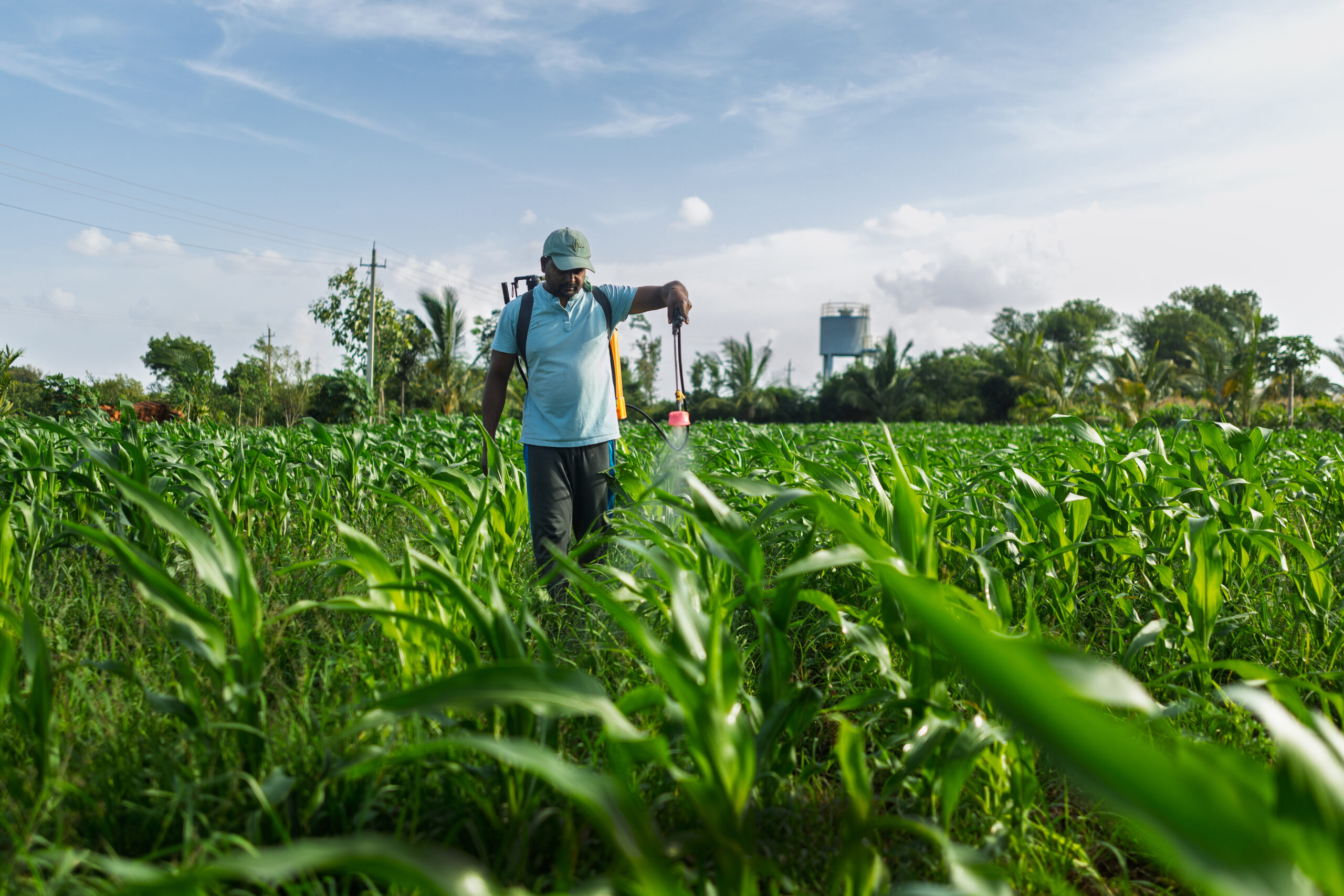
At TechnoServe, we believe the transition to regenerative agriculture is urgent and it must also be economically viable. Across Karnataka, one of India’s most climate-vulnerable states, farmers are demonstrating that environmental stewardship and economic opportunity can grow together.
Maize Farmers Adopt New Methods in Karnataka
In 2018, Karnataka experienced its worst drought in more than 150 years. Although rain eventually returned, deeper challenges persisted. Years of chemical fertilizer overuse had degraded the soil and rainfall patterns became increasingly unpredictable.
Read more of Rooted in Resilience…
In 2023, TechnoServe launched Project Srishti in partnership with Cargill to support evidence-based regenerative agriculture for more than 10,000 farming households in Karnataka. The project established nine trial plots across diverse agro-climatic zones to test combinations of regenerative practices. Results were measured against metrics like yield, production cost, soil health, and labor requirements.
“The experiment was about identifying which practices are most suited for the region,” said Hanumanth, a member of the Project Srishti team. “Based on our findings, we conducted method demonstrations. Farmers could then observe, compare, and learn the methods practically.”
For farmers like Chandru Hotteppanavar, the impact was visible within a single season. “The crop on which we sprayed Jeevamrutha [a biofertilizer] has 40-45 roots, whereas the conventional maize crop only has 19-20 roots.” Chandru has since adopted intercropping with leguminous crops to improve soil fertility and invested in a biodigester to automate biofertilizer preparation.
With 60% of Karnataka classified as drought-prone and maize largely rainfed, reliance on groundwater has intensified risk. Project Srishti introduced water conservation measures to replenish groundwater and reduce soil erosion.
“With TechnoServe’s training and government subsidies, I built a recharge structure on my farm,” said Vinod, a Project Srishti farmer. “Now, because of that, my water supply lasts a month longer than other farmers. Even if there’s a dry spell, water security on my farm is much better.”
Since its inception, the project has trained 3,029 women, established 668 farmer field schools, and supported the conservation or restoration of more than 24 million liters of water.
Rooted in agronomic best practices, smallholder inclusion, and environmental responsibility, TechnoServe’s work in India demonstrates that sustainability, climate resilience, and economic growth must go hand in hand.

Building New Skills
Digital Tools for Global Reach
Ana Emilia Figueroa Hernández, 32, spent three years painstakingly building Michu, her artisanal jewelry brand in El Salvador. But she struggled to market her business online and was repeatedly turned away from local entrepreneur fairs, where competition for space was fierce.
But growing her brand required a set of digital skills she didn’t have yet. Then, in 2024, she found CRECE Academy, TechnoServe’s online training platform for small businesses in Latin America. It modernizes the legacy of CRECE tu Empresa, a program that supported thousands of entrepreneurs over eight years, by offering fully digital, practical training accessible anywhere.
Discovering AI’s Potential Through CRECE Academy, Emilia transformed her business approach. “Before, I thought selling online was just about posting a product and waiting for people to buy,” she said. “But I learned it’s about understanding customer needs and making sure they find you.”
Her most impactful discovery was ChatGPT. “The [training] modules helped me understand its potential, and I fell in love with the tool,” she said.
She streamlined content creation, automated social media planning, and generated compelling captions. The impact was immediate.
“My views have increased significantly. Before, I was struggling to get noticed. Now, I have more engagement and more sales.”
Read more of Digital Tools for Global Reach…
Scaling Digital Training Worldwide
CRECE Academy is part of a broader digital venture from TechnoServe designed to scale impact globally. Already, 25% of TechnoServe’s active entrepreneurship projects include digital enablement.
A new pilot platform integrates design elements that promote behavioral change, accessibility, and sustained engagement. Its adaptability allows content to be localized across countries and contexts, significantly expanding reach to entrepreneurs.
By redesigning proven methodologies into a digital first delivery model, we are able to reach thousands of entrepreneurs simultaneously through a highly cost-efficient structure.

Strengthening Enterprise Support Organizations
For Emilia, this is just the beginning. She envisions scaling her business, opening a store, and hiring employees. “I almost gave up and moved abroad, but I decided to give Michu one more chance,” she said. “Now, I see it growing. AI is part of that growth.”
Beyond training individual entrepreneurs, TechnoServe strengthens the local organizations that support them. Enterprise Support Organizations (ESOs) are local institutions that train, mentor, advise, and sometimes fund entrepreneurs and businesses.
Over 12 years, TechnoServe has supported more than 270 local ESOs in over nine countries. They play a vital role in entrepreneurial ecosystems but often lack the technical, institutional, and financial strength to make a significant impact. By transferring TechnoServe’s methodologies and tools to local institutions, we create sustainable engines for business growth.
In 2025, 27 ESOs across five countries were actively participating in TechnoServe’s ESO Academy, where they developed action plans to close gaps and build their capacity to deliver scaled and lasting impact for micro and small businesses.
Project Spotlight
One Million Coffee Farmers Trained
In 2012, Biruta Jean Bosco looked out at his family’s coffee farm in southern Rwanda and knew that it needed to change. Biruta and his wife worked hard, but their 403 coffee trees yielded little. As a result, it was difficult to pay the school fees for their five children, and the couple often had to take loans from neighbors or sell livestock to meet any unexpected expenses.
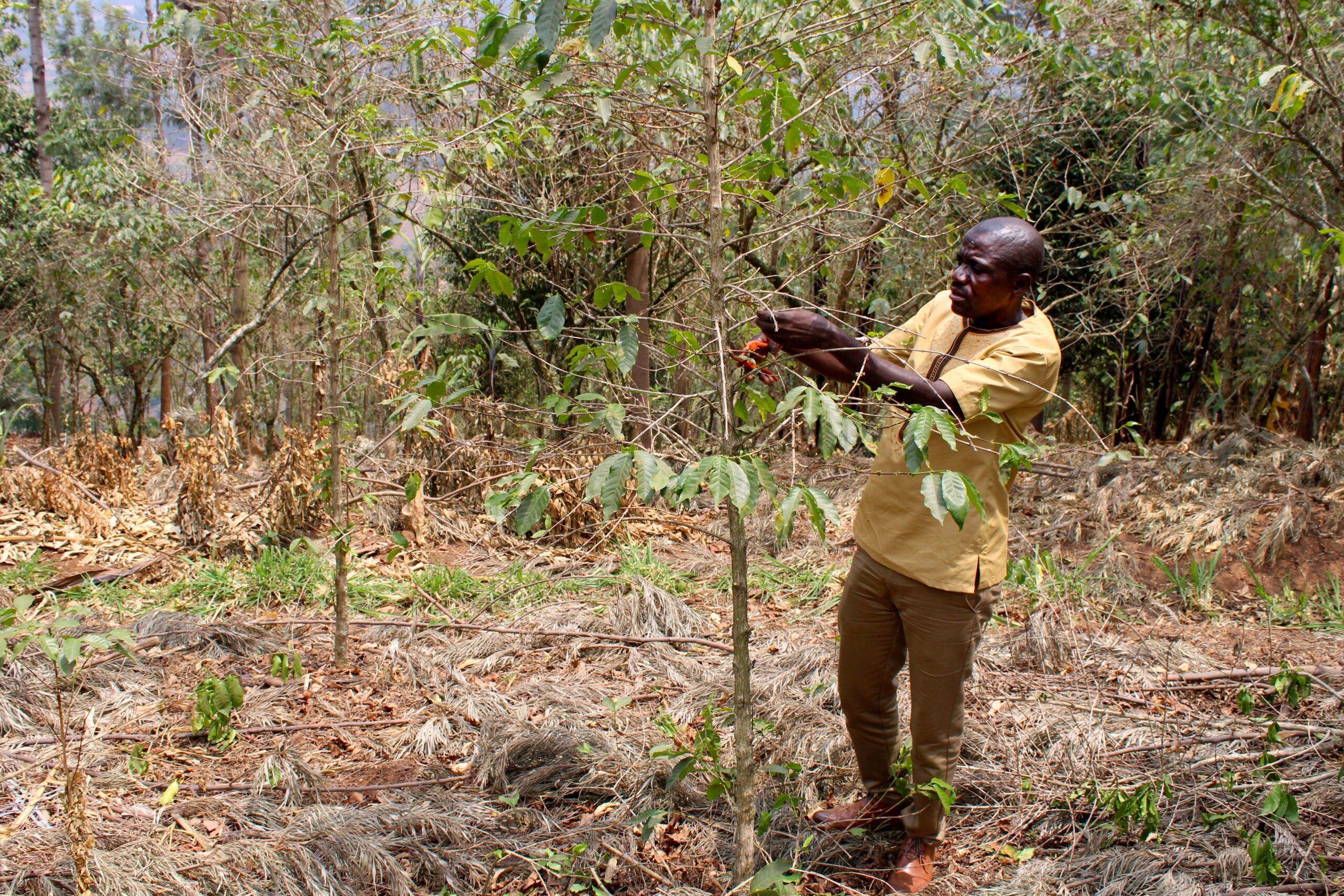
Change came that year when Biruta learned about the opportunity for agronomy training. He enrolled in TechnoServe’s Coffee Farm College and learned the skills he needed to transform the farm: how to properly apply mulch, make compost, control soil erosion, prune the coffee trees, and weed around the trees without damaging their root system.
“Practicing these best agronomy practices was a long process, because our coffee trees were in very bad state,” Biruta recalled, but he worked with the hope that this effort would provide a better future for his family.
Read more about One Million Coffee Farmers Trained story…
Marking a milestone
Biruta was not alone in placing his faith in better farming practices. In 2025, TechnoServe achieved a major milestone: we delivered training to one million coffee farmers since 2009. Across 16 countries in Latin America, Africa, and South Asia, this training has enabled smallholder coffee farmers to improve their incomes, strengthen climate resilience, and adopt more sustainable farming practices.
Improved coffee farming is a powerful tool in the effort to eliminate poverty. Despite coffee’s global significance, millions of families growing the crop do not earn a decent income. Like Biruta, many of these coffee growers are challenged by small farm sizes, low yields, and increasing risks to their production that lock them in a cycle of poverty.

(TechnoServe)
Regenerative farming practices can help break this cycle. A TechnoServe study published in April 2025 with support from Nestlé, JDE Peet’s, and the Rudy & Alice Ramsey Foundation quantified the transformative potential of such practices. Looking across nine leading origins, it found that the transition toward regenerative production can boost farmers’ incomes by an average of 62%, increase coffee exports by 30%, and reduce greenhouse gas emissions by 3.5 million tons of CO₂e annually.
Such training also generates a strong return on investment. Every dollar invested in TechnoServe coffee projects completed between 2022 and 2025 generated $4.71 of additional income for farmers and others in the coffee value chain.
Over more than a decade, TechnoServe’s coffee programs have become more impactful and inclusive. In 2009, just 26% of participating farmers were women, reflecting many of the inequalities in coffee value chains. By 2024, TechnoServe had increased that share to 47% through continuous innovation in how it staff projects, designs training, and recruits farmers.
“I feel happy and motivated”
For Biruta and his family, the impact of training was transformative and lasting. When he started attending training in 2013, he harvested 756 kilograms of coffee cherries. Two years later, production stood at more than 1,300 kilograms. Even years after Biruta’s training in Coffee Farm College ended, yields on the farm kept improving. In 2024, he harvested nearly 2,000 kilograms.
The improved yields, coupled with higher coffee prices, have meant that Biruta and his family are earning much more. The farm is no longer scraping by. It’s now a source of employment, as Biruta hires laborers to help with mulching and harvesting.
The increased income has helped improve the family’s standard of living and prospects for the future. Biruta installed electricity and water in his house and purchased a cow as a source of milk for home consumption and income. He has also been able to comfortably pay for his children’s school fees, and his oldest has already graduated from university. Biruta expects his children will have an easier life than he has had.
“I feel happy and motivated because, through the adoption of best practices, my coffee production has increased both in volume and quality, and the price has also risen,” he said.
Training the next million farmers
TechnoServe believes in a future with coffee, as well. In partnership with leading coffee roasters, governments, foundations, and generous individuals, TechnoServe is committed to providing its proven, transformative coffee training to more farmers around the world.
“A million trained farmers is a remarkable achievement, but millions more still need the chance to build a viable livelihood while protecting the landscapes that sustain coffee. We are excited to work with our partners to scale this work even further,” said Paul Stewart, TechnoServe’s global coffee director
Securing a Future for Coffee in Puerto Rico
After Hurricane Maria ravaged Puerto Rico in 2017, the future of coffee on the island looked bleak. An estimated 80% of the coffee trees on the island were destroyed.
“We were at risk of losing Puerto Rico’s centuries-old coffee sector. That would have been an incalculable loss not only for thousands of farming families but also for the whole island,” said Alejandro Marchand, manager of TechnoServe’s Revivamos Nuestro Café (Let’s Bring Back Our Coffee) project.
Launched in 2018 with support from Nespresso, the Colibri Foundation, the Hispanic Federation, and the Peter Alfond Foundation, the project trained more than 1,200 coffee farming households in regenerative agriculture practices over the past seven years. Of those households, 77% reported increased yields.
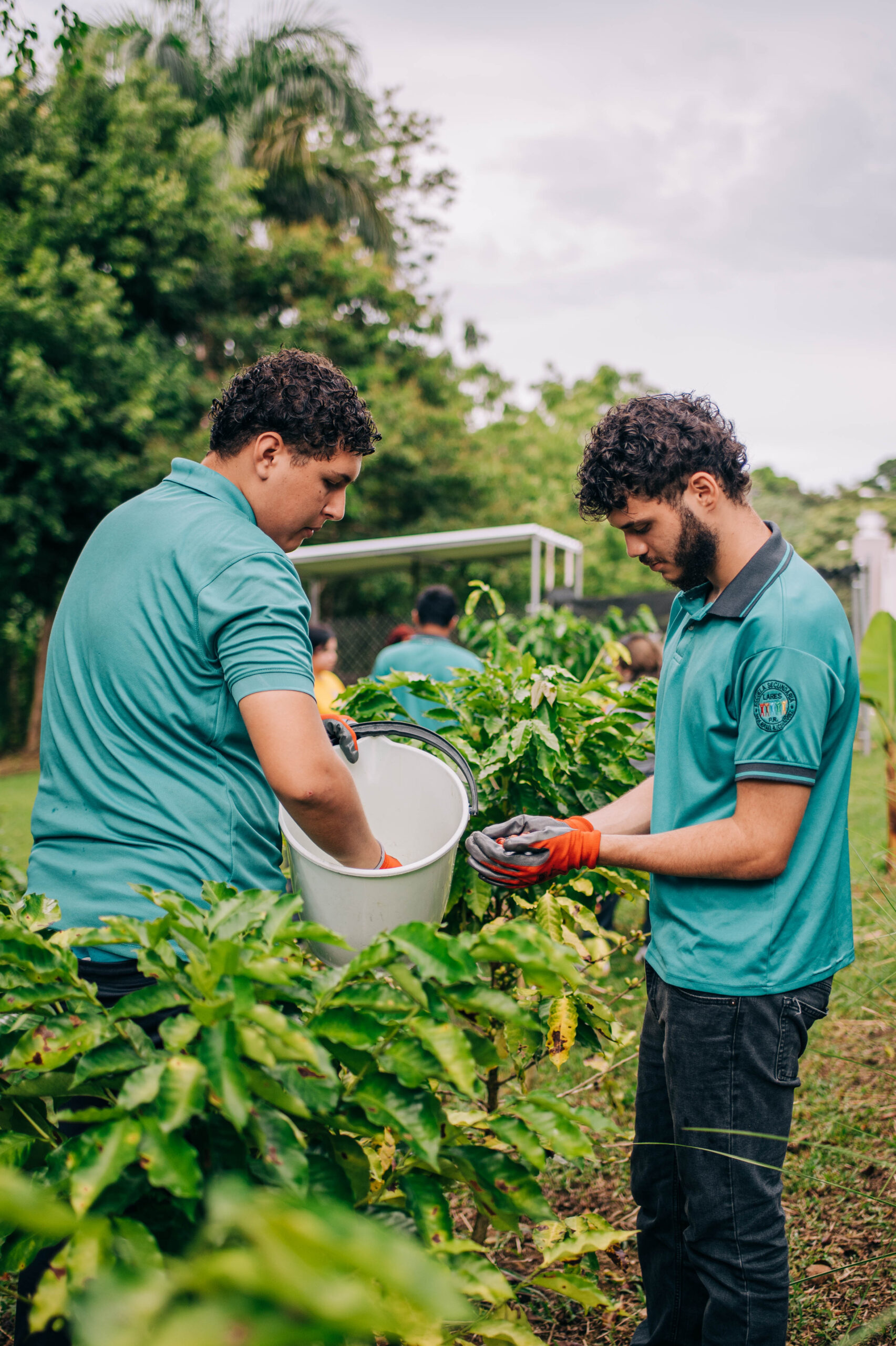
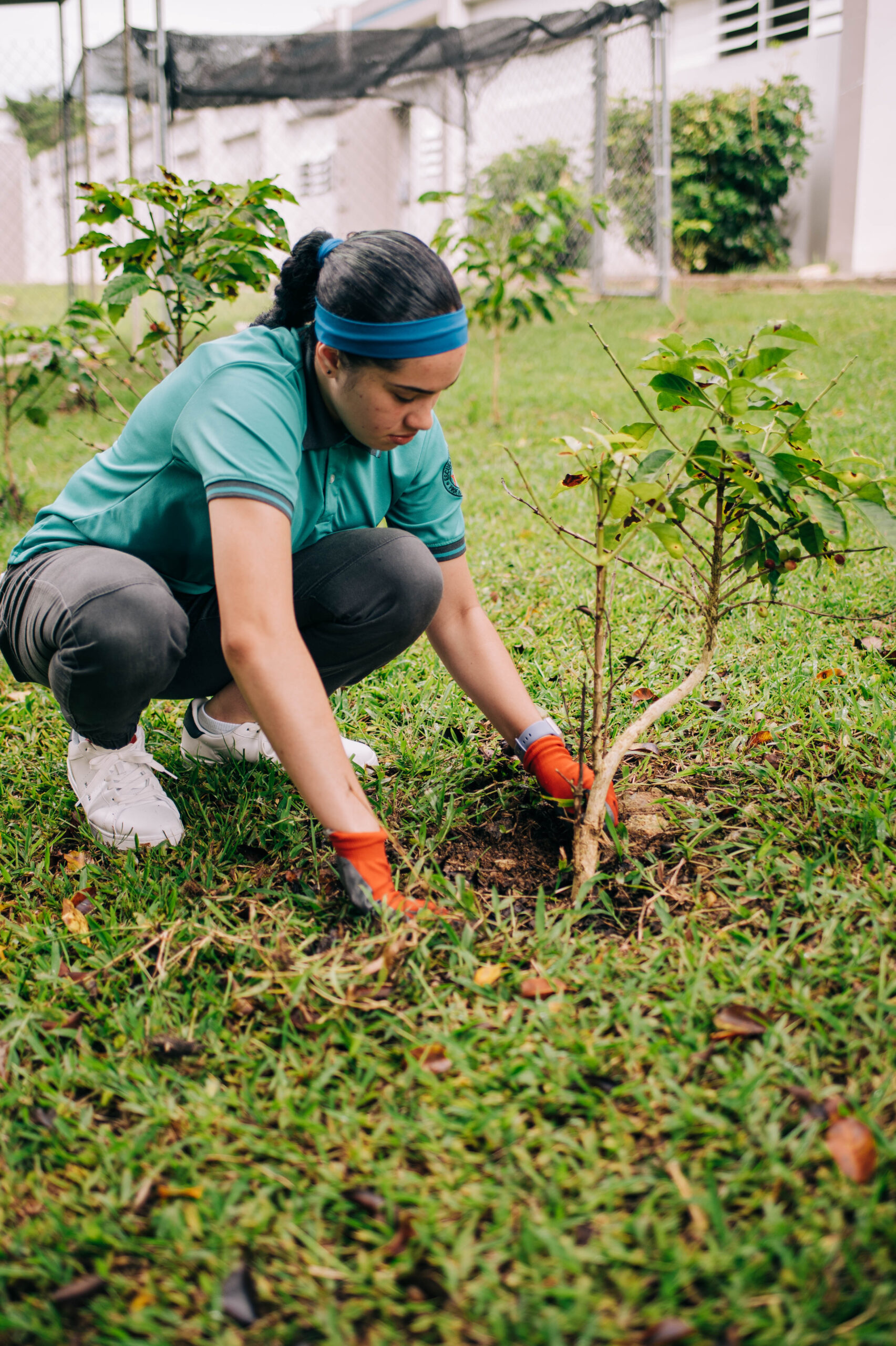
Students in Puerto Rico putting skills into practice after completing hands-on, school-based coffee agronomy training led by TechnoServe.
(TechnoServe / Olivia Sakai)
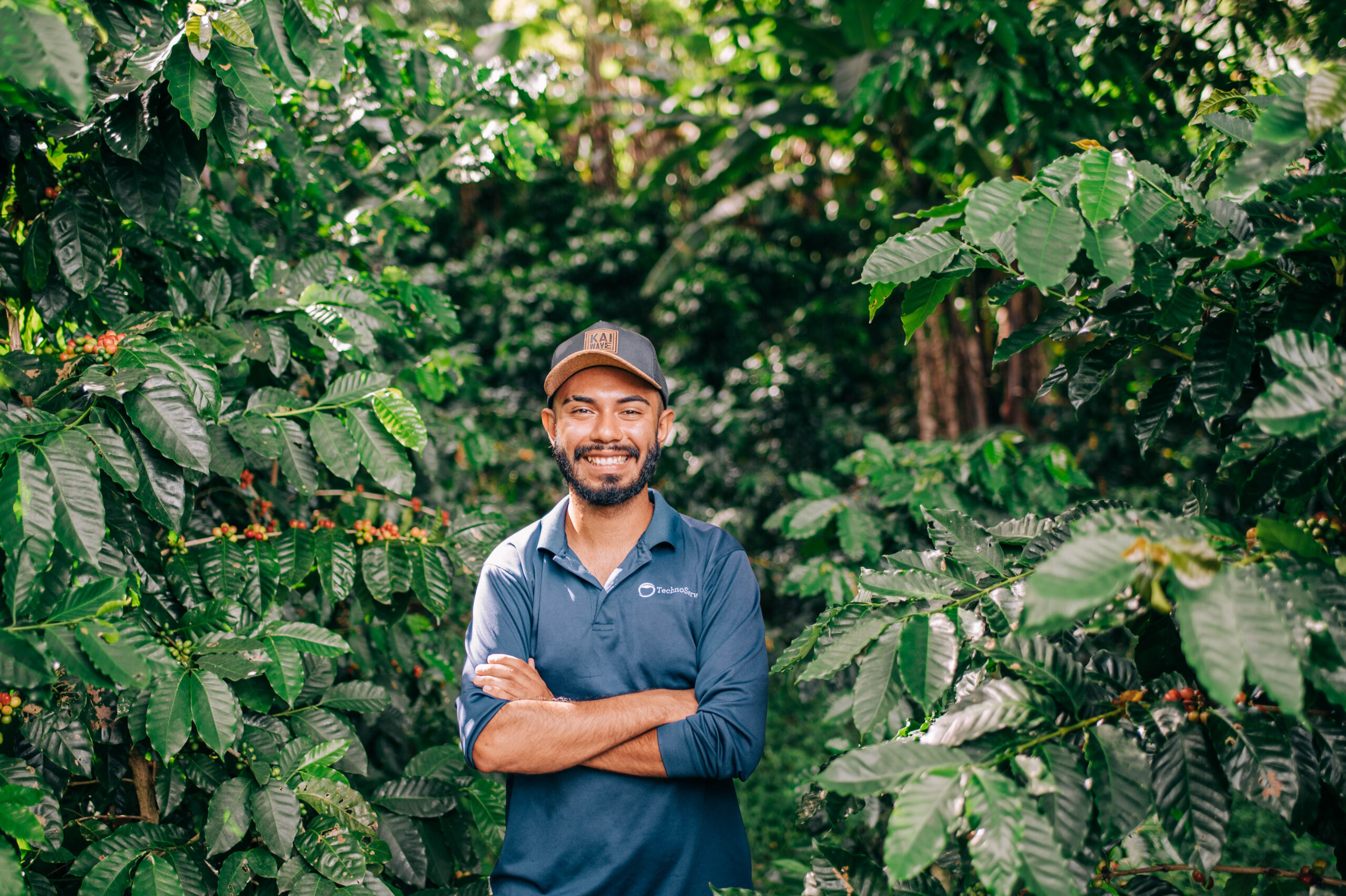
“The changes are evident: in the soil, in productivity, in resistance to pests, and in your pocket. These practices take care of the farm, the economy, and the future,” said Carlos Cordero, the smallholder coffee farmer featured on our cover who participated in the program. “I feel secure and motivated as a young coffee farmer.” His success led him to become a TechnoServe farmer trainer so that others in his community could improve their coffee production.
With support from project partners, the initiative also helped farmers plant 11 million coffee trees. But securing coffee’s long-term future in Puerto Rico doesn’t just require new trees. Only 5% of the island’s coffee farmers are under the age of 35.
To cultivate the next generation of coffee growers, Revivamos Nuestro Café also implemented an agronomy course in 14 public middle and high schools. Teachers received training in coffee agronomy so that they could instruct their students.
By the end of the project, 900 students received short video instructions with hands-on experience on demonstration plots to learn about the opportunities in the coffee value chain and the skills needed to unlock them.

Donor profile
Investing in a Better World
As a professional investor, Matt Kamm approaches giving the same way he does investing—by pursuing proven models with measurable returns. Looking at TechnoServe, he sees the same qualities that he seeks in a business to invest in.
“I get really excited when I find a business that has a great story, a great track record, and proven results,” Matt said. “I get that kind of feeling when I look at TechnoServe, and I see what they do for their clients around the world.”
Matt and his wife, Kathryn Kamm, have supported TechnoServe for over 10 years. They were drawn to the organization’s business solutions for fighting poverty.
“We thought their model and approach were really unique,” Matt shared. “The idea of providing business and technical services to help people increase their incomes and quality of life struck us as very powerful.”
In 2025, Matt and Kathryn stepped up in a significant way. TechnoServe’s REWARDS program, an initiative that will support 1,000 women with disabilities to build micro-entrepreneurial businesses in Kenya, was at risk of being eliminated due to government funding cuts. When the Kamms learned that the program was at risk, they became one of several funders who helped restore REWARDS and ensure its continuation for multiple years.
Read more of Matt’s story…
“We chose to increase our support to TechnoServe this year because we’re well aware that organizations around the world were facing sudden government funding cuts, even ones like TechnoServe, that have proven to be very effective and generate high returns,” Matt explained. “We thought it was time for supporters to step up, respond to this increased need, and demonstrate the kind of world they want to live in.”
For Matt and Kathryn, the decision to give reflected their confidence in TechnoServe’s approach and their personal commitment to paying their success forward. As a father of three daughters, Matt explained that they have been fortunate to raise their kids in a place with many opportunities. “We try not to lose sight of that,” he said.
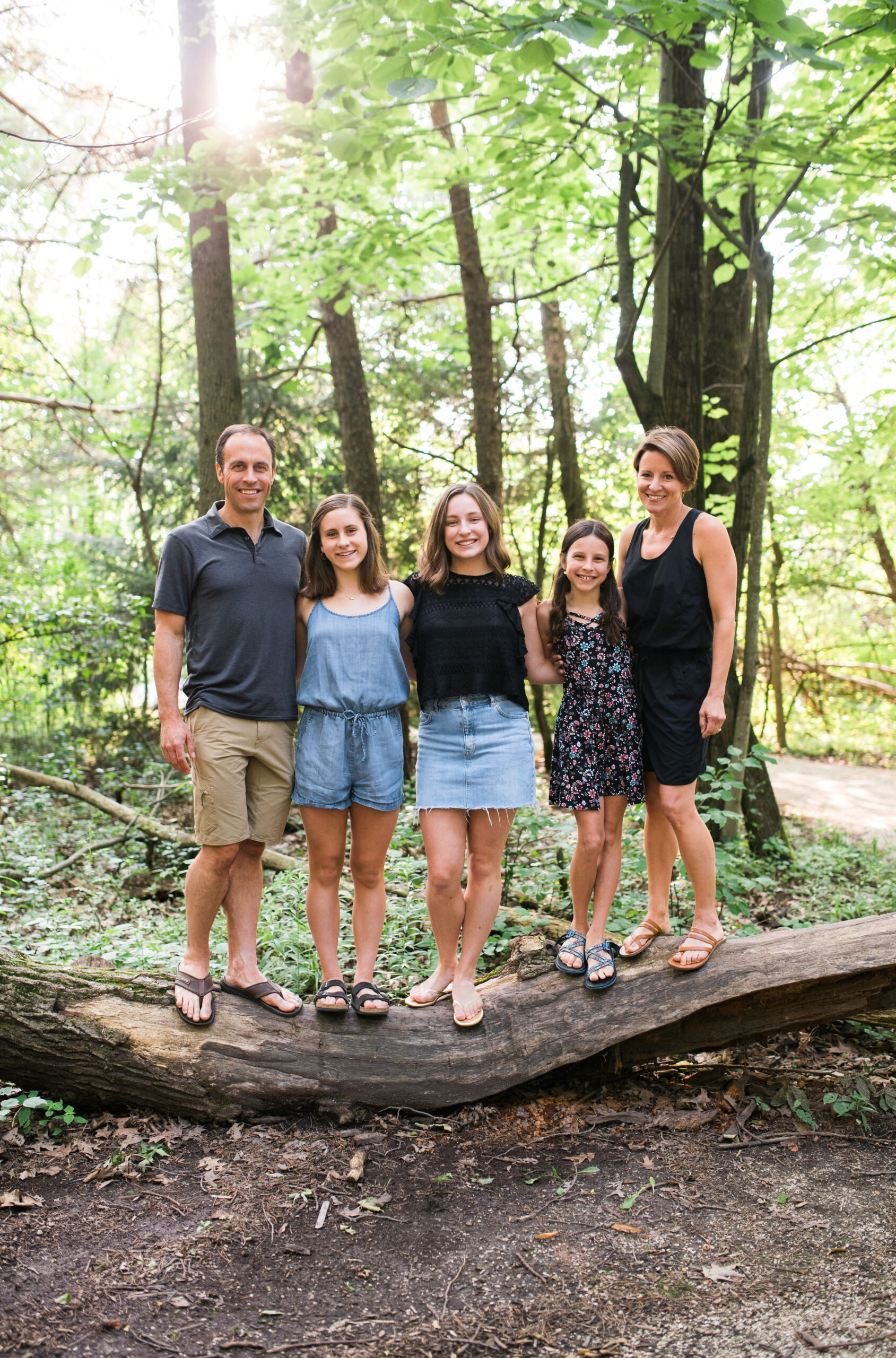
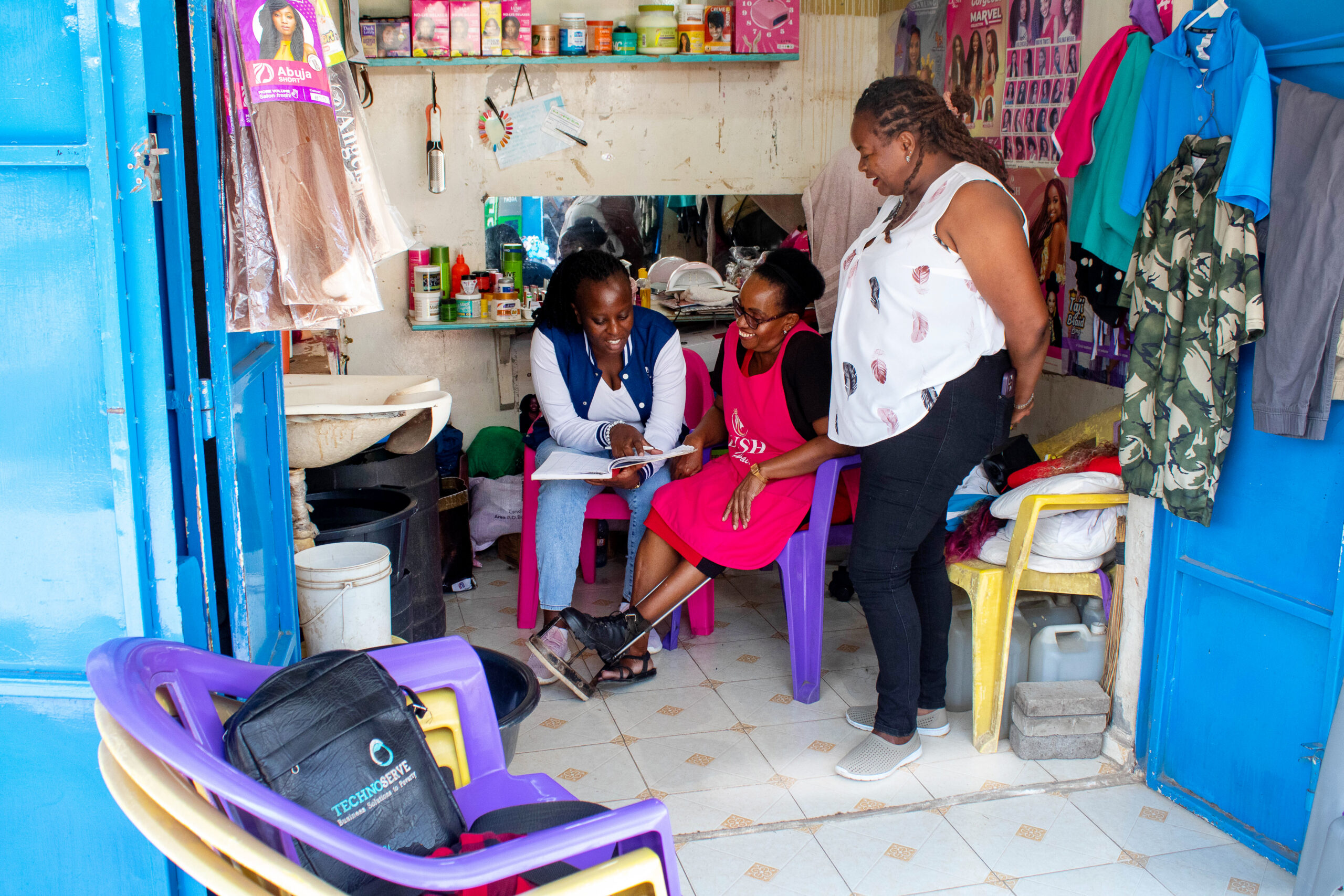
The Kamms believe that when they see opportunities where even modest investments can open life-changing possibilities for people with far fewer resources, it’s important to act.
“We want to do what we can in our lives to help promote opportunity and dignity for all people,” Matt explained. “It’s incredibly rewarding for us to be able to do that through a really successful organization like TechnoServe.”
2025 Highlights
March
TechnoServe’s From Pilot to Scale: Shared Value Creation for Inclusive Agribusiness captured five years of CASA TAF’s lessons on designing and implementing inclusive business plans that create value for agri-food businesses in Africa and Asia while delivering better livelihoods for smallholder farmers.
April
With support from JDE Peet’s, Nestlé, and the Rudy & Alice Ramsey Foundation, a new TechnoServe study, “The Regenerative Coffee Investment Case,” found that regenerative agriculture could increase smallholder farmer incomes by an average of 62%, boost coffee exports by 30%, and reduce greenhouse gas emissions by 3.5 million tons of CO₂e annually.
May
TechnoServe, in partnership with AGRA and Nestlé Nigeria, launched the Strengthening Farmers’ and SMEs’ Resilience through Climate Smart Grain Production and Accessing the Structured Markets (StreFaS) initiative in Nigeria, a bold step toward building a climate-resilient agricultural sector.
June
TechnoServe and the Indonesian Nutrition Foundation for Food Fortification brought together a coalition to launch Millers for Nutrition in Indonesia to help milling businesses improve fortification practices and enhance the nutritional quality of the staple foods they produce for the local population.
July
With support from the Argidius Foundation, TechnoServe announced the Enterprise Development Academy, a comprehensive digital training platform to strengthen local enterprise support organizations across low- and middle-income countries.
August
TechnoServe, with funding from the Anglo American Foundation, launched the Empleos Verdes Arequipa project to transform the recycling value chain in the Peruvian city of Arequipa and generate inclusive and sustainable jobs for youth and women.
September
TechnoServe celebrated the 10th anniversary of the Sustainable Guar Initiative, a pioneering program supported by Syensqo that champions responsible guar sourcing and fosters inclusive growth for farming communities in India.
October
TechnoServe announced that one million smallholder coffee farmers had received agronomy training since 2009, equipping them to improve their incomes, strengthen climate resilience, and adopt more sustainable farming practices.
November
At the UN Climate Change Conference, TechnoServe noted that food systems are central to climate solutions and welcomed the increase in financial investments for climate adaptation, calling for farmers to receive the vital support they need to protect their environment.
December
TechnoServe, BID Lab, and Argidius launched VerdeXcelerate – Agtech for Impact to develop the agtech ecosystem in Colombia, Costa Rica, El Salvador, Guatemala, Honduras, and Panama.
Financial summary
2025 Financials
TechnoServe is dedicated to the highest standards of financial transparency and conduct. After all, our donors and stakeholders deserve to see just how efficiently and effectively their generous support has been put to use.
2025 Sources of Funds

2025 Allocation of Expenses
Restricted net assets: $5,700,000
Unrestricted net assets: $10,400,00
End of year net assets:
$16,100,000
Audited financial information for 2025 was not available at the time of publication—the numbers presented here are unaudited. Official, audited figures will be published at technoserve.org/financials when they become available.
*Partial year implementation and close out costs.
Financial summary
2025 Financials
TechnoServe is dedicated to the highest standards of financial transparency and conduct. After all, our donors and stakeholders deserve to see just how efficiently and effectively their generous support has been put to use.
2025 Sources of Funds
Total Revenue: $117,410,000
| Source | Amount | Percentage |
|---|---|---|
| Foundations | $18,690,000 | 16% |
| Corporations | $31,800,000 | 27% |
| US Government* | $18,300,000 | 16% |
| Other Government | $35,200,000 | 30% |
| Private Fundraising | $10,200,000 | 9% |
| Other | $3,220,000 | 3% |
2025 Allocation of Expenses
Total Expenses: $113,770,000
| Category | Amount | Percentage |
|---|---|---|
| Africa | $63,711,200 | 56% |
| Latin America & Caribbean | $14,790,100 | 13% |
| India | $6,826,200 | 6% |
| Global | $10,239,300 | 9% |
| Management & General | $14,400,000 | 13% |
| Fundraising | $4,400,000 | 4% |
Restricted net assets: $5,700,000
Unrestricted net assets: $10,400,00
End of year net assets:
$16,100,000
Audited financial information for 2025 was not available at the time of publication—the numbers presented here are unaudited. Official, audited figures will be published at technoserve.org/financials when they become available.
*Partial year implementation and close out costs.
Technoserve
Letter from CEO and Board Chairs
In 2025, the global development landscape shifted in ways few could have anticipated. The shutdown of the U.S. Agency for International Development and foreign aid cuts elsewhere disrupted TechnoServe’s work and many of the communities we serve. Programs closed, partnerships changed, and the scale of our work in some places contracted.
And yet, this year also reaffirmed what has defined TechnoServe for nearly six decades. We are rooted in local communities, in world-class expertise and analytical skill, and in our commitment to enduring impact. At the same time, we are rising: adapting our model, strengthening partnerships, and pursuing new ways to help people build lasting incomes through business solutions.
Despite program cuts, TechnoServe’s diversified funding base—supported by governments around the world, many of the world’s great companies, several foundations, and generous donors— enabled more than two-thirds of our projects to continue without interruption. In 2025, these projects continued to change lives and achieve lasting, cost-effective impact. Last year, our work enabled:
• Nearly 1.2 million people or enterprises to improve their revenue
• $489 million in additional financial benefits to our clients
• 102,000 new and better jobs
• $5.70 return on investment
Excitingly, 44% of our 1.2 million beneficiaries last year were women or women-owned businesses—our highest percentage ever. We’re working tirelessly to achieve our 50% target for women beneficiaries, but it’s great to see momentum in the right direction. In addition, TechnoServe helped prevent 279,000 tons of CO2e emissions—the equivalent of removing over 65,000 gas-powered cars from the road for a year.
And as committed as we are to quantifying and understanding our program results, the meaning of this impact becomes most clear through the stories of our clients: young people learning how to create greater opportunity for themselves by starting and growing their own businesses. People who were about to give up and leave their countries, now finding innovative ways to grow their incomes. Smallholder farmers overcoming climate challenges to increase their crop yields and incomes, revitalizing their farms and families.
The people we serve remind us that times of difficulty can also be times of growth and opportunity. Despite last year’s obstacles, TechnoServe itself and our clients around the world proved to be resilient. And we are so proud to have continued to help our clients achieve long-lasting change for themselves, their families, and communities. We cannot thank you enough for being part of this journey—rooted in experience, and rising toward a future where everyone has the opportunity to build a better life.

Partners
TechnoServe’s success is made possible by partnerships with leading foundations, corporations, public-sector agencies, and multilateral organizations. Some of our partners in 2025 are below.

2025 Board of Directors
Co-chair
Michael J. Bush
Managing Member
BIV Investments
Co-chair
Rachel Hines
Former Managing Director
J.P. Morgan
Vice Chairman
Peter A. Flaherty
Arcon Partners, LLC
Secretary
Jennifer Bullard Broggini
Senior Advisor
Lago Holding Sagl
Treasurer
Michael Spies
Managing Partner
Fuse Strategies, LLC
________________
Monica Adractas
Managing Director
Venture Capital Funds
Olusegun Olutoyin Aganga
Former Managing Director
Goldman Sachs
Imoni Akpofure
Finance and Sustainability Professional
Daniel Aminetzah
Senior Partner
McKinsey & Company
Scott Baker
Partner
Reed Smith, LLP
Gerald Baldwin
Director and Former Chairman & CEO
Peet’s Coffee & Tea
Thomas C. Barry
President & CEO
Zephyr Management, LP
Bob Bechek
Advisory Partner
Bain & Company
Monica de la Torre
Co-founder
Fundación Colibrí
Jean-Marc DuVoisin
Advisor and Board Member
Multiple startups and nonprofits
Russell Faucett
Managing Director
Gyrafalcon Advisors
Mia Funt
President & Co-founder
ByHeart
Aedhmar Hynes
Global Communications Professional
Timothy M. Kingston
Chairman, Latin America Investment Banking
Goldman Sachs
Divyangana Kumar
Managing Director, Foodservice North America
Cargill
Robert Manly
Former Executive Vice President
CFO and Chief Synergy Officer
Smithfield Foods, Inc
Charles Moore
Fellow, Rock Center for Corporate Governance
Lecturer in Law & Business
Stanford University
Kurt Peterson
Partner
Reed Smith LLP
William Warshauer
President & CEO
TechnoServe Inc.
Download PDF
TechnoServe has always found a different way to make a difference.
TechnoServe siempre ha encontrado una manera diferente de marcar la diferencia.
Depuis toujours, TechnoServe a trouvé une manière différente de faire la différence.
A TechnoServe sempre encontrou uma maneira diferente de fazer a diferença.
Download PDF
TechnoServe has always found a different way to make a difference.
TechnoServe siempre ha encontrado una manera diferente de marcar la diferencia.
Depuis toujours, TechnoServe a trouvé une manière différente de faire la différence.
A TechnoServe sempre encontrou uma maneira diferente de fazer a diferença.
Transparency and accountability
A nonprofit organization you can trust
At TechnoServe, we prove our transparency and accountability every day. That’s why we’ve been awarded four stars by Charity Navigator, an “A” rating by CharityWatch, and recognized by GuideStar’s highest level of recognition: the Platinum Seal of Transparency.

Captions and Credit for Images
This report was assembled by the Communications team at TechnoServe. The authors and contributors are Trishna Gurung, Julieta Ocampo, Nick Rosen, Olivia Sakai, Rebecca Regan-Sachs, Bethany Peevy Downie, Oorna Mukherjee, James Tinker, and Smitha Allapat. Print design and layout by Liz Beeles with support from Lyvi Sieg-Valenzuela. Digital design by Nikolas Rodrigues.